Festive Season Lands at the Airport First.
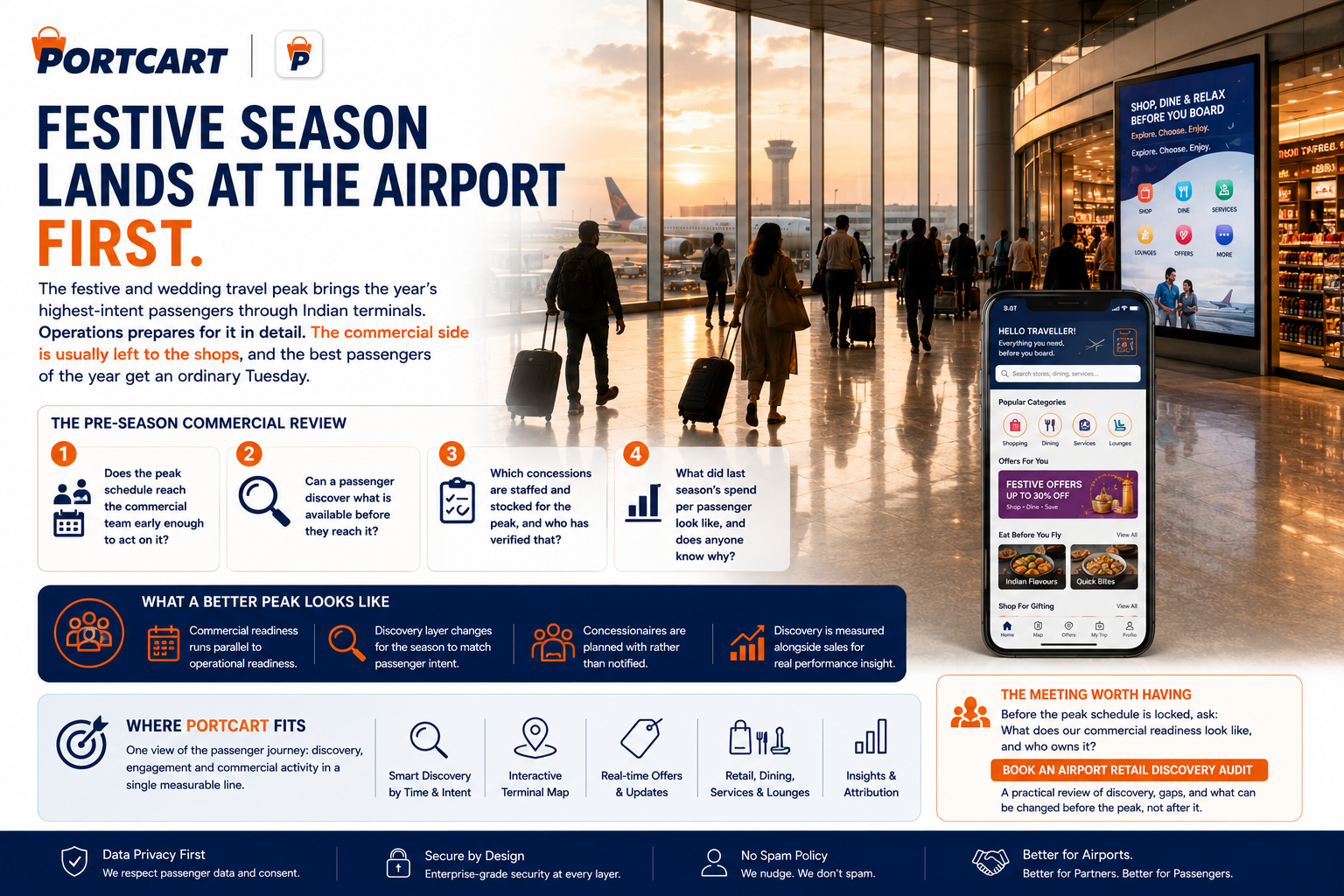
The festive and wedding travel peak brings the year's highest-intent passengers through Indian terminals. Operations prepares for it in detail. The commercial side is usually left to the shops, and the best passengers of the year get an ordinary Tuesday.
The festive travel peak is close. From Ganesh Chaturthi through Diwali and into the wedding season, Indian terminals fill with a specific kind of passenger: families flying home, wedding parties moving in groups, people travelling with gifts already bought and gifts still to buy.
The terminal is getting ready. Additional staff rostered. Security lanes re-planned. Slot coordination with airlines. Baggage capacity checked. Queue modelling updated. Contingency briefings written.
The operational preparation at a well-run Indian airport is genuinely impressive work, and it is done weeks ahead.
Now ask what the equivalent commercial preparation looks like. In most terminals the honest answer is that there is not one. Concessionaires are told the peak is coming and left to prepare individually, each seeing only their own unit.
So the highest-intent passengers of the year walk through a terminal that presents itself to them exactly as it does on an ordinary Tuesday.
The festive passenger is not the usual passenger
This is what makes the gap expensive rather than merely untidy.
The festive traveller behaves differently from the weekday business flyer the terminal is optimised around. They arrive earlier, because everyone expects crowds, which means longer dwell. They travel in groups, so decisions are made collectively and take longer. They are frequently carrying an occasion: a Diwali visit, a wedding, a family gathering, all of which come with gifting obligations that have not yet been met.
That combination, time to spare and a reason to buy, is close to the ideal retail condition. It arrives at the terminal by itself, a few times a year, and it lasts several weeks.
The terminal meets it with the same signage, the same directory board and the same fixed wayfinding it uses in February.
Discovery is capacity
There is a useful way to think about this that borrows the language operations already uses.
Before the peak, an airport asks how much capacity it has: security lanes, seats, stands, staff. Capacity that cannot be reached is not capacity, which is why queue design gets so much attention.
Retail works the same way and is rarely described that way. A store a passenger never finds has no effective capacity, whatever its floor area or stock position. A dining option discovered at the gate with eight minutes to spare might as well not exist. When a passenger with seventy-five minutes cannot work out what is available in the direction they are already walking, the terminal's commercial capacity is smaller than its floor plan claims.
The practical consequence for a peak season is important: you cannot add retail space before Diwali. Construction takes years. But discovery can be expanded in weeks, and it is the constraint that actually binds during a peak.
The argument that ends every post-season review
After the peak, non-aero revenue will be up. Traffic rose, so revenue rose.
That number settles nothing, because the denominator moved. The commercial question is spend per passenger and whether what was on offer matched the intent walking past. When that cannot be answered, the post-season review turns into the same conversation every year: concessionaires say visibility and location are the problem, the airport says the units underperformed, and neither side has evidence.
Both may be right. Nobody can tell, because the terminal measured sales and never measured discovery.
The pre-season commercial review
Four questions, before the peak begins:
- Does the peak schedule reach the commercial team early enough for them to act on it, or does it arrive as information after operations has planned?
- Can a passenger discover what is available in the terminal before they reach it, at the point where they are still deciding how early to arrive and what to buy?
- Which concessions are staffed and stocked for the peak, and who has verified that rather than assumed it?
- What did last festive season's spend per passenger look like against a normal week, and does anyone know why it moved the way it did?
If those have answers, the terminal has two readiness programmes and this article owes you nothing. If they do not, the pattern is familiar: the festive schedule reaches operations first, the discovery layer is identical to a normal week, and nobody can name a category passengers looked for and failed to find.
That is not an operations failure. Operations delivered exactly what it owns, to a high standard. The gap is that nobody owns the passenger's ability to find things, so it belongs to no programme at all.
What a better peak looks like
- Commercial readiness runs as a parallel track to operational readiness, on the same timeline, with the same discipline.
- The discovery layer changes for the season, because the passenger mix and their intent have changed: gifting-relevant categories surfaced, dining discoverable by time available rather than by physical location alone.
- Concessionaires are planned with rather than notified, so stock and staffing match the schedule they were not previously shown.
- Discovery is measured alongside sales, so the post-season review can distinguish between a unit that underperformed and a unit nobody could find.
None of this requires new floor space, and none of it competes with the operational plan. It is the same planning discipline applied to the second half of the airport's business.
Where Portcart fits
Portcart is built to give airports one view of the passenger journey: discovery, engagement and commercial activity in a single measurable line. For a terminal that means passengers can find the retail, dining and services relevant to the time they actually have, and the airport can see where discovery breaks down, which is the part of non-aero performance that is currently invisible.
The meeting worth having
Before the peak schedule is locked, put one item on the concessions agenda: our operational readiness for the season is documented and thorough, so what does our commercial readiness look like, and who owns it?
If that question does not have an owner, book an Airport Retail Discovery Audit with us before the season starts. It is a working review of how a passenger with sixty to ninety minutes actually discovers what your terminal offers, where that breaks, and what can realistically be changed before the peak rather than after it. Bring the festive schedule and last season's non-aero numbers.