Airport Service Discovery Done Right: Lounges, Forex, Wi-Fi, Medical, and Parking
Travellers spend an hour in the terminal and never find the lounge, the pharmacy, or the cheaper forex counter. Service discovery is the quiet revenue lever most Indian airports leave on the table.
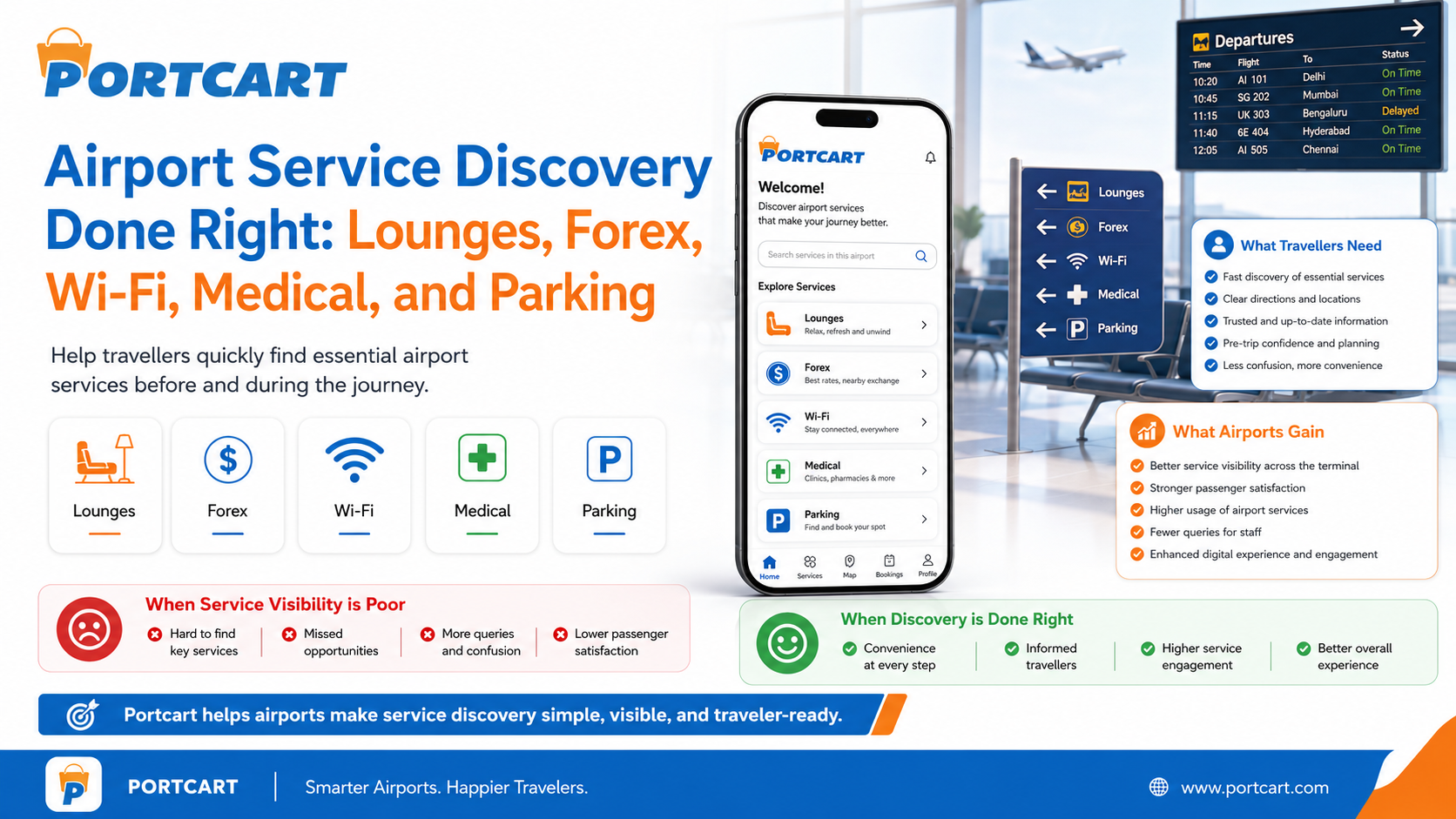
A traveller spends an hour in an Indian terminal, sits on a hard bench because they never found the lounge, changes money at the first counter because they did not know a better rate was fifty metres away, and hunts for a charging point that a paid pod could have solved. The services were all there. The traveller just never discovered them. Service discovery is the quiet revenue lever most airports leave on the table, and fixing it improves the experience and the till at the same time.
The hidden cost of a service nobody finds
Every unused service at an airport is a double loss. The lounge that sits half empty is revenue the airport did not earn. The traveller who waited on a bench instead is a worse experience the airport did not need to deliver. Both losses come from the same gap: the service existed, but the traveller did not know about it, could not find it, or learned about it too late to use it.
This is different from retail conversion. A traveller who walks past a store made a choice. A traveller who never finds the lounge made no choice at all, because they never knew it was an option. Closing that gap is almost pure upside, because the supply already exists and is paid for.
Where discovery breaks: three moments
Service discovery fails at three distinct points, and each needs a different fix.
Before arriving. Many travellers would pre-book a lounge, a meet-and-assist, or premium parking if they knew it existed and could reserve it. If the only place to learn about a service is inside the terminal, the pre-trip decision never happens.
On entering the terminal. A traveller walking in with a specific need, a SIM card, a currency exchange, a pharmacy, should be able to see where to go within seconds. When the only guidance is a cluttered directory board, most people give up and improvise.
At the point of need. The traveller who suddenly needs medical help, a feeding room, or a prayer space needs to find it now, not after walking the length of the concourse. Discovery at the moment of need is the hardest and the most important.
The services travellers most often miss
- Lounges, especially pay-per-use access for travellers without a card that grants entry.
- Forex, where rate differences between counters are real money and rarely visible.
- Wi-Fi and charging, including paid fast options.
- Pharmacies and medical assistance, which are urgent when needed and invisible until then.
- Parking, particularly premium, valet, or pre-bookable options.
- Practical needs: feeding rooms, prayer spaces, baggage wrap, sleeping pods, left luggage.
Each of these is a service a traveller would happily use, and each is routinely missed.
The fix: layered discovery, not more signs
The instinct is to add another sign. The better answer is layered discovery that meets the traveller at each of the three moments.
Pre-trip, make the full service catalogue visible and, where possible, bookable, so the lounge or the parking is reserved before the traveller leaves home. In the terminal, give clear, modern wayfinding that answers where is the nearest in seconds, not a wall of logos. At the point of need, surface the right service contextually, so a traveller searching for help is guided to the closest option. The principle is to treat services as a discoverable, searchable catalogue rather than a static list, and to design for the traveller's question, where is the nearest X, rather than the airport's org chart.
Pre-booking: the revenue most airports leave behind
The highest-value moment in service discovery happens before the traveller reaches the terminal. A traveller who can reserve a lounge, premium parking, a meet-and-assist, or fast-track at the time they book a flight is a traveller who has committed to spend before arrival, and who turns up calmer for it. Most Indian airports surface these services only inside the terminal, which means the pre-trip decision, the easiest sale of all, never happens.
Parking is the clearest case. A traveller who pre-books a covered or premium spot has paid before arrival and removed a stress from the journey. The same traveller deciding on the day often circles the lots, settles for whatever is free, or resents the rate. Pre-booking turns a last-minute grudge purchase into a planned, confident one, and it does the same for lounges and assistance. Making the service catalogue visible and bookable ahead of travel converts intent that currently evaporates between the booking and the kerb.
A worked discovery example
Take a traveller whose child falls ill at the gate and who needs a pharmacy. In the common case, they ask a staff member, get pointed vaguely down the concourse, and walk five minutes with an unhappy child, unsure they are even heading the right way. In a terminal with discovery solved, they search at the point of need, get the nearest pharmacy and a walking direction in seconds, and reach it fast.
The service existed in both cases. The only difference is whether the traveller could find it at the moment it mattered. Now multiply that single moment across lounges, forex, feeding rooms, prayer spaces, and medical help, every day, across thousands of travellers. The gap between a service being available and a service being discovered is a large, quiet, daily loss of both revenue and goodwill, and almost none of it shows up in an availability report.
Measure usage, not availability
The trap is to declare victory because the services exist. Availability is not discovery. The number that matters is usage: what share of travellers who would benefit from a service actually find and use it. Track lounge occupancy against eligible footfall, forex counter usage, pre-booking rates for parking. When usage rises after a discovery improvement, that is the lever working. When availability is high but usage is low, discovery is the gap, every time.
A service-discovery checklist
- Make the full service catalogue visible before travel, and bookable wherever possible.
- Let travellers pre-book parking, lounges, fast-track, and assistance at the time they book the flight.
- Give in-terminal wayfinding that answers where is the nearest in seconds, not a wall of logos.
- Surface services contextually at the point of need, especially medical help, feeding rooms, and prayer spaces.
- Map every service to a clear, current location, since a wrong direction is worse than none at all.
- Cover the practical needs travellers forget to look for: charging, left luggage, baggage wrap, sleeping pods.
- Track usage against eligible footfall, not just availability, so undiscovered services show up as a number.
- Test discovery the hard way: time how long a real traveller takes to find three named services.
What good looks like
An airport with service discovery solved is one where a traveller arrives already knowing the lounge is booked, finds the pharmacy in seconds when a child falls ill, and changes money at a rate they could actually compare. The services were always there. Now they are used. The airport earns more from supply it had already paid for, and the traveller has a measurably better few hours.
If you run an Indian terminal, the fastest diagnostic is to stand at the entrance and ask travellers to find three services: the nearest lounge, a pharmacy, and the best forex rate. Time how long it takes and how many give up. That number is your service-discovery problem, and it is almost always larger than the signage budget suggests.
Portcart Team. Built for mall and airport operators in India.