Dwell-Time Spend: Turning Airport Wait Time Into Retail Revenue
An airport is paid in minutes. The longer a traveller is comfortably inside after security, the more they spend. Most terminals measure dwell time but never design for converting it.
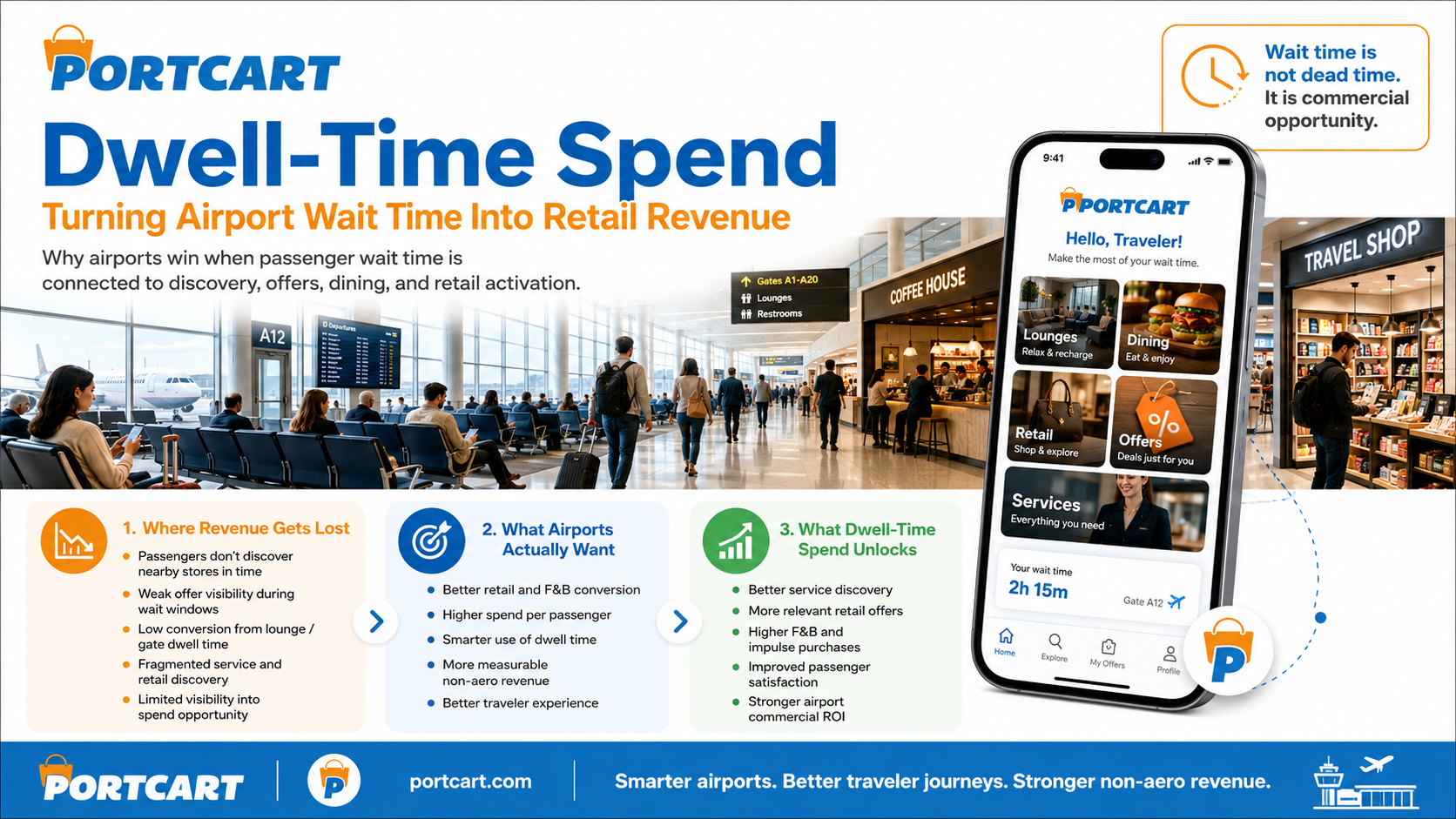
An airport is, in retail terms, paid in minutes. The longer a traveller is comfortably inside the terminal after security, the more they browse, eat, and buy. Cut the dwell and the spend falls with it. Most terminals measure dwell time as an operations metric, queue lengths and processing times, and never treat it as the revenue lever it actually is. Dwell-time spend is where airport retail economics are quietly won.
Why spend tracks dwell
The logic is simple and well understood across travel retail. A traveller who clears security with ninety relaxed minutes will wander, sit, eat, and pick up a gift. A traveller who clears with fifteen anxious minutes heads straight to the gate. The retail floor is the same. The difference is the time, and the state of mind, the traveller brings to it.
This is why airport retail behaves differently from a high street. On a high street, footfall is the lever. Airside, footfall is fixed by the flight schedule, every passenger is already there, so the lever is not how many people but how long they comfortably stay and how ready they are to spend while they do.
Comfortable dwell, not just dwell
The trap is to chase raw dwell time. Dwell stuck in a slow security line is not retail time, it is stress that suppresses spend. Dwell spent walking a confusing concourse looking for a seat is not retail time either. Only comfortable dwell, time the traveller spends relaxed, oriented, and unhurried, converts.
That reframes the problem. The goal is not to trap travellers longer. It is to move them through the stressful parts fast and into a comfortable airside environment with time to spare. A traveller who clears quickly and then has an hour to relax spends far more than one held up at security and then rushing. Comfortable dwell is created by speed before it and quality during it.
The golden window after security
The single most valuable stretch of the journey is the period just after a traveller clears security and before boarding is called. The stress of check-in, bag drop, and screening is behind them. The flight is not yet pressing. They have money, time, and a relaxed mind. This is when duty-free, gifting, F&B, and impulse purchases land.
Designing for this window means putting the strongest retail and F&B right where travellers arrive into airside, when the window opens, not scattered toward the gates where the clock has started ticking again. The first few minutes of airside calm are the most monetisable minutes in the building.
Faster processing is a retail lever
Here is the counterintuitive part for an operator. Speeding travellers through security and immigration does not shorten their spend, it lengthens it. Every minute saved at the checkpoint is a minute added to the comfortable airside window where spend happens. Throughput, usually owned by operations, is therefore also a retail decision.
A terminal that processes travellers quickly and predictably gives them confidence to relax and spend airside, because they are not holding minutes in reserve against a slow queue. A terminal with unpredictable security makes travellers hoard time at the gate just in case, and hoarded time is not spent in stores. Investing in throughput is investing in retail.
What kills comfortable dwell
If comfortable dwell is the asset, it is worth naming what destroys it, because each killer is fixable. Unpredictable security and immigration queues come first, because they make travellers hoard time at the gate rather than spend it on the floor. A confusing concourse is second: a traveller who cannot orient quickly spends their minutes navigating, not browsing. Too few seats is third, and badly underrated, because a traveller who cannot find a comfortable place to sit leaves the retail zone for the gate bench early and stops spending. Poor information is fourth, no clear sense of how long until boarding or how far the gate is, because uncertainty makes people conservative with their time. Each of these quietly converts relaxed minutes back into anxious ones, and anxious minutes do not spend.
A worked dwell-to-spend example
Consider two travellers on the same flight. The first clears security in five minutes, lands into a calm, well-signed airside with plenty of seating and clear boarding information, and has eighty relaxed minutes. They get a coffee, browse duty-free, and pick up a gift, perhaps a thousand rupees of spend. The second hits a twenty-five-minute security queue, emerges flustered with fifty-five minutes left, cannot find a seat, and heads straight to the gate to wait it out, spending nothing.
Same flight, same retail floor, same prices. The only variable was comfortable dwell, and it was the difference between a thousand rupees and zero. Scale that across every departure of every day, and the case for investing in throughput, wayfinding, and seating as retail levers, not just operational niceties, makes itself. The terminal that treats the security queue as a retail problem, because it is one, earns more from the same passengers than the one that treats it as purely an operations metric.
Measure dwell against spend
Dwell time on its own is an operations number. It becomes a retail metric only when paired with spend. Track spend per passenger against comfortable airside dwell, and the relationship becomes visible and manageable. When a process change adds relaxed minutes, watch whether spend per passenger rises. When dwell is high but spend is flat, the floor is not converting the time, which points at layout, mix, or comfort rather than at traffic.
A dwell-to-spend checklist
- Plot spend per passenger against comfortable airside dwell, and manage the relationship directly.
- Treat security and immigration throughput as a retail lever, not only an operations metric.
- Put the strongest retail and F&B in the golden window where travellers first arrive into airside.
- Give travellers clear boarding and walk-time information, so they relax instead of hoarding minutes.
- Provide enough comfortable seating inside the retail zone, not just at the gates.
- Make the concourse easy to orient in, so minutes are spent browsing, not navigating.
- Watch for high dwell with flat spend, which points at layout and comfort, not at traffic.
- Fix the queue before adding more stores, since anxious minutes do not convert.
What good looks like
A terminal that has this right moves travellers through the stressful steps quickly, lands them into a calm, well-designed airside the moment they clear, and puts its strongest retail and F&B right in that golden window. Travellers feel unhurried, the floor converts the minutes, and spend per passenger reflects it. Dwell stops being a queue statistic and becomes the revenue engine it always was.
If you run an Indian terminal, the most useful single chart to build is spend per passenger against comfortable airside dwell. If you have never plotted the two together, you are managing your biggest retail lever blind, and the first relaxed minutes after security are where the chart will tell you the money is.
Portcart Team. Built for mall and airport operators in India.