Navratri (Nine Nights), One Number: What Garba Season Does to Your Trading Day.
Navratri keeps a mall open late for nine consecutive nights, and the season is reported afterwards as crowds and photographs. Nobody computes what one night cost the mall's own books or what it brought in. The decision to run all nine is made once in September and never revisited.
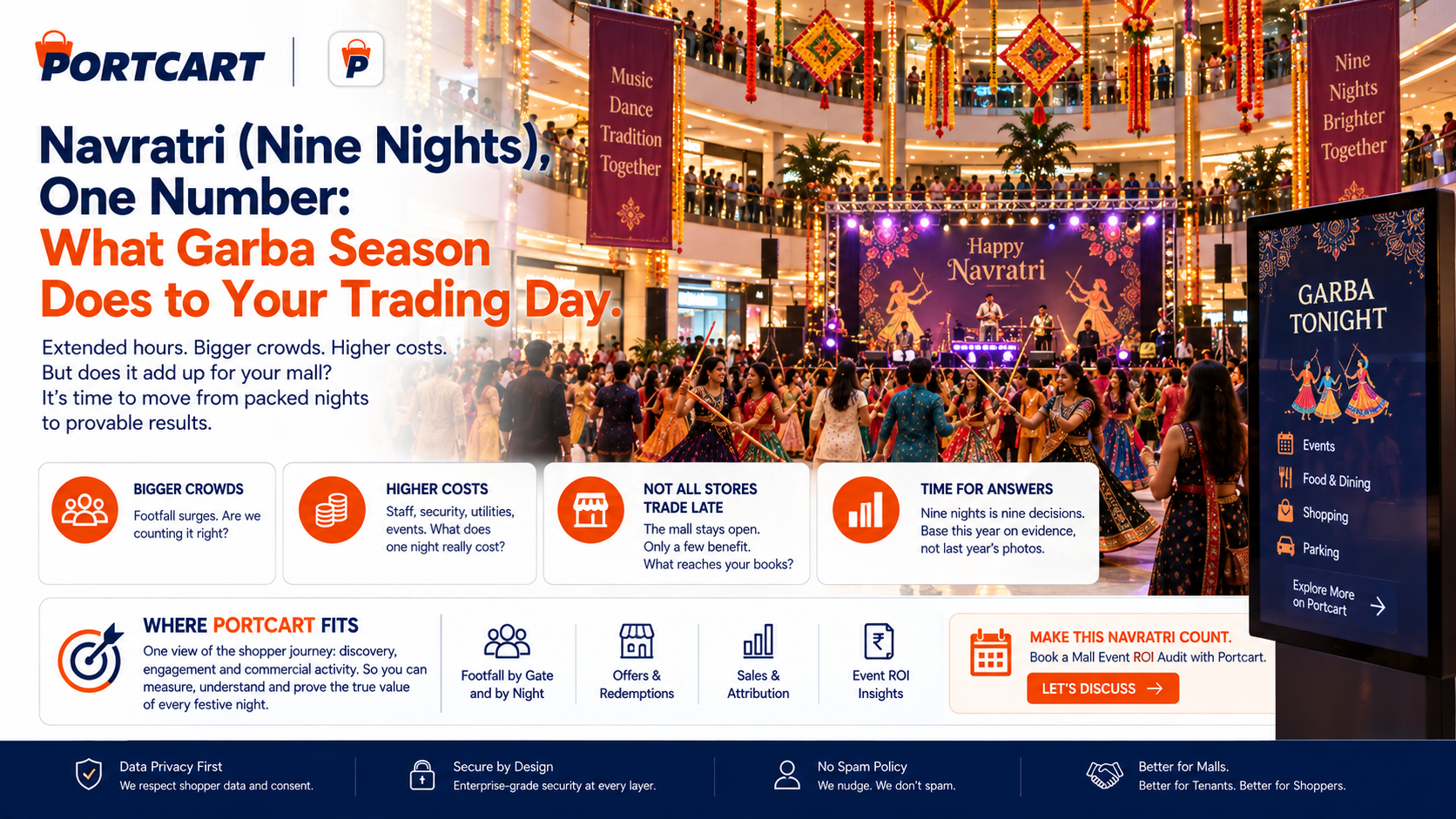
Navratri begins on Sunday 11 October. For nine nights, in Gujarat, in Mumbai and Pune, and increasingly in cities that never used to, the evening belongs to garba and dandiya.
Malls have learned to meet it. Hours extend to midnight or later. A dandiya night takes over the atrium. The food court runs a second shift. Security, housekeeping and parking go onto double rosters. Tenants are asked which nights they will stay open, and most say all of them, because everyone else is.
On the tenth day the report is written: record footfall, packed nights, photographs of the atrium. It will be reused next September as the reason to do it all again.
Here is the number that report never contains: what one of those nights cost the mall, and what it brought in.
An extended night is a spend decision
Strip away the festival and look at what "open till midnight" actually commits the mall to.
Three to four extra hours of staff across operations, security, housekeeping and parking, most of it at overtime rates. The whole building cooled and lit for the duration. Event production, sound, permissions and crowd management for the dandiya floor. Extra cleaning after it. A second wave of the same the next night, and the next, nine times.
Every one of those is a cost the mall carries on its own books. Together they are a spend decision, and a spend decision needs a number. The published argument that a crowded event is not the same as a working event applies here at its largest scale: nine nights run as events and measured as nothing.
What makes Navratri different from a single event is repetition. One event is one bet. Nine consecutive nights are the same bet placed nine times, and the mall makes it once, in September, with a single yes.
The building stays open for a third of the tenants
Walk a mall at 11pm on a Navratri night and the second problem is visible.
The food court is full. Ethnic wear, footwear, accessories and a few others are trading well. The rest of the floor is lit and staffed and quiet. Anchor tenants, in particular, are often dead after ten. The mall is paying to keep the entire building open for the fraction of it that trades late.
That would be fine if the mall's own books saw the upside. Whether they do depends on the leases. Many Indian mall leases combine a minimum guarantee with a revenue share, but the mix varies by tenant, and the categories that trade late are not necessarily the ones on revenue share. Where the rent is fixed, a tenant's strong late-night sales do not reach the mall at all. The mall carried the building's marginal cost; the tenant kept the marginal revenue.
Almost no mall has checked its late-hours upside against its lease structure for this purpose. It is not a hard exercise. It is simply one nobody has been asked to do.
One night, on paper
Put an illustrative shape on it, and treat every figure below as arithmetic to be replaced with your own.
Say one extended night costs a mall ₹3 lakh across overtime, security, housekeeping, utilities, parking operations and its share of event production. Say tenants trading after the normal close did ₹25 lakh of additional sales that night, which would make the night look excellent in the season report.
Now split that ₹25 lakh by lease. If ₹15 lakh of it was with tenants on fixed rent, the mall's books see nothing from it. If the remaining ₹10 lakh was with tenants on revenue share at, say, 8 percent, the mall's contribution from sales was ₹80,000. Add parking income and any sponsorship for the night, perhaps another ₹70,000. Contribution: about ₹1.5 lakh. Cost: ₹3 lakh.
On its own books the night lost money, on a night the report calls a record. It may still have been worth running, for the shoppers it captured, the tenants it kept happy, the sponsor it retained or the position it holds in the city's calendar. But those are reasons that should be written down and weighed, not assumed under the word "packed".
Your figures will differ. The point is not the result. The point is that the arithmetic is almost never done, for even one night, before nine are approved.
Four questions about last year's nine nights
Before this year's plan is signed, put these to the operations review:
- What did one extended night cost the mall, all in, across staff, security, housekeeping, utilities, parking and event production?
- Which tenants actually traded after the normal close, and which were open but idle?
- How much of the late-hours spend was with tenants on revenue share, so that it reached the mall's own books?
- If you had to cut two of the nine nights, which two, and on what evidence?
If all four have answers, the mall is running Navratri as a business and this article owes you nothing. If the first has an answer and the other three do not, the cost column exists and the contribution column does not, and that is the finding.
Deciding nine nights one at a time
None of this is an argument for fewer festival nights. It is an argument for deciding them on evidence rather than on September's single yes.
- Measure night one properly: cost on one side; the mall's own share of incremental sales, parking, sponsorship and shoppers captured on the other.
- Decide nights two to nine on night one, not on last year's photographs. Concentrate extended hours where they earn, which for most malls means the weekends and the traditionally busiest nights of Ashtami and Navami, and treat the quieter midweek nights as a choice rather than a default.
- Ask tenants who trade late to be on the late-hours plan, and let tenants who do not close at the normal hour without penalty. A lit, idle store costs the mall and earns nobody.
- Price sponsorships and activations on last year's measured nights, not on a footfall estimate a sponsor can dispute.
- Report the season as contribution by night, with the crowds as context rather than as the result.
Where Portcart fits
Portcart is built to give malls one view of the shopper journey: discovery, engagement and commercial activity in a single measurable line. For a festival season that means the offers shoppers claim, the redemptions at stores and the activity by gate and by night are connected, so the contribution column of a night can be filled rather than guessed. The cost column the mall already has. The gap has always been the other one.
The meeting worth having
The extended-hours plan is being locked this week. Before it is signed, ask the first question in the operations review: what did one night cost us last year?
If nobody can answer it in the room, book a Mall Event ROI Audit with us and bring last year's nine nights. It is a working session that builds the one-night P&L from what the mall already knows, shows which nights can be defended and which cannot, and sets up this year so that night one tells you what to do about the other eight. Bring the operating cost line for last October and the list of tenants who stayed open. The season's real number is somewhere between those two documents.