Mall Event ROI in India: A Math Walkthrough
Direct ticket revenue is the headline number for a mall event. The real economics are the indirect revenue, sponsor pipeline, and loyalty enrollment lift. The full math walkthrough.
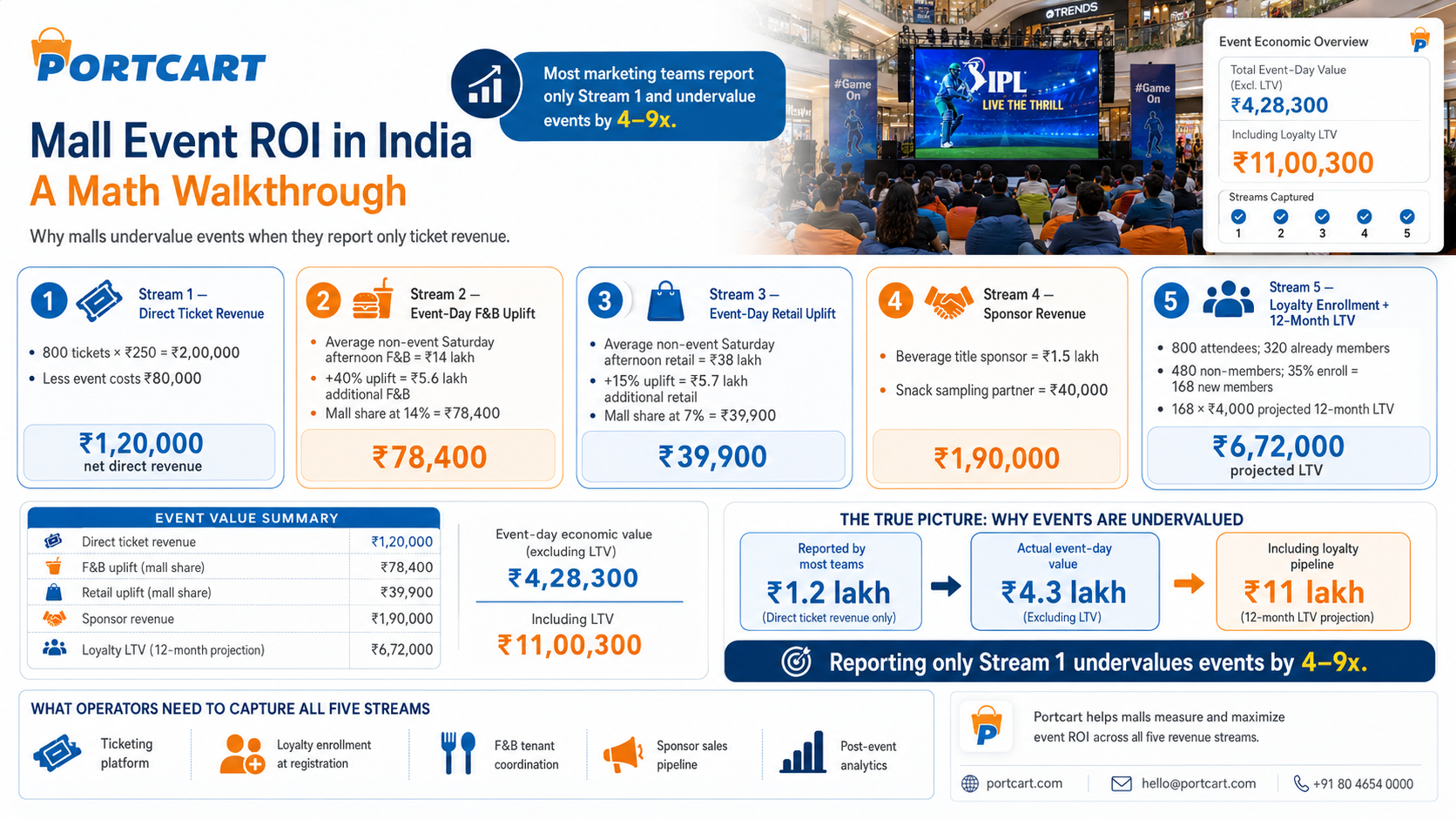
Mall operators in India consistently undervalue events because they look only at direct ticket revenue. A Saturday IPL viewing party at a 6 lakh sq ft mall might sell 800 tickets at ₹250, generating ₹2 lakh of direct revenue. Subtract ₹80,000 in event costs and the net is ₹1.2 lakh. That's the headline number marketing teams report. The real economics include four other revenue streams, each typically larger than the ticket revenue, and the mall just made 4-9x more from the event than the report shows.
The real economics include four other revenue streams, each of which is typically larger than the ticket revenue. This piece walks through the full math on a representative mall event.
The five revenue streams from a mall event
Stream 1: Direct ticket revenue
What gets reported. Ticket count × ticket price - direct event costs.
For our IPL viewing party example: 800 tickets × ₹250 = ₹2,00,000. Less event costs ₹80,000 = ₹1,20,000 net direct revenue.
Stream 2: Event-day F&B uplift
Event attendees eat and drink at mall F&B during the event. Pre-event, post-event, and during halftime breaks. A study across 12 Indian mall events in 2025 (mixed format: IPL viewing, kids workshops, music gigs) found event days produce 35-50% F&B revenue uplift vs equivalent non-event Saturday afternoons.
For our example: average non-event Saturday afternoon F&B revenue at this mall = ₹14 lakh. Event day uplift +40% = ₹5.6 lakh additional F&B. Mall captures revenue share (avg 14% on F&B) = ₹78,400 from F&B uplift.
Stream 3: Event-day retail uplift
Event attendees also walk through the mall and make incidental retail purchases. Smaller uplift than F&B (10-20%) but spread across more tenants.
For our example: average non-event Saturday afternoon retail revenue = ₹38 lakh. Event day uplift +15% = ₹5.7 lakh additional retail. Mall captures revenue share (avg 7% on retail) = ₹39,900 from retail uplift.
Stream 4: Sponsor revenue
The event is co-sponsored by a brand (beverage partner, F&B partner, financial services brand). Sponsor pays for placement, sampling rights, signage, and exclusive offer rights to attendees.
For our IPL viewing party: a beverage brand pays ₹1.5 lakh as title sponsor, a snack brand pays ₹40,000 for sampling rights. ₹1,90,000 in sponsor revenue.
For larger events (IP activations, multi-day festivals), sponsor revenue can be the largest single stream, often 2-5x the ticket revenue.
Stream 5: Loyalty enrollment + lifetime value
Event attendees often become loyalty enrollees at the event registration. A well-run event captures 25-50% enrollment among non-member attendees.
For our example: of 800 attendees, 320 were already loyalty members. Of the remaining 480, 35% enrolled at the event = 168 new members. Each new active loyalty member has a 12-month expected lifetime value of ₹3,000-8,000 in attributable additional spend. Conservatively ₹4,000 each = ₹6,72,000 in projected 12-month LTV.
Total
| Stream | Value | |---|---| | Direct ticket revenue | ₹1,20,000 | | F&B uplift (mall share) | ₹78,400 | | Retail uplift (mall share) | ₹39,900 | | Sponsor revenue | ₹1,90,000 | | Loyalty LTV (12-month projection) | ₹6,72,000 | | Event-day economic value | ₹4,28,300 (excluding LTV) | | Including LTV | ₹11,00,300 |
The marketing team reported ₹1.2 lakh. The actual value is ₹4.3 lakh on event day alone, or ₹11 lakh including the loyalty pipeline. The mall just made 4-9x more from the event than the report shows.
This is why mall operators who treat events as a permanent function with dedicated headcount consistently outperform operators who treat events as marketing flourish.
Where the math gets even better
For premium events, all five streams scale up:
- Premium music nights / Bollywood movie premieres / influencer meet-and-greets. Ticket prices ₹500-1,500. Sponsor revenue ₹3-10 lakh. Loyalty enrollment 100-300 new members. Total event-day value ₹10-25 lakh.
- Multi-day festivals (food festivals, regional cultural events, kids weeks). Ticket revenue spread across 3-7 days. Sponsor revenue ₹5-20 lakh. F&B uplift sustained across the period. Total event-period value ₹15-40 lakh.
- IP-licensed activations (Marvel, Disney, cricket league, anime). Ticket revenue ₹3-12 lakh over a 2-4 week installation. Sponsor revenue often the IP licensee themselves co-funding (₹5-25 lakh). Footfall lift sustained across the entire installation period. Total period value ₹20-80 lakh.
Where the math gets worse
Not every event makes sense. Three categories of event the math doesn't support:
- Generic mall promotions ("Big Summer Sale Saturday") that draw existing shoppers without adding incremental traffic. Cannibalises rather than adds.
- Events with no sponsorship pipeline (operator funds 100% of event cost). Drops Stream 4 entirely.
- Events that don't capture loyalty enrollment (no registration desk, no QR code at entry). Drops Stream 5 entirely.
Plan events that hit all five streams or skip them.
Operational requirements
Capturing all five streams requires operational infrastructure:
- Ticketing platform with attendee-data capture
- Loyalty enrollment flow at event registration (consent-aware)
- F&B tenant coordination so they're staffed up for event-day surge
- Sponsor sales pipeline (separate function, often the mall's marketing director)
- Post-event analytics that attribute mall-wide revenue lift to the event
Most malls have 1-3 of these. The ones pulling ahead have all five.
Frequently asked questions
How many events per year is realistic for a mid-sized mall?
A 5-7 lakh sq ft metro mall can sustain 18-30 ticketed events per year (roughly bi-weekly), plus 6-12 non-ticketed activations (smaller activations, brand sampling days). The events team becomes a permanent function at this volume.
Should we charge tickets even when sponsors fund the event?
Usually yes. ₹50-100 tickets cover the loyalty-enrollment opportunity and signal that the event has value. Free events tend to attract no-show rates of 30-50%.
What's the right pricing for tickets?
Match the audience. ₹150-300 for family-friendly content (IPL, kids workshops). ₹500-1,500 for premium music or movie premieres. Free with RSVP for sponsor-driven sampling events.
How do we attribute event-day mall revenue to specific events?
Compare event-day revenue to a rolling 8-week average of equivalent weekday + non-event weekend baselines. The delta is event-attributable. Doesn't need to be precise to within ₹10,000; the directional signal is what matters.
How Portcart handles this
The full economic capture from mall events is the core design intent of Portcart's events module.
- [Events and Ticketing](/modules): ticketing infrastructure with attendee-data capture, loyalty enrollment at registration, post-event analytics that joins attendance against mall-wide F&B and retail spend.
- [Loyalty Layer](/modules): event-attendee enrollment captured with DPDP-compliant consent, projected LTV reporting.
- [Voucher Management](/modules): sponsor offer fulfilment, attendee-only voucher campaigns.
- [Communication Engine](/modules): pre-event marketing, day-of reminders, post-event thank-you with cross-sell.
If your mall's events are still being reported on a ticket-revenue-only basis, request a demo and we'll show you how to capture and report the full five-stream economics.