Your Mall Event Was Crowded. That Does Not Mean It Worked.
The atrium was packed, the deck said footfall was up, and the CFO still asked which stores made money. Why event reports built on presence cannot defend a budget, and what Monday's report should say instead.
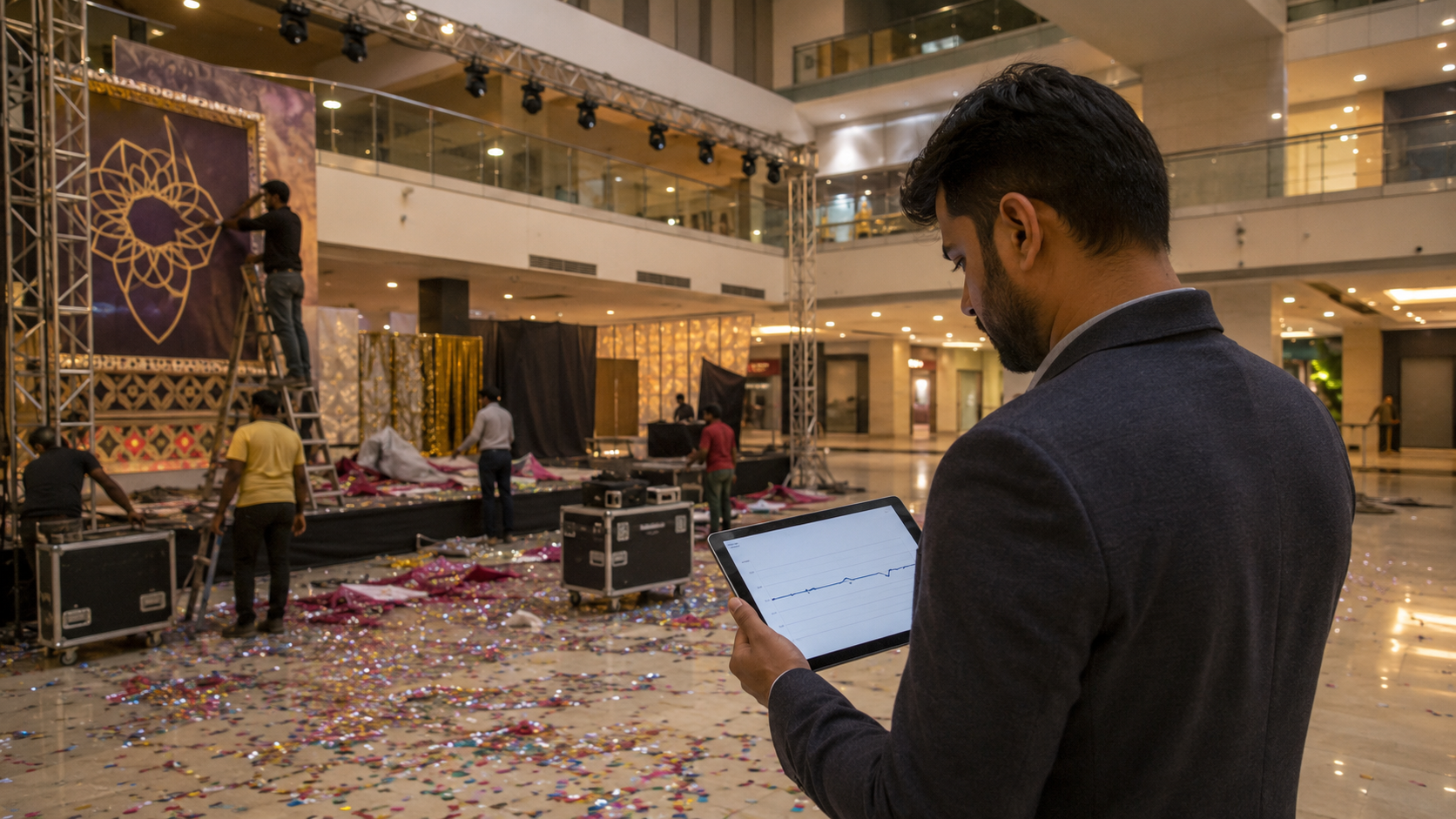
The Sunday night photos look great. The atrium is packed for the Diwali weekend event. The stage, the crowd, the queue at the wristband counter.
On Monday morning the deck goes to the Centre Director with one number under the photos: footfall, up 22 percent on the previous weekend.
Then the CFO asks the question that ruins the meeting. Which stores made money because of this?
Silence. Not because the team did not work hard. Because nothing in the measurement chain can answer it.
The number on the deck is not the number that matters
Footfall counts presence at the door. It says nothing about behaviour after the door.
An event can fill the atrium and still empty the corridors. Shoppers cluster around the stage for two hours, watch the show, and leave through the same gate they entered. The anchor store on Level 2 sees a normal Saturday. The salon on Level 3 sees a slow one, because its regulars avoided the crowd.
Meanwhile the report says the event brought 60,000 extra visitors. Both things are true. That is the problem. A metric that stays true while stores gain nothing is not a performance metric. It is a headcount.
Most malls in India are measuring the wrong outcome. An event crowd is not event ROI.
The villain is the measurement chain, not the marketing team
It is worth being precise about what fails here, because it is not the people.
Look at the instruments a typical mall event is judged with: door counters, photographs, a social media reach report, sometimes a stall-holder count. Every one of them stops at the atrium. Not one follows a visitor from the event to a store door, to a bill, or to a repeat visit two weeks later.
So the marketing team gets judged on the only number their system can produce. When management asks a question the chain cannot answer, the team looks unprepared. They are not. They are unequipped.
This is the quiet unfairness of most event reporting: the team is held responsible for a result their tools were never designed to see.
What an unmeasured event actually costs
The event budget is not the real cost. The real cost is every decision made blind after it.
Consider a mid-size mall that spends �,�40 lakh on a festive weekend event and draws 60,000 extra visitors. Now run one piece of arithmetic. If just 5 percent of those visitors had been guided to stores with an offer they could claim and redeem, at an average bill of �,�1,500, that is �,�45 lakh of sales the mall could point to, by store, by day.
Label this honestly: that is illustrative arithmetic, not a benchmark. Your percentages will differ. The point is not the total. The point is that today most malls cannot see any version of this number. Not 5 percent, not 2 percent, not zero. The data does not exist.
Which means, concretely:
- The event budget is renewed or cut on opinion, not evidence.
- Brands are never shown their share of the uplift, so events do nothing for renewal conversations.
- The same format repeats every year, because nobody can say which part worked.
- When footfall rises and sales stay flat, there is no data to explain the gap, and the marketing head absorbs the doubt.
Six signs your events are judged on presence, not performance
Read these against your last big event.
- The post-event report leads with photos and a footfall percentage.
- Nobody can name one store that measurably gained from the event.
- Brands were informed about the event, but their offers were not part of it.
- The budget discussion is entirely about cost. Return never comes up, because it cannot.
- The event calendar looks the same as last year, because there is no evidence to change it.
- When management asks why sales stayed flat despite the crowd, the honest answer is "we cannot tell."
Three or more, and the problem is not your team. It is the chain your team reports through.
What good looks like
A defensible event report is not complicated. It connects attendance to action:
- how many visitors claimed an offer during the event,
- how many redeemed it at a store, and at which stores,
- what those stores saw compared with a normal weekend,
- and what came back in the following days.
That report names stores and numbers. It gives the Centre Director something to take to the board, gives brands a reason to co-fund the next event, and gives the marketing head a budget defence that does not depend on photographs.
None of this requires the marketing team to work harder. It requires the event, the offer, and the store outcome to live in one measurable line instead of three disconnected ones.
Where Portcart fits
Portcart is built to give malls and airports one view of the shopper journey: discovery, engagement, and commercial activity. For events, that means the campaign, the offer a visitor claims, and the redemption at the store sit in one place. The Monday report can then say what happened after the crowd went home, store by store, instead of stopping at the door count.
The meeting worth having
Before the next event calendar is approved, put one question on the agenda: what did our last event change, and how do we know?
If the honest answer is a footfall number and a photo album, book a Mall Event ROI Audit with us. It is a working session on your own numbers: what your current chain can prove, where it goes dark, and what it would take to make the next festive budget defensible. Bring the last event's deck. That is all it needs.