A Gift Voucher Is a Scheduled Second Visit. Most Malls Treat It Like Paper.
Onam, Avani Avittam and Rakhi land inside three days, and gift-card volume follows. Every voucher you sell is a dated promise that someone will walk back into your mall. Most malls record the cash and lose the visit.
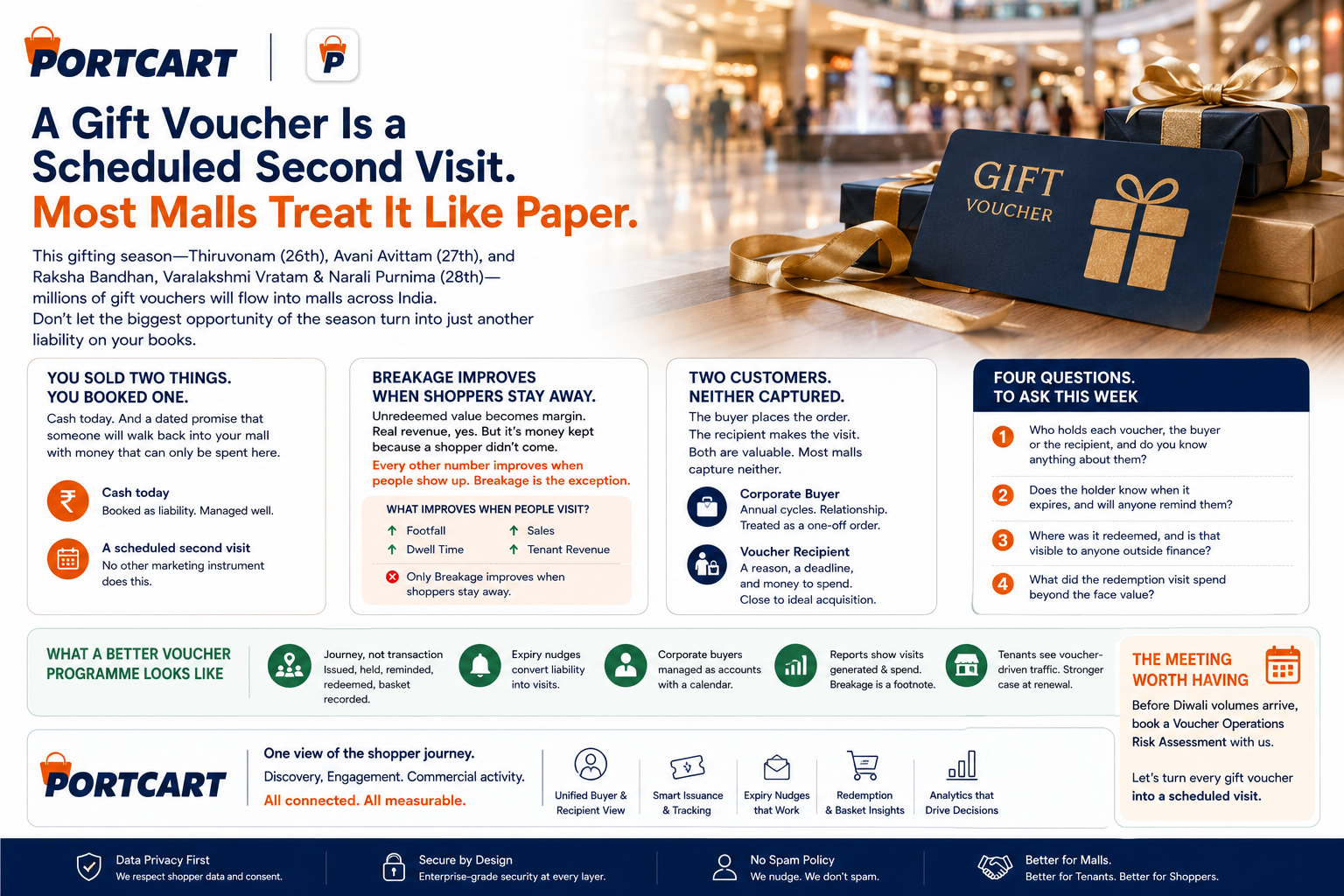
Next week the gifting season opens properly. Thiruvonam on Wednesday the 26th, Avani Avittam on the 27th, and then Friday the 28th carrying Raksha Bandhan, Varalakshmi Vratam and Narali Purnima together. Three days, every region of the country, and one common instinct: buy something for someone else.
A lot of that arrives at your mall as gift vouchers. Corporate orders that closed the week before, family gifting at the counter, cards bought because the buyer does not know the size or the taste.
When the window closes, the report will show vouchers sold, value outstanding, and eventually a breakage figure. That report describes a payment instrument.
It does not describe what the mall actually sold.
You sold two things and booked one
When a mall sells a gift voucher, two things happen.
The first is cash today. Finance sees it, books the liability, and manages the float. That part works well in most malls.
The second is a dated promise that a specific person will walk back into your property, within a defined period, with money that can only be spent here. No other marketing instrument does this. A campaign hopes for a visit. A voucher schedules one.
Almost no mall manages the second thing, because the voucher lives in a settlement system rather than a shopper system. It is a number that gets issued and eventually cleared. Nobody owns the visit inside it.
Breakage is the only line that improves when shoppers stay away
Now the uncomfortable part.
Unredeemed voucher value eventually books as margin. It is real revenue, it is legitimate, and no operator should apologise for it. But look at what it is: money the mall keeps because a shopper did not come.
Every other number in a mall's P&L improves when people show up. Breakage is the exception. A programme judged on breakage is a programme quietly rewarded when its own instrument fails to bring anyone through the door.
That is not an argument to give the money back. It is an argument about what gets celebrated. If the voucher report leads with breakage, the mall has adopted a success measure that runs against its own business model.
Two customers, neither of them captured
There is a second thing hiding in gifting season, and it is bigger than the vouchers.
The buyer and the recipient are two different people. The corporate procurement manager placing a Rakhi order for 400 employees is not the person who will walk in and spend it. Both are commercially valuable, and in most malls neither is properly held.
The buyer is a B2B relationship with an annual cycle: Rakhi, Diwali, New Year, employee milestones. Treated as a transaction, they will compare prices next year and possibly move to e-vouchers that pull spend away from physical stores entirely.
The recipient is often a shopper who has a reason to visit, a deadline, and money already committed. That is close to an ideal acquisition: the hardest part, giving them a reason to come, is already done.
Most malls finish the gifting season having met thousands of both and recorded almost none of them.
What the ambiguity costs
Put an illustrative shape on it. Say a mall sells ₹80 lakh of vouchers across the gifting window, at an average of ₹2,000 a voucher. That is roughly 4,000 vouchers, which is roughly 4,000 scheduled visits.
If 12 percent go unredeemed, the mall books around ₹9.6 lakh of breakage, and about 480 of those visits never happen. The remaining 3,520 do happen. If the average redemption basket runs even half as much again as the face value, those visits carry a meaningful amount of additional spend beyond the voucher itself.
Treat all of that as arithmetic, not benchmarks. Your average value and redemption pattern will differ. The point is which of the two numbers reaches the dashboard. The breakage figure almost always does. The additional spend on 3,520 scheduled visits usually does not exist as a number at all, which means the programme is judged on the smaller and less useful half of what it produced.
Four questions about the vouchers you sell next week
- Who holds each voucher, the buyer or the recipient, and do you know anything about them?
- Does the holder know when it expires, and will anyone remind them?
- Where was it redeemed, and is that visible to anyone outside finance?
- What did the redemption visit spend beyond the face value?
If you can answer all four, this programme is being run as a shopper business and the article owes you nothing. If you can answer one, the problem is not the loyalty team. It is that vouchers were set up as a payment instrument, and payment instruments are not designed to tell you about people.
The signs travel together: the dashboard shows sold, redeemed and outstanding; nobody can say whether corporate recipients ever came; no expiry reminder is ever sent; and breakage appears in the deck as a positive.
What a better voucher programme looks like
- The voucher is treated as a journey, not a transaction: issued, held, reminded before expiry, redeemed, basket recorded.
- Expiry nudges exist, because a reminder converts a dormant liability into a visit, which is the entire point of the instrument.
- Corporate buyers are held as accounts with a calendar, not as one-off orders taken again from scratch every festival.
- The programme report shows visits generated and spend attached to them, with breakage as a footnote rather than the headline.
- Tenants can be shown what voucher-driven traffic brought them, which turns the programme into a leasing argument at renewal.
None of this requires selling more vouchers. It requires the ones already sold to be visible as shoppers.
Where Portcart fits
Portcart is built to give malls one view of the shopper journey: discovery, engagement and commercial activity in a single measurable line. For vouchers that means issuance, redemption and the visit around it connect, so a gift card becomes an observable shopper with a deadline instead of a settlement record. Breakage does not disappear. It stops being the only thing the programme can report.
The meeting worth having
The gifting window opens on Wednesday. Whatever your programme records next week is what it will record at Diwali, when the volumes are several times larger.
Before that, put one item on the agenda: how many of last year's Rakhi and Onam vouchers came back, and what did those visits spend beyond the voucher value? If the honest answer is that the mall knows its breakage rate and nothing else, book a Voucher Operations Risk Assessment with us. It is a working session on your own programme: what is recorded today, what is invisible, and what needs to be in place before the Diwali orders arrive. Bring last year's voucher report.