Mall Voucher Breakage in India: Where 7-15% of Value Goes
Most Indian mall voucher programmes lose 7 to 15 percent of issued value annually. The cause is not shopper forgetfulness. It is the reconciliation gap. Here is how to close it.
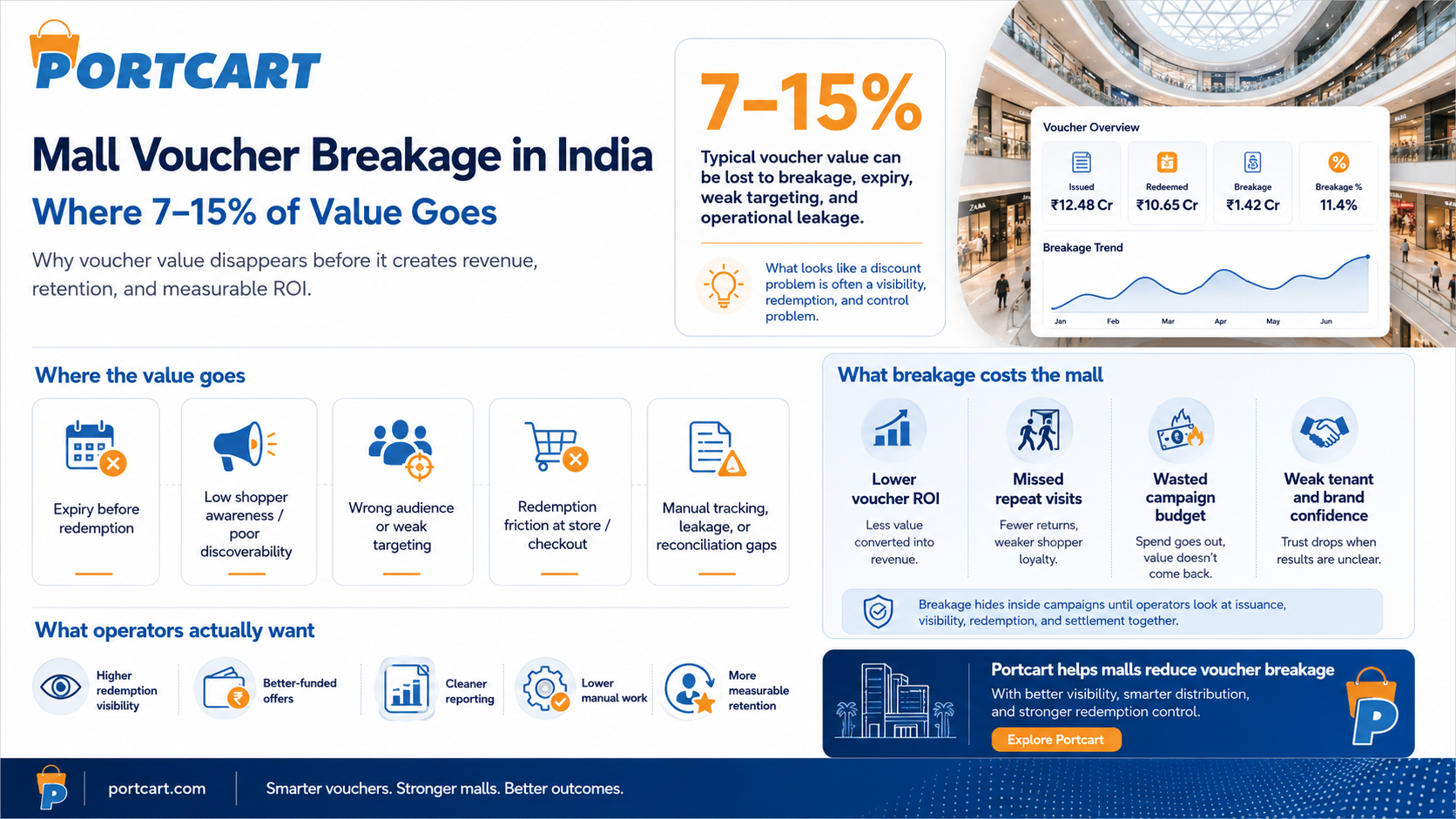
When the finance head at a Pune mall ran their 2025 voucher reconciliation, the number she could not explain was Rs 47 lakh. That was the gap between vouchers issued during the year and vouchers either redeemed against goods or formally expired. The cash was sitting in the mall's wallet account. The brands had not been billed for goods. The shoppers, presumably, had moved on. Nobody could say where 11 percent of the programme's value actually was.
This is not a story about one bad mall. The 7 to 15 percent range shows up across most Indian mall voucher programmes, and it is the single largest unaccounted-for line item in voucher P&Ls. Operators usually blame shopper forgetfulness. The actual cause is upstream of the shopper.
The three gaps that drive breakage
Gap 1: Silent-fail redemptions
A shopper presents a Rs 2,000 voucher at a tenant store. The store assistant scans the code on the mall's redemption terminal. The system says "redeemed successfully." The shopper walks away with the goods.
What the shopper does not see: in 4 to 7 percent of cases, the redemption event never makes it back to the mall's issuance system. Reasons range from intermittent network on the tenant's terminal, to the local cache not flushing before close of day, to the tenant's POS being on a different network from the mall's loyalty platform.
The voucher is marked "used" on the tenant side. It is still "unredeemed" on the mall's books. Both are wrong. The shopper got the goods. The mall thinks it still owes the goods. At quarterly reconciliation, the brand presents a stack of redemption slips that do not match the mall's records. The dispute goes into a queue that takes 45 to 90 days to clear.
Mid-sized Indian malls running multi-brand voucher programmes typically see 30 to 60 of these silent-fail cases per month. At an average voucher value of Rs 1,500, that is Rs 6 to Rs 12 lakh per quarter sitting in a dispute queue. Some fraction goes unrecovered, especially across financial year boundaries.
Gap 2: Brand credit notes that never get raised
When a brand-issued voucher (e.g. a Westside Rs 500 gift card sold through the mall) gets redeemed at a Westside store inside the mall, the cash flow is:
- Shopper paid the mall when the voucher was sold.
- Brand delivered goods at redemption time.
- Brand needs to bill the mall to recover the cash.
- Mall releases payment to the brand.
Step 3 is where 2 to 4 percent of voucher value leaks. The brand's local store manager handles the redemption transaction. The credit note for billing the mall is a separate process, typically routed through the brand's regional finance office. In high-volume months, the credit note simply never gets raised. The store's POS records the redemption. The brand's finance team never sees it. The mall never gets billed and never disburses the cash.
This sounds like the mall wins. Operationally it is the opposite. The cash sits in the mall's wallet as a liability. The brand eventually notices the gap (usually at year-end audit) and raises a backlog claim that the mall is now forced to pay in lump sum, often with the brand demanding interest or fee waivers as part of the settlement. The mall pays out anyway and absorbs the relationship damage.
Gap 3: Ambiguous expiry policy
Most mall voucher programmes in India have an expiry window written into the terms, typically 12 months from issuance. What the terms do not specify, in 60 percent of programmes we have looked at, is what happens to the cash when a voucher expires. (Needs verification at programme scale.)
The options on paper are:
- Refund the issuance value to the mall's operating account. Clean in theory, rarely actually wired up to happen automatically.
- Treat as breakage revenue for the mall. Defensible if the terms allow it. Often contested in India because gift cards fall under RBI guidelines for prepaid payment instruments.
- Refund to the shopper if traceable. Almost never done because the operational cost of identifying and reaching the shopper exceeds the per-voucher value.
When the policy is ambiguous, the cash sits in the mall's voucher wallet account in perpetuity. Auditors flag it but cannot force a treatment because the terms allow multiple interpretations. Over 3 to 5 years, the unclaimed pool grows into a number that becomes both a balance-sheet eyesore and a regulatory risk.
What good reconciliation looks like
A mall running 30+ voucher-issuing brands does not get to "good" by trying harder at the quarterly reconciliation. The reconciliation has to happen in real time, transaction by transaction. That requires three things.
1. A single source of truth for issuance, redemption, and expiry.
One system holds the canonical state of every voucher: issued, in-wallet, redeemed, expired, refunded. Tenant POS systems write redemption events to this system in real time. Brand finance teams read from it for billing. The mall's wallet account ledger derives from it.
If a redemption event fails to write back from a tenant POS (Gap 1 above), the system flags the inconsistency within 24 hours, not at the end of the quarter. The mall's ops team has time to investigate while the shopper, the store manager, and the brand finance contact still remember the transaction.
2. Automated brand-side credit note generation.
When a redemption happens at a brand store, the credit note billing the mall is generated by the same system, not by the brand's regional finance office. The brand's finance team receives it, validates it within a defined SLA (typically 7 to 14 days), and the mall's payment is scheduled automatically.
This removes the human step at Gap 2. The brand cannot forget to bill because the bill is auto-generated.
3. Pre-defined expiry treatment per voucher type.
Before any voucher is sold or issued, the programme defines what happens at expiry: refund to mall operating account, treat as breakage, or refund to shopper. The treatment is encoded in the system. At expiry, the cash moves automatically.
This eliminates Gap 3. Auditors see a clean policy that is consistently applied. RBI guidance can be addressed through the terms upfront, not retroactively.
A practical playbook for the first six months
If you are running a mall voucher programme today and the breakage rate is over 7 percent, here is the rough sequence.
Months 1-2: Measure honestly. Pull every voucher issued in the last 12 months and trace each to one of four states: redeemed and reconciled, redeemed but not reconciled, in-wallet (active), or expired. The "redeemed but not reconciled" bucket is your real breakage. Most operators discover the number is worse than they thought.
Months 2-3: Negotiate brand-side credit note SLAs. For your top 10 voucher-issuing brands, get explicit written commitment on a credit note SLA (e.g. 14 days from redemption). Without this, no system change at the mall fixes Gap 2.
Months 3-5: Wire the redemption-event writeback. Whether through Portcart, an in-house build, or another vendor, the tenant POS terminals must write redemption events to a single voucher state system in real time. This is the largest lift in the project and the one that determines whether breakage falls to 2 percent or stays at 10.
Months 5-6: Encode expiry treatment. Define and document the expiry treatment for every voucher type the mall sells. Get sign-off from the operator's finance head and the external auditor. Encode into the system.
By month 7, the breakage rate should be measurable in real time and the gap should be visibly closing month on month. A well-run programme can get to 2 to 3 percent. Anything below 2 percent is usually a measurement error.
Where Portcart is positioned on this
Portcart is being built to provide the single source of truth layer described above. The voucher module handles issuance, redemption tracking, expiry policy enforcement, and brand-side credit note workflow. Real-time reconciliation is the design target, not a by-product.
We are not claiming any specific breakage-reduction number today. The number depends on which of the three gaps a given mall is most exposed to, and on how tightly brand-side processes can be wired. What we can say is that the operating-layer foundation matters more than any single tactic. Operators trying to close the gap with a quarterly Excel reconciliation are working against the system. Operators with the right plumbing in place can have an honest conversation about every rupee.
What to do next
If your voucher programme breakage is over 7 percent and you have not done the Months 1-2 audit recently, that is the first move. The audit takes about 80 hours of effort across ops, finance, and the brand contacts. It produces the only number that matters: the share of issued value that is actually unaccounted for, not just unredeemed.
Once you have that number, the decision on whether to invest in real-time reconciliation infrastructure becomes obvious. Programmes losing under 2 percent can probably stay on quarterly reconciliation with tight SLAs. Programmes losing 7 percent or more cannot.
Portcart Team. Built for mall and airport operators in India.