Bulk Voucher Issuance for Indian Malls: From Single-Pick Modals to CSV-First Workflows
A mall HR team issuing 800 vouchers to staff for Diwali should not click 800 single-pick modals. The bulk-issuance workflow pattern that scales without sacrificing audit discipline.
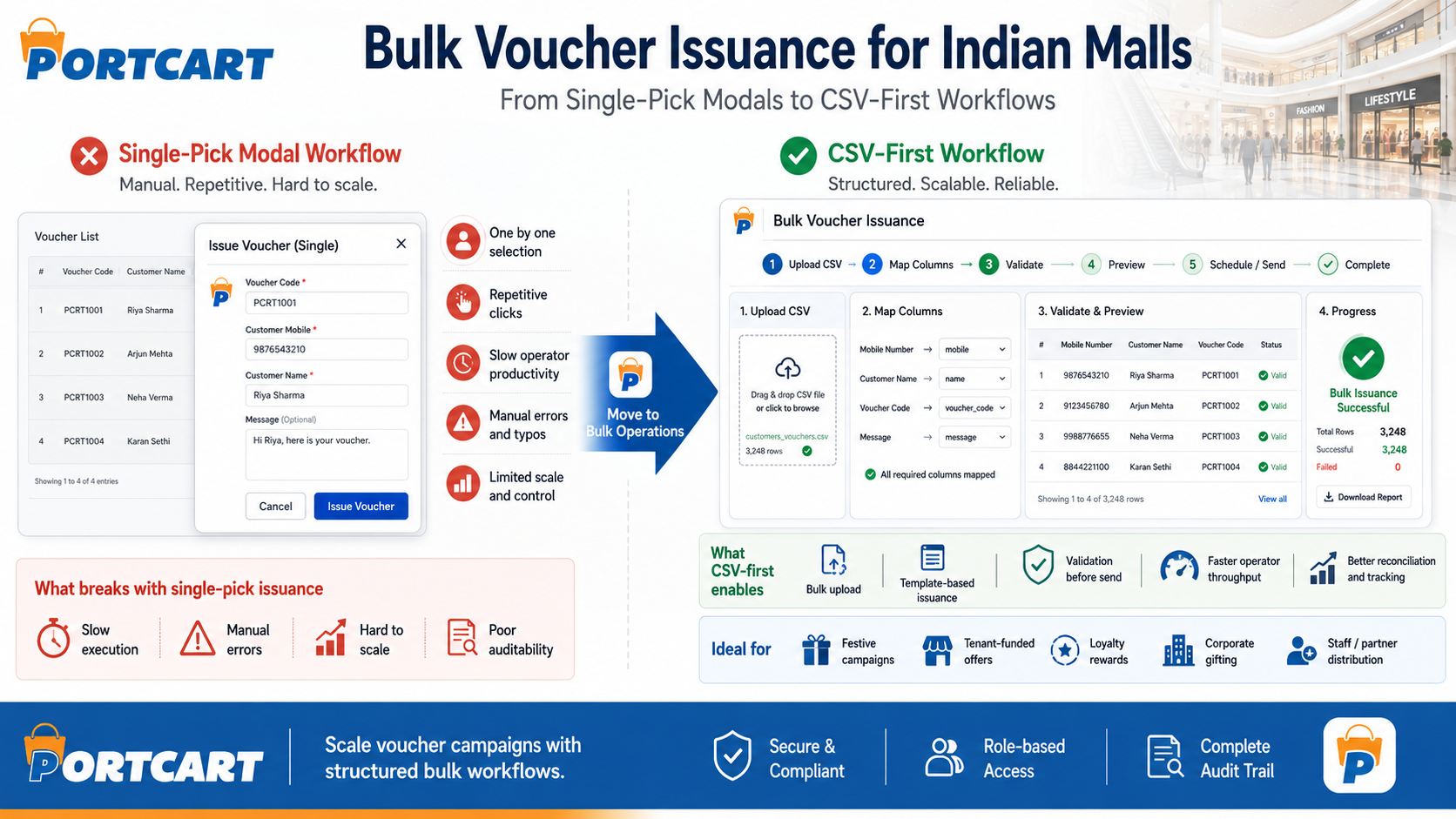
A mall HR team in Mumbai needed to issue 800 Diwali vouchers to security guards, housekeeping staff, valets, and contract workers in October 2025. Each voucher: ₹500 to a partner gift card platform. The mall's voucher management tool at the time required clicking through a single-pick modal for each. The HR team spent 11 hours over two days. Three vouchers ended up with wrong recipients. Two never reached because of phone number typos. The Diwali bonus came across as administratively grudging instead of celebratory. The right workflow handles this in 18 minutes.
This piece is the bulk-voucher-issuance workflow pattern that handles the same use case in 15 minutes, with audit discipline preserved and error rate near zero.
The use cases bulk issuance actually covers
Bulk issuance isn't a niche admin tool. It's a regular operational need:
- HR festival gifting: Diwali, Christmas, regional festivals. 200-1,500 vouchers.
- Loyalty tier-up celebrations: quarterly. 500-3,000 vouchers.
- Brand partner campaigns: co-branded with tenant brands. 1,000-5,000 vouchers.
- Event attendee gifting: post-event thank-you. 500-2,000 vouchers.
- Corporate gifting campaigns: for partner brands to gift their own customers. 5,000-50,000 vouchers.
- Customer service recovery: apology vouchers for a problem affecting multiple shoppers. 100-1,000 vouchers.
Most of these use cases hit a mall 6-12 times a year. The aggregate volume is substantial.
The CSV-first pattern
The right interaction model is:
- Download template. The system provides a CSV template specific to the voucher type (recipient name, phone, email, voucher value, expiry, custom message). Operator fills in via Excel or Google Sheets.
- Upload. Operator drags the CSV into the platform. System parses every row.
- Validation report. Within seconds, system shows:
- Matched rows (ready to issue)
- Unmatched rows (with specific reasons: missing phone, invalid phone format, recipient already issued voucher in this campaign, etc.)
- Total face value
- Estimated processing time
- Estimated cost (if using paid gift card platform)
- Maker-checker approval. Operator submits the matched batch for approval. The approver sees: total count, total value, sample of 5 random rows, full unmatched list (so they can see what's being excluded).
- Approval and processing. Once approved, system processes all matched rows. Real-time progress (300 of 800 issued, etc.). Audit log row per voucher.
- Delivery report. Within 10 minutes of approval, delivery report shows: successfully delivered, delivery failed (with reason), pending. Re-attempt logic for transient failures.
- Reconciliation. Voucher records appear in the standard voucher history with the campaign batch reference, so all downstream reporting and reconciliation works the same as single-issuance.
End-to-end for 800 vouchers: 8 minutes of operator time (template + fill + upload + submit), 4 minutes of approver time, 6 minutes of processing. 18 minutes total active human time. Operator can walk away after submission.
What the unmatched rows catch
The unmatched-row report is the most underrated part of the pattern. Five common reasons a row gets unmatched:
- Phone number format. Indian mobile numbers should be 10 digits (or +91 prefix). Leading zeros, missing digits, country code variations all caught.
- Duplicate recipient. Same phone number appears twice in the CSV, or already has a voucher in this campaign.
- Recipient is on suppression list. Recipient previously unsubscribed.
- Recipient identity unverified. Phone number doesn't match any known shopper (for loyalty-tied campaigns where only enrolled shoppers should receive).
- Date / value format errors. Expiry date in wrong format, voucher value not a number.
A typical 800-row Diwali list comes back with 15-50 unmatched rows on first upload. The operator fixes the source data (or accepts the exclusions) and re-uploads.
Maker-checker for high-value batches
Bulk issuance amplifies the consequences of an error. A typo that creates a ₹50,000 voucher instead of ₹500 sends ₹50,000 out the door if approved. Maker-checker thresholds should kick in for any batch above configurable totals (₹50,000 total face value is a common starting threshold).
The approver should always see:
- Total count
- Total face value
- Sample of randomly-selected rows from the batch
- Unmatched list
- Per-recipient maximum value
- Anomaly flags (any value >2x the median in the batch)
Bulk issuance without maker-checker is one of the most dangerous patterns in mall operations. Don't skip it.
The delivery channel
Vouchers can be delivered via WhatsApp, SMS, email, push, or QR-code-on-bill-receipt. Most malls use a combination per campaign type:
- HR gifting: WhatsApp primary, SMS fallback
- Loyalty rewards: in-app + WhatsApp
- Event gifting: WhatsApp
- Customer service recovery: WhatsApp + email
WhatsApp templates for voucher delivery need Meta approval. Pre-approve the templates before campaign season; getting them approved during Diwali rush is a nightmare.
The financial economics
A typical 1,000-voucher bulk campaign at ₹500 face value: ₹5 lakh of voucher value, plus ₹1,200-2,400 of WhatsApp delivery cost, plus ₹3,000-7,000 of platform processing cost. Total ₹5.05-5.10 lakh.
Single-pick equivalent: same voucher cost + 8-12 hours of operator labour. The operator labour cost is the operational waste bulk issuance eliminates.
Frequently asked questions
Can we issue different voucher values within the same bulk?
Yes. The CSV includes a value column per row. Senior employees get ₹1,000, junior get ₹500, all in one upload.
What if the gift card platform (Qwikcilver, etc.) has rate limits?
The platform should respect upstream rate limits and queue accordingly. 800 vouchers might process across 30-90 minutes if the upstream is rate-limited, but the operator doesn't need to be active during that.
Can we schedule bulk issuance for future delivery?
Yes. Recipients can receive on the morning of Diwali rather than the day the campaign was approved. Schedule field in the upload CSV.
What if a recipient's phone changes between upload and delivery?
Delivery to the original phone fails. Failure report flags it. Operator can re-issue to the corrected phone, with audit row showing the change.
How Portcart handles this
The CSV-first bulk-voucher pattern is built into Portcart's voucher management module.
- [Voucher Management](/modules): CSV template download per voucher type, upload with matched/unmatched validation, maker-checker approval at configurable thresholds, real-time processing, delivery report.
- [Communication Engine](/modules): WhatsApp, SMS, email delivery channels with template management and pre-approved templates for festival voucher campaigns.
- [Bulk-assign Drawer](/modules): the same multi-select-plus-CSV pattern extended to brand assignments, service assignments, and zone mappings.
If your mall's HR team is still clicking through single-pick modals for Diwali gifting, request a demo and we'll demo the bulk pattern on a real campaign.