Airport Retail Software in India: A Buyer's Guide for GMR, Adani, and Independent Operators
India has 153 operational airports. The retail concession opportunity at the top 30 is multiplying. Yet most airport retail still runs on bespoke spreadsheets. A buyer's guide for operators picking software in 2026.
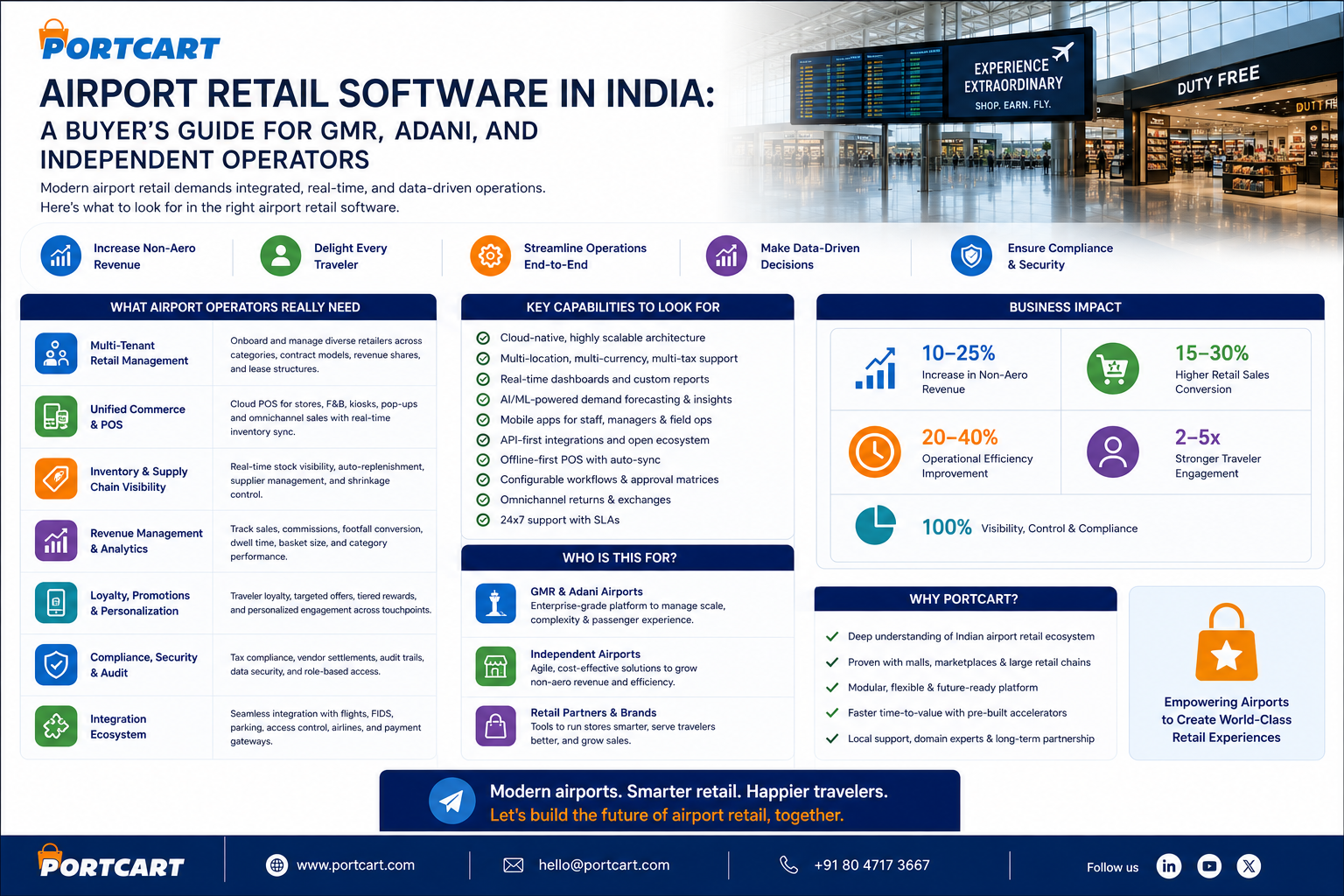
India's aviation sector is the world's third-largest by domestic passenger volume. The top 30 airports handle 95 percent of total commercial traffic, and the retail concession opportunity inside them is multiplying as Bengaluru T2, Delhi T1, Mumbai T2 retail refresh, and the GMR and Adani expansions land. Yet the technology underneath this commercial machine is surprisingly underdeveloped. Most airport retail operations in India still run on bespoke Excel sheets, ad-hoc Google Forms for tenant onboarding, WhatsApp groups for concession communication, and a fragmented set of POS systems across duty-free, F&B, and services tenants. This is the buyer's guide for operators evaluating airport retail software in 2026.
Yet the technology underneath this commercial machine is surprisingly underdeveloped. Most airport retail operations in India still run on a stack of bespoke Excel sheets, ad-hoc Google Forms for tenant onboarding, WhatsApp groups for concession communication, and a fragmented set of POS systems across duty-free, F&B, and services tenants.
This piece is a buyer's guide for operators evaluating airport retail software in 2026. It is written for the GMR Airports, Adani Airports Holdings, AAI, and the smaller terminal operators running tier-2-airport retail.
What airport retail actually requires
The technical surface is wider than mall retail in several important ways.
Airports have passenger throughput cycles measured in hours, not days. A retail brand inside a terminal handles a peak-of-3,000-passengers spike in a 90-minute window when an A380 lands, then nothing for two hours. Inventory, staffing, and analytics need to model this rhythm.
Airports have dual-pricing realities. The same bottle of perfume sells at INR pricing in the public concourse and USD-denominated pricing inside the international departure area. Software needs to handle this without operational chaos.
Airports have regulatory layers malls do not. CISF security clearances for tenant staff, AERA tariff compliance for concession fees, BCAS guidelines for retail space, customs procedures for duty-free, GST treatment for international vs domestic sales. Software has to play nicely with all of these.
Airports have passenger-side discovery realities. A passenger arriving on a 90-minute connection wants to know where the lounge is, what time the McDonald's closes, whether the duty-free perfume she wants is in stock, where she charges her phone, and where the cleanest washroom is. All in under three minutes.
The 11 capabilities a serious airport retail platform needs
1. Tenant concession management
Track every retail tenant with their lease term, concession-fee structure (often minimum guarantee plus revenue share), trading hours, store size, category, and historical performance. Renewal pipeline tracking sits on top.
2. Sales reporting and AERA-compliant data export
Airport regulators require concession fee reporting in specific formats. The system should generate these on demand. Manual quarterly compilations are a recurring source of operational pain.
3. Duty-free POS integration
Duty-free is the highest-value retail in most airports. POS integration with the major duty-free operators (Heinemann, Avolta/Dufry where present, India-specific concessions) needs to be a first-class capability. Real-time sales feed into the operator dashboard.
4. ADSR (Advanced Shopper Data Registry)
A purpose-built capability for airport retail. ADSR verifies that a duty-free purchase claim is matched to an actual boarding pass, departure scan, and customs declaration. Prevents fraud (returned-merchandise grey market), enables loyalty enrollment with verified passenger data, and produces clean audit trails for customs.
This is Portcart-coined terminology. To our knowledge no other Indian airport retail platform offers this as a productised capability.
5. Service master and passenger-facing discovery
Lounges, forex, parking, baggage assistance, Wi-Fi, transport (taxi, metro, prepaid auto, hotel shuttle), medical, baby care, prayer rooms, smoking zones, dental emergency, mobile charging, every service the airport offers should be a discoverable entity with location, hours, contact, and (where applicable) booking flow.
6. Lounge management and capacity
Lounges with finite capacity need real-time availability, booking integration with DragonPass and Priority Pass, integration with airline-tier benefits, and operational reporting on utilisation.
7. Communication channels
Passenger-side communication runs across SMS, WhatsApp, push (for app users), and increasingly on PWA-based offers triggered by airline departure announcements.
8. Concessionaire portal
The retail operators inside the airport need their own portal to manage their store listings, request leasing extensions, log incident reports, communicate with airport ops, and submit sales reports.
9. Compliance under DPDP and aviation regulations
Passenger data is high-sensitivity. DPDP compliance overlays existing aviation data norms. The system should default to consent-required for any personalisation, support data principal requests cleanly, and maintain audit trails on every consent grant.
10. Multi-terminal, multi-airport configuration
Operators running multiple airports (GMR has Delhi, Hyderabad, Goa Mopa; Adani has Mumbai, Ahmedabad, Lucknow, Mangaluru, Jaipur, Guwahati, Thiruvananthapuram, Navi Mumbai) need a single platform that supports per-airport configurations, per-terminal layouts, and cross-airport analytics.
11. Integration with airline systems
Increasingly, retail platforms need to pull flight delay information, gate change notifications, and connection-window data to deliver context-aware offers ("your flight is delayed 90 minutes, here are 3 things within 5 minutes of your gate").
What to skip
Some features that sound airport-relevant but turn out to be operational noise:
- Real-time queue-time tracking at every retail outlet (data is volatile, decisions cannot be made fast enough to act on it)
- AI-driven dynamic pricing for duty-free (regulatory and tenant-relationship complexity outweighs the modest revenue lift)
- Native airport-specific apps that compete with airline apps (passengers already have 2-4 travel apps; another one will not get downloaded)
Focus the platform on the high-leverage operational layers, not the dashboard features that sound impressive in a sales pitch.
The vendor landscape in India 2026
The current market has three distinct vendor types:
Global travel-retail platforms (Inform, AIM Software, occasional Heinemann custom builds): expensive, slow to deploy, designed for European duty-free chains. India localisation is a 12–18 month project for each.
Indian retail platforms with airport modules (some mall-tech vendors with bolted-on airport support): cheaper, faster to deploy, but rarely cover ADSR, concession management depth, or AERA reporting.
Bespoke builds (each major Indian airport has commissioned at least one custom build over the years): tailored, expensive to maintain, hard to evolve.
Portcart sits in a fourth category: a platform purpose-built for Indian retail concession operations across malls, airports, and travel retail, with ADSR, concession management, and passenger discovery as native capabilities.
What to ask vendors
If you are evaluating airport retail software in 2026:
- Does the platform support ADSR-style verification natively, or is it on a roadmap?
- Can it model the concession fee structure your contracts use (MG plus revenue share with category-specific rates)?
- Does it export AERA-compliant concession reports without a custom build?
- Does it integrate with the duty-free POS systems your specific operators use?
- Can it run a multi-terminal, multi-airport portfolio under one operator account?
- Does it handle DPDP-compliant consent capture for passenger-side personalisation?
- What is the production deployment cycle from contract signing to live? (Anything over 6 months is a red flag.)
Where this is going
The next 24 months will see a clear separation between airports running on integrated retail platforms and airports running on Excel-plus-WhatsApp. The integrated operators will win the international duty-free flagships, the premium F&B brands, and the loyalty-aware passenger segments. The fragmented operators will continue to absorb the operational friction that makes their retail mix less competitive.
The infrastructure investment is meaningful but recoverable. A well-deployed airport retail platform pays back in 12–18 months on a single major terminal through concession yield improvement, duty-free fraud reduction (ADSR), and tenant retention.
How Portcart handles this
Portcart's airport modules are built specifically for Indian airport retail operations.
- [ADSR](/modules): boarding-pass-verified duty-free claim registry with full audit trail.
- [Airport Concession Management](/modules): tenant lease tracking, concession fee structures (MG plus revenue share), AERA-compliant reporting export.
- [amenity and services mapping](/modules): passenger-facing discovery for lounges, forex, parking, baggage, Wi-Fi, transport, medical, baby care.
- [Loyalty Layer](/modules): integrates with verified ADSR data so airport loyalty can run with confidence on duty-free purchases.
- [Communication Engine](/modules): DPDP-compliant consent capture, multi-channel messaging.
If you are running an Indian airport retail operation, request a demo to see the stack against your existing concession portfolio.