AI for Mall Tenant Mix Decisions: What Good Actually Looks Like
Tenant mix is still decided by gut and relationships. Here is what good AI for tenant mix actually does, what to ask vendors, and why the decision stays with your team.
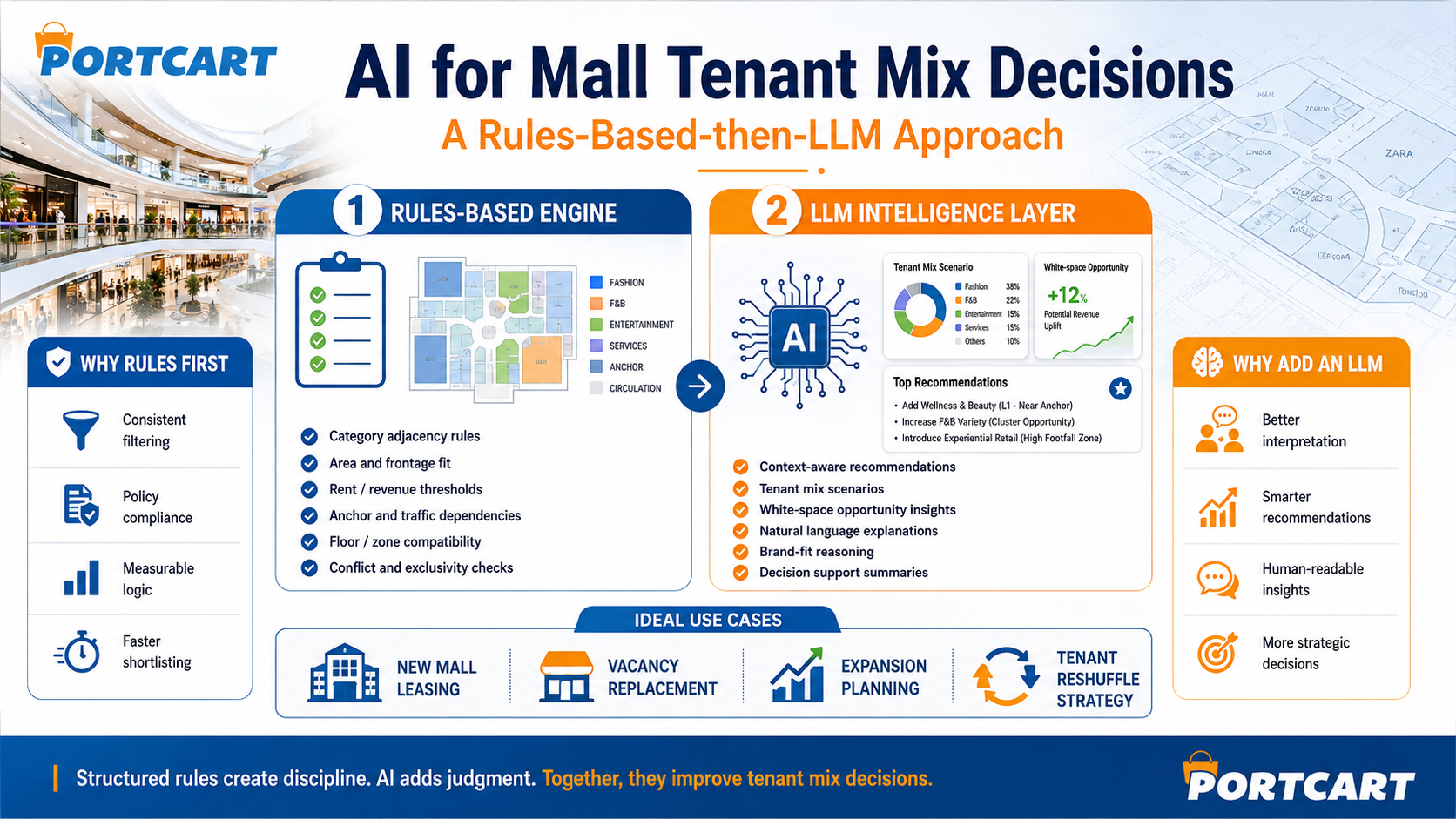
A leasing director in Pune has 40 open units and a universe of well over a thousand brands to consider. The board wants more F&B and a flagship anchor by next Diwali. Today that shortlist gets built from memory, a few broker calls, and a spreadsheet that is stale the week it is made. Vendors now pitch "AI-driven leasing." Most of it is hype, some of it is genuinely useful, and the difference matters when a wrong anchor locks up 20,000 square feet for nine years.
The real problem with tenant mix today
Most Indian malls decide tenant mix from experience and relationships. That works for the first mall and the first few anchors. It stops working when you are pre-leasing a new asset on a deadline, balancing MG against revenue share, matching brand price points to a specific catchment, and trying not to repeat the mix of the competing mall four kilometres away. The data that should inform the call, which brands are expanding, at what store sizes, on what terms, sits in brokers' heads and out-of-date sheets. The result is slow shortlists and decisions that are hard to defend when the board asks "why this brand and not that one."
Why "AI picks your tenants" is the wrong promise
The loudest pitch is a tool that ingests your data and names your tenants. Treat that with suspicion. A model with no operational ground truth does not know that one brand's last three openings underperformed, or that your mall's character is built around regional F&B. It is also inconsistent, and worst of all it cannot be audited. When leasing is a multi-crore, multi-year commitment, "the AI said so" is not an answer you can take to a board. The decision has to stay with people who can be held accountable for it.
What good AI for tenant mix actually does, from your seat
Useful AI is not a decision-maker. It is an analyst's force-multiplier. From the operator's chair it should do four things:
- Narrow the field. Go from every brand in India to a focused shortlist that fits your open categories, your catchment's price points, your available store sizes, your commercial terms, and your city, while leaving out brands already locked into a nearby competitor.
- Explain itself. You should be able to ask why any brand is on or off the list and get a straight, specific answer. Auditable beats clever.
- Add a layer of judgement. A good tool reads your mall's written positioning and recent leasing wins and losses, then surfaces non-obvious candidates and flags the brands worth a second look.
- Leave the decision to you. The output is a brief your team reviews, overrides, and signs off. Never an automated commitment.
What that looks like in practice
Take a five lakh square foot mall opening in Indore in late 2027. The operator wants F&B up to around 18 to 20 percent by opening, which means two anchors and a handful of smaller brands. Instead of starting from a blank sheet, the leasing analyst starts from a focused, ranked shortlist of F&B brands that actually fit Indore's catchment, the available kitchen sizes, and the mall's commercial model, with a few non-obvious regional candidates flagged for a look.
The leasing lead reviews that shortlist in a single pipeline meeting. They drop some names on context the tool did not have, accept a few of the flagged outliers, and add two of their own. They leave with a dozen brands to pursue and a clear rationale for each. The work that used to take weeks of back-and-forth gets done in that meeting. The judgement stays human. The shortlist just arrives faster and better supported.
Questions to ask any vendor pitching AI for leasing
This is the part to keep handy on the next vendor call:
- Can I see exactly why a brand was included or excluded? If not, you cannot defend the shortlist.
- Does it understand my mall's positioning, or only what is in a spreadsheet?
- Does it surface where it disagrees with itself, or hide everything inside one score? The disagreements are the interesting part.
- Is the output an aid to my team's judgement or a replacement for it? Anyone selling fully automated leasing decisions is selling over-confidence.
- Does it run on a current, real brand directory, or on stale data? A shortlist is only as good as the brand data under it.
- For an India deployment, does it meet your data-residency needs for sensitive inputs?
The same discipline, narrow with clear criteria, add judgement, keep humans deciding, applies to campaign targeting, voucher planning, and event programming too. The tool that respects it is worth your time. The one that promises to do your job for you is not.
Frequently asked questions
Will this replace my leasing team? No. It removes the slow analytical grind so the team spends its time on judgement and relationships, which is where leasing is actually won.
How current does the brand data need to be? Very. A shortlist built on a two-year-old brand list will recommend brands that have stopped expanding or already signed elsewhere.
What team do we need to run it? A leasing analyst and a leasing lead. You do not need to hire a data scientist to get value from it.
What about data residency? For India deployments, make sure sensitive inputs are handled in line with your residency requirements before you commit.
How Portcart handles this
Portcart's AI tenant-mix suggestions is built for exactly this. It turns your live brand directory into a focused, ranked, fully auditable shortlist for any open category, adds an AI-assisted qualitative read of fit, and keeps every decision with your team. Every recommendation can be traced back to a clear reason. It works alongside the brand pages (thousands of Indian brands tagged with the category, geography, store-size, and price-point details leasing teams actually filter on) and the leasing pipeline (captures brand interest and routes it to your team without exposing inventory publicly).
Want to see it against your own catchment? Request a demo and we will run it on your real numbers.