Why New Malls Should Not Open With Empty Brand Pages
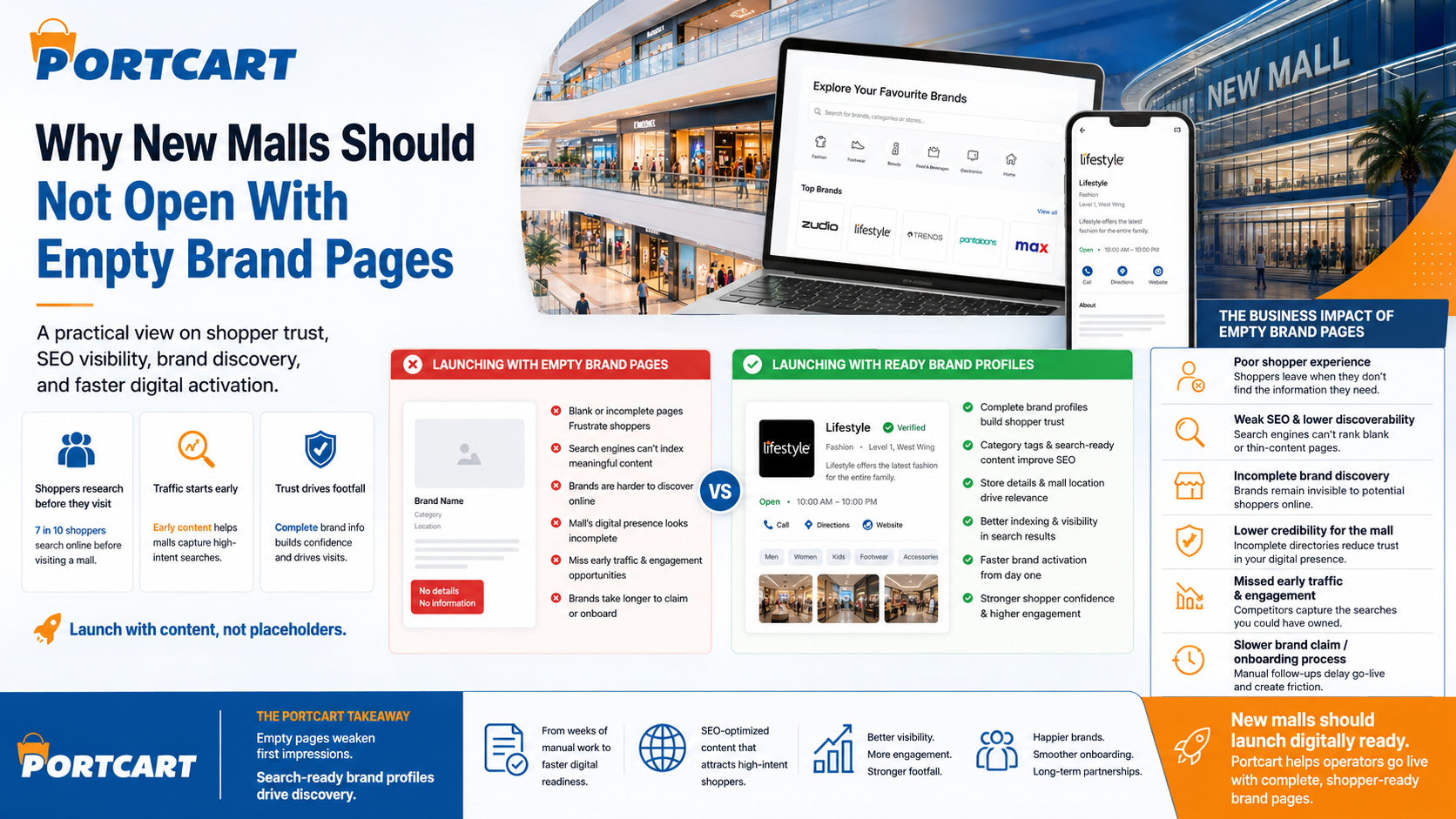
New malls should not launch with incomplete brand pages. A structured brand directory improves shopper discovery, tenant visibility, SEO readiness, and mall operations.
TL;DR
* New malls often struggle to launch with complete brand directory pages. * Manual tenant profile creation is slow, repetitive, and easy to delay. * AI-assisted drafting can help mall teams prepare brand pages much faster, while keeping human review in control. * The real benefit is not just speed. It is consistency, SEO readiness, shopper discovery, tenant visibility, and lower operational dependency. * A better-structured brand directory improves visibility for both the mall and its tenant brands across search, category discovery, and shopper intent queries. * Portcart helps malls create structured brand pages and later allows brands to claim and maintain their own listings.
Opening a new mall is not just about leases, interiors, events, hoardings, and launch campaigns. It is also about digital readiness.
A shopper searching for a brand expects to know whether that brand is present in the mall, where it is located, what it offers, what the timings are, and whether there are any offers or contact details available.
If the mall directory is incomplete, the shopper does not wait. They search elsewhere.
This is where many malls lose digital visibility before they even begin.
A typical mall may have 60, 80, or 100 tenant brands. Each one needs a public-facing page with a logo, brand description, category, store location, contact details, store timings, photos, and search-friendly content.
When this work is done manually, it can take weeks.
When it is rushed, the result often looks incomplete, inconsistent, or outdated.
AI-assisted brand profile creation changes this workflow. It does not remove the need for human review. It removes the slowest part of the process: repetitive drafting, formatting, structuring, and first-level content preparation.
The mall team can then focus on what matters more: checking accuracy, improving tone, approving brand pages, and preparing the directory for shoppers.
What Manual brand profile creation Actually Involves
For every tenant brand, the mall team usually needs to prepare:
* Brand name and logo * Store category and sub-category * Short brand description * Store location inside the mall * Store timings * Contact details * Representative photos * SEO title and description * Relevant shopper-facing keywords * Offer, coupon, or loyalty readiness * Any special notes about the brand’s positioning
This sounds simple for one brand.
But for 80 brands, it becomes a serious operational task. The team has to collect information, check sources, write content, standardise tone, format images, assign categories, and review everything before publishing.
The output looks professional when done carefully.
It looks weak when done in a hurry.
And in today’s environment, weak digital pages affect more than appearance. They affect discovery, search visibility, shopper trust, brand perception, and tenant visibility.
The Problem With Incomplete Mall Directories
Many mall websites and apps have the same issue.
Some brand pages have proper content. Some have only a logo. Some have no description. Some have old photos. Some have outdated store timings. Some are missing categories. Some brands are present in the mall but not properly searchable online.
For shoppers, this creates friction.
For brands, it reduces visibility.
For mall marketing teams, it creates repeated manual work.
For leasing and operations teams, it creates dependency on internal staff for every small update.
A mall directory should not be treated as a one-time data-entry task. It should be treated as a living digital layer of the mall.
Where AI-Assisted Brand Drafting Helps
AI-assisted workflows can help mall teams create a first draft of each brand profile faster and more consistently.
The system can prepare structured profile drafts based on approved brand inputs, mall requirements, and standardised content formats. The admin team then reviews, corrects, improves, and approves the page before it goes live.
This is the right balance.
AI helps with speed and structure.
Humans protect accuracy, tone, and brand sensitivity.
The final output should never feel like random AI-generated text. It should feel like a polished mall directory where every brand page follows a consistent format.
Human Review Is Still Non-Negotiable
AI should assist the mall team, not replace editorial judgement.
Before publishing, the admin team should verify the following.
1. Brand Description
The description should be simple, accurate, and useful for shoppers. It should not sound exaggerated, generic, or overly promotional.
2. Category Accuracy
The brand must appear under the right category. A fashion brand, luggage brand, beauty brand, electronics brand, restaurant, entertainment venue, or service provider should be easy for shoppers to discover.
3. Factual Accuracy
Specific claims must be checked carefully. Dates, parent company references, ownership details, founder names, and brand history should not be published unless verified.
4. Store-Level Details
Mall-specific details such as floor, zone, unit number, store timings, contact number, and available services must be confirmed by the mall team or the brand.
5. Brand Sensitivity
Some categories need extra care. Healthcare, pharmacy, financial services, insurance, children’s products, and regulated services should always go through stricter review.
The best model is simple:
AI prepares. Humans approve.
What This Unlocks for Malls
A complete brand directory is not just a digital brochure. It supports multiple mall functions.
1. Better Shopper Discovery
Shoppers can quickly find whether a brand is available in the mall, where it is located, and what it offers.
This reduces confusion and improves the mall visit experience.
A shopper looking for a fashion store, footwear brand, restaurant, salon, electronics outlet, entertainment zone, or kids’ activity option should not struggle to find basic information.
The mall directory should guide them clearly.
2. Stronger Search Visibility
Structured brand pages help the mall appear for searches related to:
* Brand name * Mall name * City * Category * Store type * Shopping intent * Restaurant or service intent
This is especially useful when shoppers search before visiting.
For example, if someone searches for a particular brand in a specific city or mall, a properly structured mall page has a better chance of appearing as a useful result.
The mall should not depend only on third-party listings, outdated directories, or generic search results to represent its own tenant mix.
3. Better Visibility for the Mall and Its Tenant Brands
A well-structured brand directory improves visibility for both the mall and the brands inside it.
When every brand page has clear category tagging, mall-specific location details, useful descriptions, and search-friendly content, shoppers are more likely to discover those pages while searching online.
This helps the mall appear in more brand-led and category-led searches, while also giving tenant brands stronger visibility within the mall’s own digital ecosystem.
For example, a shopper searching for a fashion brand, footwear store, restaurant, salon, electronics shop, or kids’ entertainment option in a particular city can be guided back to the mall’s own page instead of depending only on third-party listings or generic search results.
This means the mall directory does not just inform shoppers.
It becomes a visibility engine for tenants.
4. Faster Launch Readiness
New malls, renovated malls, and newly acquired malls can prepare their digital directory much faster than traditional manual workflows.
This matters because digital readiness should not begin after the mall opens.
It should be ready before launch campaigns, leasing announcements, social media promotions, influencer visits, and shopper communication begin.
A mall that opens with complete digital pages looks more prepared, more premium, and more shopper-friendly.
5. Better Brand Visibility
Every tenant gets a cleaner digital presence inside the mall ecosystem.
This helps both large national brands and smaller regional brands.
Large brands benefit because shoppers can confirm their presence, location, and offers inside the mall.
Smaller brands benefit because they get discoverability they may not be able to build independently.
A mall directory should not only list brands. It should help them become discoverable.
6. Lower Admin Burden
The mall team spends less time creating repetitive content and more time reviewing, approving, and improving the overall quality of the directory.
This is important because mall teams already manage leasing coordination, retailer communication, events, campaigns, footfall initiatives, signage, customer queries, and reporting.
Directory maintenance should not become another slow manual burden.
7. Easier Future Updates
Once the brand profile is structured properly, it becomes easier to add:
* Coupons * Offers * Loyalty campaigns * Store events * New arrivals * Seasonal promotions * Brand announcements * Store photos * Restaurant menus * Service updates * Leasing-related visibility * Shopper communication campaigns
A clean brand directory becomes the foundation for future mall engagement.
The Next Step: Brand-Claim Flow
The strongest mall directory model is not only admin-managed.
It should eventually become brand-maintained.
Once the mall publishes the initial brand profile, the brand should be able to claim its listing. After verification, the brand team can update photos, descriptions, store timings, offers, product highlights, and campaign content.
This reduces long-term dependency on the mall team.
It also gives brands more responsibility for keeping their own information fresh.
The mall remains the controller and reviewer. The brand becomes an active participant.
This is especially useful for malls with many tenants, frequent store changes, seasonal offers, event-led campaigns, and active leasing pipelines.
When AI-Assisted Brand Profile Creation Needs Extra Care
AI-assisted drafting is useful, but it is not suitable for blind publishing.
There are cases where more manual involvement is required.
Brands With Limited Online Presence
Some regional stores, local restaurants, kiosks, and service providers may not have enough public information available.
These profiles need direct input from the brand or mall team.
Newly Launched or Rebranded Businesses
If a brand has recently changed its name, positioning, logo, or ownership, the profile should be checked carefully before publishing.
Outdated information can damage trust.
Regulated or Sensitive Categories
Pharmacy, financial services, healthcare, wellness, insurance, and legal services should go through stricter editorial review.
The mall should avoid publishing unverified claims in sensitive categories.
Premium and Luxury Brands
Luxury and premium brands often have strict brand guidelines.
Their profile content, imagery, and tone should be handled carefully.
For these brands, consistency and brand control matter as much as speed.
Frequently Asked Questions
Does AI-Generated Content Hurt SEO?
AI-assisted content is not the problem.
Low-quality, inaccurate, repetitive, or unreviewed content is the problem.
For mall directories, the content should be helpful, accurate, location-specific, and reviewed before publishing.
A shopper should get useful information, not generic filler text.
Should Malls Publish AI-Generated Brand Pages Directly?
No.
AI should create the draft.
The mall team should review and approve it before publishing.
Human review protects accuracy, tone, and brand quality.
Can Brands Update Their Own Pages Later?
They should be able to.
A brand-claim flow allows verified brand representatives to maintain their own listing, while the mall keeps control over approval and quality standards.
This keeps the directory fresher without increasing the mall team’s workload.
Is This Only Useful for New Malls?
No.
It is also useful for existing malls with:
* Outdated directories * Missing brand pages * Incomplete SEO content * Poor store information * Inconsistent category tagging * Weak tenant visibility * Manual update dependency
A stale mall directory can be refreshed and made more useful for shoppers.
Is This Only About Content?
No.
A strong brand directory becomes the base layer for:
* Offers * Coupons * Loyalty * Events * Leasing interest * Tenant communication * Store discovery * Shopper engagement * Brand visibility * Campaign communication
The directory is not just a list.
It is the operating layer for mall discovery.
How Portcart Helps
Portcart helps malls create structured digital brand pages that are easier to manage, update, and connect with other mall workflows.
The platform supports:
* Brand directory creation * Store and restaurant listing pages * Category-based discovery * Mall-specific brand pages * Coupon and offer readiness * Brand-claim workflows * Shopper discovery across malls and airports * Future integration with loyalty, vouchers, leasing interest, and campaign communication
The goal is simple.
A mall should not open with empty or weak digital pages.
Every brand should be discoverable.
Every shopper should find useful information.
Every tenant should get better visibility.
Every mall team should spend less time on repetitive data entry and more time improving the shopper experience.
If you are opening a new mall, refreshing an old mall directory, or trying to improve retailer visibility, Portcart can help you create a cleaner and more structured digital layer for your property.