AI in Indian Retail in 2026: 11 Specific Use Cases Past the Hype
Eleven AI use cases that genuinely help Indian mall teams in 2026, the practical catch in each, and five where the hype runs ahead of reality. AI assists, people decide.
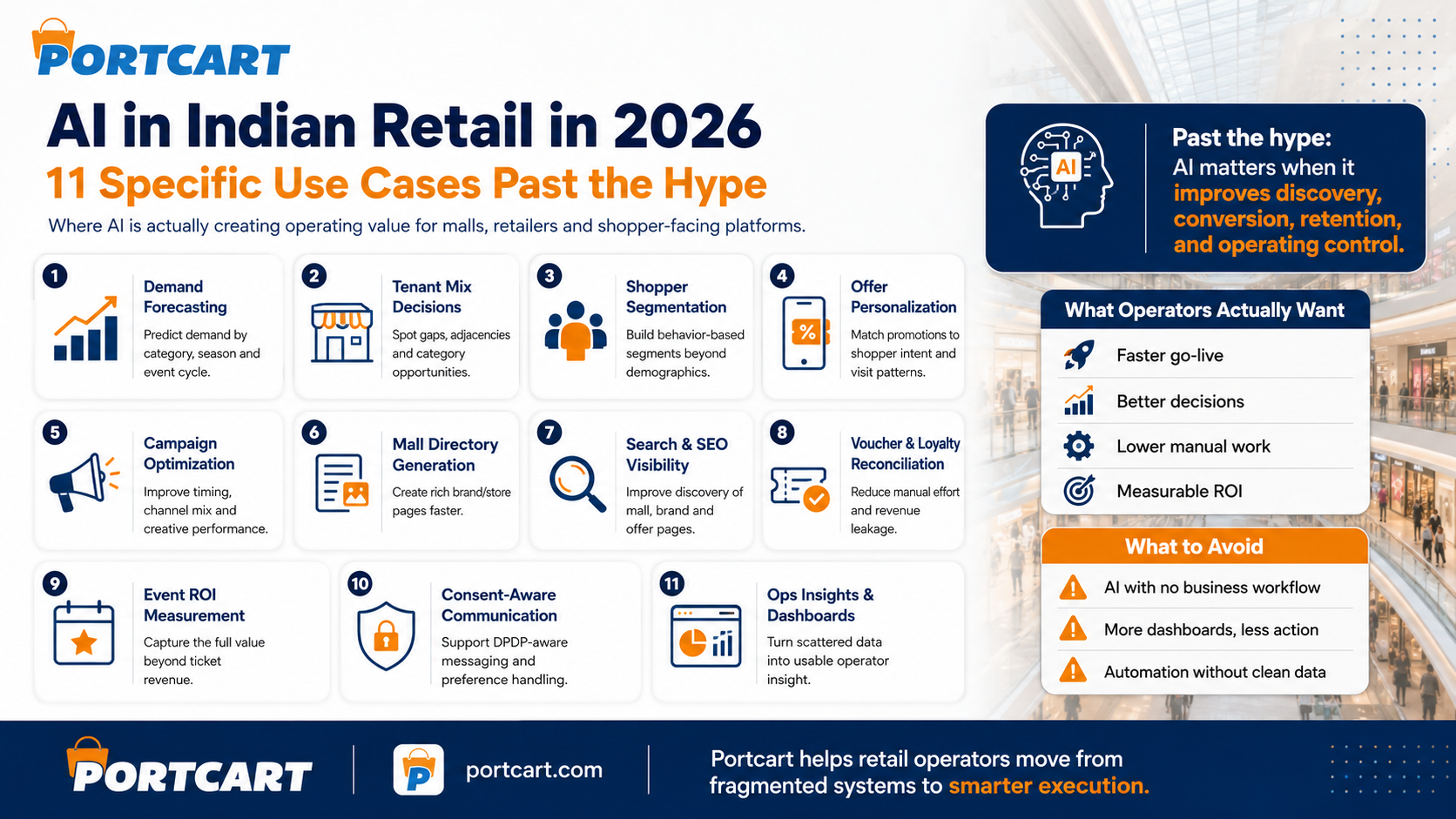
Most "AI in retail" writing stays at the strategy layer. This is the operator's version: eleven places AI actually helps a mall team in 2026, what each one is good for, and the practical catch to watch for. Throughout, the rule is the same. AI assists. People decide.
Eleven use cases that work
1. Tenant-mix shortlisting. Turn a huge brand universe into a focused, explainable shortlist for your open categories, so leasing starts from a ranked list instead of a blank sheet. The catch: it shortlists, it does not decide. The leasing director still picks. More in our tenant-mix guide.
2. Brand profile drafting. Produce a first-draft listing for a brand from public information, ready for an editor to check and publish. The catch: review for invented facts (founding dates, parent companies) before it goes live.
3. Voucher campaign copy. Generate several message variants per channel so your campaign manager edits and picks rather than writing from scratch. The catch: WhatsApp template messages still need Meta approval before they go out, however good the draft.
4. Shopper concierge chatbot. Answer shopper questions about brands, services, hours, events, and offers, around the clock. The catch: it must answer only from verified mall data and say "I don't know" rather than guess. An unpinned chatbot will confidently invent a parking rate.
5. Leasing deck drafts. Turn a structured brief into a first-draft pitch deck the leasing director polishes, saving hours of formatting. The catch: the human still owns the brand-mall fit narrative. A draft is a starting point, not a finished pitch.
6. Loyalty redemption suggestions. Recommend rewards a shopper is likely to value, lifting redemption rates. The catch: never suggest a reward they cannot actually use. A live check against stock and active campaigns matters.
7. Invoice-loyalty fraud checks. Flag suspicious loyalty claims before they cost you, protecting the points economy. The catch: tune carefully. A real shopper wrongly flagged becomes a support complaint, so err toward catching real fraud and accept a few misses.
8. Reading uploaded bills. Let a shopper photograph a bill and have the key details captured for loyalty, instead of manual entry. The catch: Indian receipts are messy (GST lines, regional-language text, brand-name variants), so a solid validation step is essential.
9. Event timing. Use your own event and footfall history to pick better days and times for activations. The catch: do not over-read small samples. Three data points are not a trend.
10. Sponsor pitch drafts. Draft a sponsor pitch from event details and the sponsor's past activations, so your team starts from a draft instead of a blank page. The catch: your relationship manager edits it. AI does not know what was said in the last conversation with the sponsor.
11. Footfall forecasting. Forecast footfall from history, weather, season, holidays, and the event calendar, for staffing and inventory planning. The catch: accuracy plateaus around plus or minus 8 to 15 percent for most malls. Use it to plan shifts, not to promise revenue.
A note on AI-written marketing content
Drafting social copy, email subject lines, and blog posts works as well in Indian retail as anywhere. The winning pattern is the same: AI drafts, an editor reviews and polishes, AI offers a few headline variants, a human picks. Treat it as a productivity boost for the marketing team, not a replacement, and keep editorial review mandatory.
Where AI does not help (yet)
Five areas where the hype runs ahead of the value:
- Predicting individual shopper behaviour beyond simple segments. At the individual level the predictions are still noisy.
- Real-time pricing. Mall pricing is brand-controlled, not mall-controlled, so there is little for an operator to optimise.
- Automated lease negotiation. Drafting helps. Negotiation needs human relationships and judgement.
- Face-recognition analytics. DPDP makes most facial-recognition personalisation legally fraught. ANPR for parking is fine. Faces are risky.
- Fully autonomous customer service. A hybrid model (AI handles FAQs, humans handle escalations) works. Fully autonomous still fails too often on Hinglish and regional-language queries.
Buy it, or build it yourself?
Two paths. Buy AI as part of a platform that manages it for you, or wire up AI providers directly in-house. For almost every Indian mall operator, the first is the right call. Direct integration only starts to pay off at very high volume, and the in-house operational burden rarely justifies itself at single-mall or small-group scale. Spend your team's time on using the outputs, not on the plumbing.
The team you actually need
A typical 2026 mall AI setup is smaller than people expect:
- A marketing or operations lead (not a data scientist) who owns the AI roadmap.
- A platform that delivers the AI capabilities.
- An editor for content outputs.
- A leasing analyst for tenant-mix work.
Most malls over-hire here. A dedicated data scientist is hard to justify at single-mall scale. Groups of five or more properties can justify a dedicated AI operations lead.
Frequently asked questions
Which AI model should we use? For these use cases the user-visible difference between the major providers is small. The quality of the platform built around the model matters more than the model badge.
Should we worry about chatbots making things up? Yes. Any customer-facing AI must answer only from verified mall data and refuse when unsure. Never let raw generative output reach a shopper unchecked.
How does DPDP affect AI? Shopper personal data used for AI needs the same consent as any other personalisation. Most retail AI runs on aggregate or anonymised data, so the overlay is light. Be careful with flows that send personal data to a provider.
Is on-premise AI worth it? For the volumes most malls run, no. Hosted AI is cheaper, faster to deploy, and easier to operate, except where specific data-residency rules demand otherwise.
How Portcart handles this
Portcart builds these capabilities into the platform, so an operator gets the outcomes without assembling anything:
- [AI tenant-mix suggestions](/modules): tenant-mix shortlists, voucher campaign drafts, brand profiles, and leasing decks, each reviewable before anything is used.
- [AI Shopper Concierge](/modules): answers shoppers from verified mall data and declines when it does not know.
- [Loyalty](/modules): redemption suggestions with sensible fallbacks.
- [Voucher Management](/modules): invoice checks that protect the points economy.
You get the use cases above as features, with a human in control of every decision. If your organisation is mapping its AI plans for 2026 and 2027, request a demo and we will walk through the ones that fit your operation.