Who Is Inside Your Mall Right Now?
Several fit-outs are running at once, crews come and go daily, and the gate is a paper register. Ask the simplest safety question there is and most malls cannot answer it. The same register is why openings slip, and a slipped opening is rent that has not started.
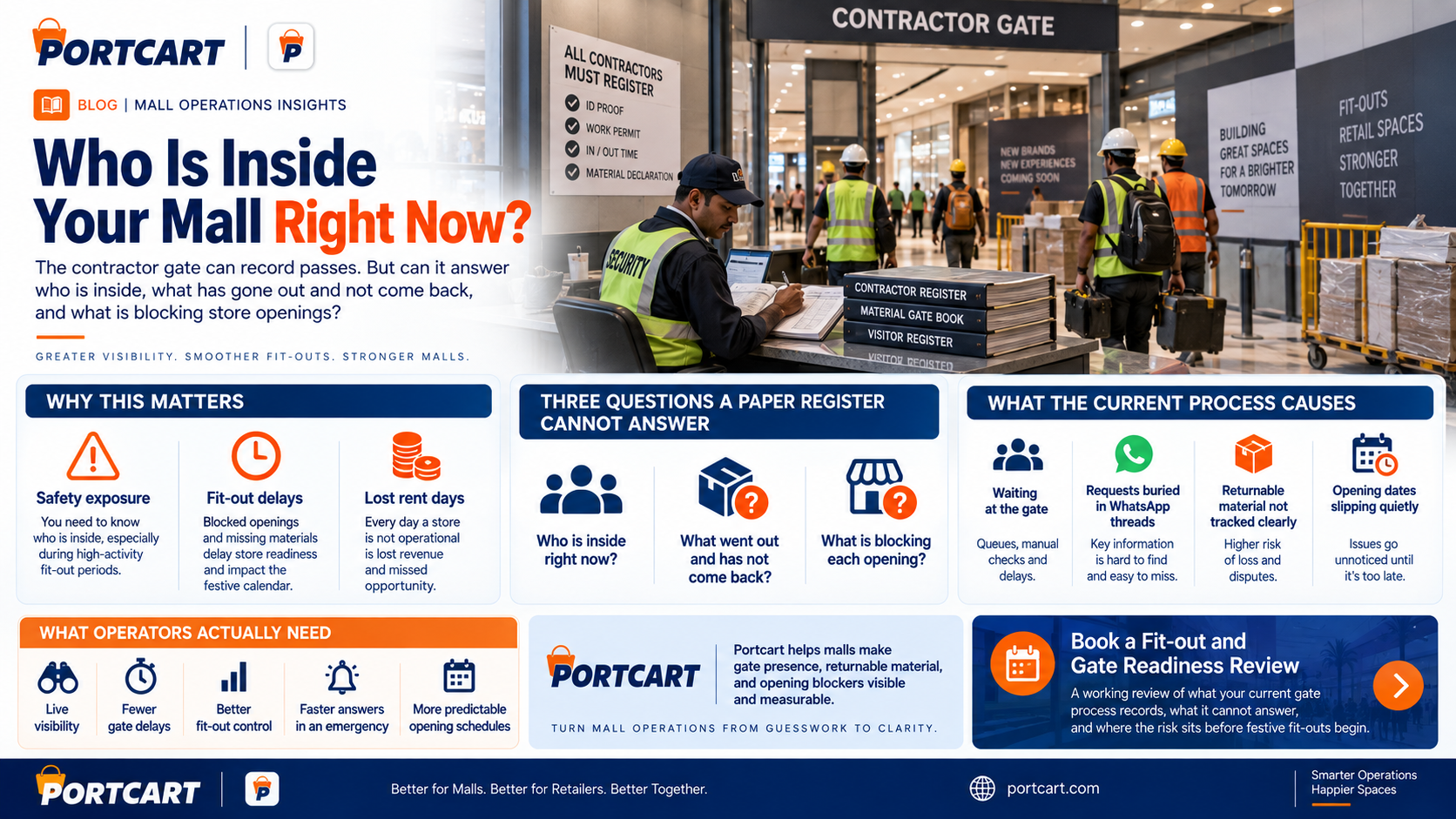
Walk to the contractor gate of most Indian malls and you will find three paper books. One for people coming in. One for material going out that is expected back. One for material going out that is not.
Security fills them carefully. Each pass has a serial. The books are kept for years.
Now ask the person at the desk a simple question: how many contractor staff are inside the building right now?
Watch what happens. They will open the first book, run a finger down the day's entries, try to remember who left, and give you a number they would not want to defend. That is not carelessness. It is the form. The register was built to record that a pass was issued. It was never built to say who is here.
Why the question matters more than it sounds
The first reason is the one nobody wants to test. When a fire alarm sounds, the mall needs a list of everyone inside who does not know the building: the crew on the third-floor fit-out, the electrician's team in the basement, the driver waiting at the loading bay. Shoppers follow the signage. Contractors follow whoever is nearest. The mall is responsible for both, and for the second group it usually cannot produce a list.
The second reason is commercial, and it is the one that repeats every season.
A store under fit-out is a store not paying rent. In most Indian mall leases the rent-free fit-out period is fixed, and the rent commencement date is fixed with it. When the fit-out runs over, the mall has a choice between holding the brand to the date, which starts a relationship badly, and extending, which is rent it will never see. Either way, every day the store is not trading is a day of sales the mall's revenue share was counting on.
Fit-outs slip for many reasons. A surprising number of them run through the same gate register.
Where the days go
Talk to a brand's project manager about why an opening moved and the story is rarely dramatic. It is small delays, stacked.
The crew for tomorrow was messaged to the mall's operations team on WhatsApp in the evening. Someone retyped it into the pass form the next morning. The crew arrived before the passes existed and waited at the gate. An hour gone.
The brand needed an after-hours access slot and a power upgrade. Both were asked for in a message thread. One was actioned, the other was missed in the scroll. Three days gone before anyone noticed it had never been raised.
A returnable pallet of fixtures went out for rework. The book recorded it leaving. Nothing recorded that it was due back, so nobody chased it until the fit-out team asked where it was. A week gone.
None of these is a failure of effort. In each case someone did the work in front of them. The problem is that the work in front of them was transcription: moving a request from a message to a form, or from a form to a memory. Every transcription is a delay, and every delay lands on the opening date.
The three questions a register cannot answer
Put the safety point and the commercial point together and the gate needs to answer three things, continuously, without anyone searching:
- Who is inside right now? Not who was issued a pass this week. Who is in the building at this moment.
- What has gone out and not come back? Returnable material with a date it was expected, so the overdue list exists before someone asks.
- What is blocking each opening? The power upgrade, the water point, the after-hours access, the signage approval: each with an owner and a status, so "why is this store not open" is a glance rather than a meeting.
A paper book answers none of them, and it is not because the book is badly kept. A pass is a document issued once. Presence is a state that changes many times a day. Overdue is a comparison against a date that the book never asked for. A blocker is a request that arrived in a chat. The form and the question are different shapes.
Four questions for your operations head
Before the festive handovers start, ask these and pay attention to how long each answer takes:
- If the alarm sounded now, how long would it take to produce a list of every contractor inside, and would you trust it?
- What material went out on a returnable pass in the last month and has not come back?
- How many brand requests are sitting in WhatsApp threads right now waiting to be retyped into something?
- For each store under fit-out, what is the single requirement currently blocking it, and who owns it?
If all four have fast, confident answers, the gate is doing its job and this article owes you nothing. If the honest response to the first one is "we would have to go and count", that is the finding. The mall is carrying a safety exposure it has not priced and losing rent days it has not attributed, and the cause is the same form in both cases.
What a working gate looks like
None of this needs more security staff or more books. It needs the register to hold a state rather than an event.
- Presence is a live answer: the mall can say who is inside without walking to the gate.
- Material that leaves on a returnable basis carries a return date, so the overdue list builds itself.
- The brand's project team can raise tomorrow's crew and this week's requirements as requests, and the mall decides on them, so nothing waits to be retyped and nothing is lost in a scroll.
- Each fit-out shows its blockers with an owner, which turns the weekly "why is this not open" meeting into a list that was already true before the meeting.
- A pass issued in error is cancelled with a reason, not crossed out, so the record still tells the truth later.
The visible result is fewer waits at the gate and fewer surprise slips in the opening schedule. The less visible result is that the fire-drill question gets an answer.
Where Portcart fits
Portcart is built to give malls one view of the shopper journey: discovery, engagement and commercial activity in a single measurable line. Fit-out and gate operations sit at the start of that line, because a store that opens on time is the first commercial outcome a mall can influence. Portcart is built to make presence, material return and opening blockers answerable, so the operations team spends its time on decisions rather than transcription.
The meeting worth having
Before the festive fit-out run, ask the first question in the operations meeting and time the answer.
If it takes longer than a minute, book a Fit-out and Gate Readiness Review with us. It is a working session on your own gate: what the registers record today, what they cannot answer, and what needs to be in place before several crews are on site at once. Bring last season's fit-out schedule with the original and actual opening dates. The gap between those two columns is the number this article is about.