Your Footfall Number Has Two Authors. You Can Name Neither.
Ganeshotsav week produces the most quoted and most disputed footfall figures of the year. Ask who counted at Gate 3 on the peak day and who typed the number into the sheet, and most malls cannot answer either. A number with no author cannot be defended in a renewal.
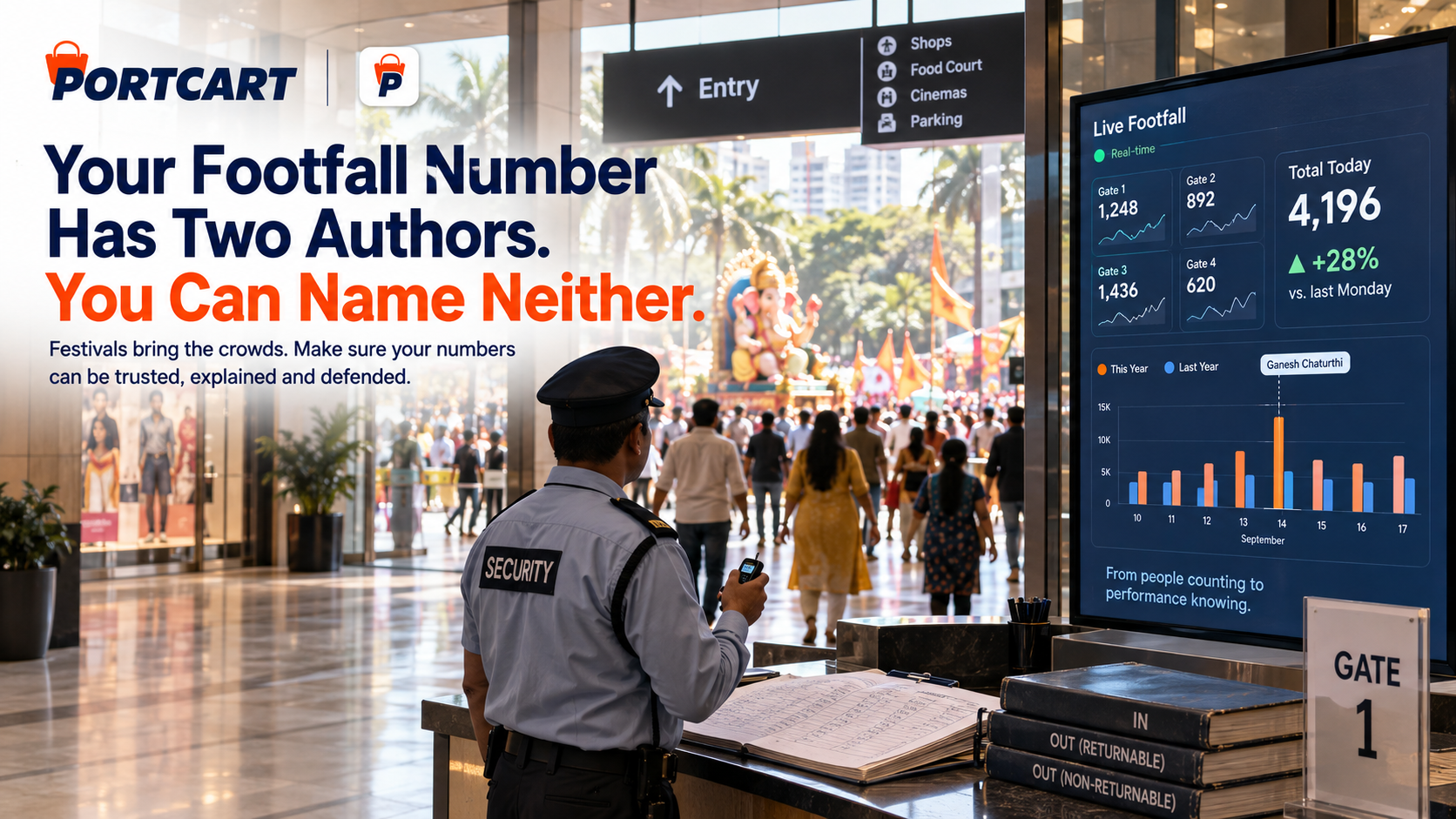
Ganesh Chaturthi falls on Monday, and for ten days the streets around a great many Indian malls will belong to processions, pandals and road closures. Gates will open and close around the neighbourhood's rhythm. Evenings will surge. Visarjan day will empty some catchments and flood others.
When it is over, the mall will quote a number for the week. It will appear in a festive report, a brand partner's campaign summary and, before long, a renewal deck: footfall up during Ganeshotsav, with a percentage attached.
Now ask a simple question about the peak day. Who counted at Gate 3?
Every footfall number is written by two people
At most Indian malls, at least some gates are still counted by a person. Someone stood at the entrance for a shift with a clicker or a tally sheet. Where sensors exist, someone still reads the output, reconciles it against the other gates and carries it into a spreadsheet.
So a footfall figure always has two authors. The first is the person who counted. The second is the person who typed the number into the place it is now quoted from. They are almost always different people, on different shifts, sometimes in different departments.
Ask a mall to name them for a date three weeks ago and the answer is usually silence, then a search through a shared drive.
That silence is the problem. A number whose authors cannot be named is not a record. It is an estimate wearing a uniform.
Three rooms where the number gets challenged
This would not matter if footfall stayed inside the operations team. It does not. It travels to the three conversations where the mall has the most to lose.
The rent review. Leasing quotes the Ganeshotsav uplift to justify the renewal terms. The tenant, whose own tills did not move as much, asks how the figure was arrived at. If the honest answer is "security counts it and someone enters it", the negotiation has just moved onto the tenant's numbers instead.
The campaign report. A brand partner paid for a festive activation on the promise of the week's traffic. Their report shows what they sold. The mall's shows what it counted. When the two disagree, only one side can say who produced their figure.
The board pack. The festive quarter is judged on a handful of numbers, and footfall is always one of them. It takes one pointed question from an asset manager, "how confident are we in this?", to turn a good quarter's narrative into an argument about method.
In all three, the mall is not losing because its count was wrong. It is losing because it cannot show where the count came from.
The correction that doubles the day
There is a second failure hiding in most footfall sheets, and it is quieter.
Counts get corrected. A gate was missed, a shift double-entered, a sensor read against the wrong day. The correction is made by adding a new row with the right figure. The old row stays. Three months later, a report that sums the sheet counts the festival's biggest day twice, and nobody knows, because the sheet has no idea which of the two figures is the live one.
A footfall record should have one answer per gate per day. A correction should replace the original, and the original should still be visible so the change can be explained. Most sheets do neither, which is how a year's footfall quietly inflates without anyone deciding it should.
The gate that was closed for the procession
The third gap is the one Ganeshotsav exposes most sharply.
On visarjan day, the road outside Gate 2 is closed from the afternoon and the gate with it. The day's total drops. Anyone reading the sheet later sees a weak day. The mall knows why, but only in someone's memory, because the reading was never tied to a gate.
A mall knows its own gates better than anyone. A footfall figure that cannot be broken down by gate cannot be explained when the explanation is a gate. And during a festival week, the explanation is usually a gate.
Four questions about last Ganeshotsav's peak day
Ask these in the operations meeting before this year's figures are quoted anywhere:
- Who counted at each gate that day, by name?
- Who entered the figure into the sheet the number is now quoted from?
- Was any figure for that week corrected afterwards, and does the original still exist alongside the correction?
- Which gate drove the total, and which gate was closed or reduced, and for how long?
If all four have answers, the mall's footfall is a record and this article owes you nothing. If two or more do not, every uplift figure built on that week is an estimate, and the mall should decide whether it wants to negotiate on estimates.
What an accountable count looks like
None of this needs more sensors. It needs the number to keep its authors.
- Every reading carries the name of the person who counted and the identity of the person who recorded it, separately, because they are different people with different responsibilities.
- Every reading belongs to a gate, and the gates are the mall's own, named the way the mall names them.
- A day has one live figure per gate. A correction replaces it and the original stays visible.
- The question "how many on the peak day, and how do we know" has an answer that does not depend on anyone's memory.
The difference is not precision. A clicker count is a clicker count. The difference is that the figure can be defended by the mall rather than merely asserted by it.
Where Portcart fits
Portcart is built to give malls one view of the shopper journey: discovery, engagement and commercial activity in a single measurable line. Footfall is the first number on that line, and Portcart is built to record it as an accountable reading: per gate, per day, carrying who counted and who recorded, with corrections that replace rather than add. The count does not become more precise. It becomes a number the mall can stand behind in a renewal.
The meeting worth having
Ganeshotsav starts on Monday. The figures it produces will be quoted for the rest of the year.
Before the first of them reaches a renewal deck, ask the first question in the operations meeting and see whether it has an answer. If it does not, book a Footfall Accountability Review with us. It is a working session on how your footfall is counted, recorded, corrected and quoted today, and what needs to be in place before the festive quarter's numbers are used in a negotiation. Bring last Ganeshotsav's peak-day figure and the sheet it came from. The gap between the number and its authors is the subject.