Tenant Sales Reporting Under GST: The Reporting Plumbing Most Malls Get Wrong
Most Indian malls receive tenant sales reports via PDF or email attachments, manually reconcile them against MG-vs-revenue-share calculations, and chase missing reports for 90+ days each quarter. A modern reporting plumbing fixes this.
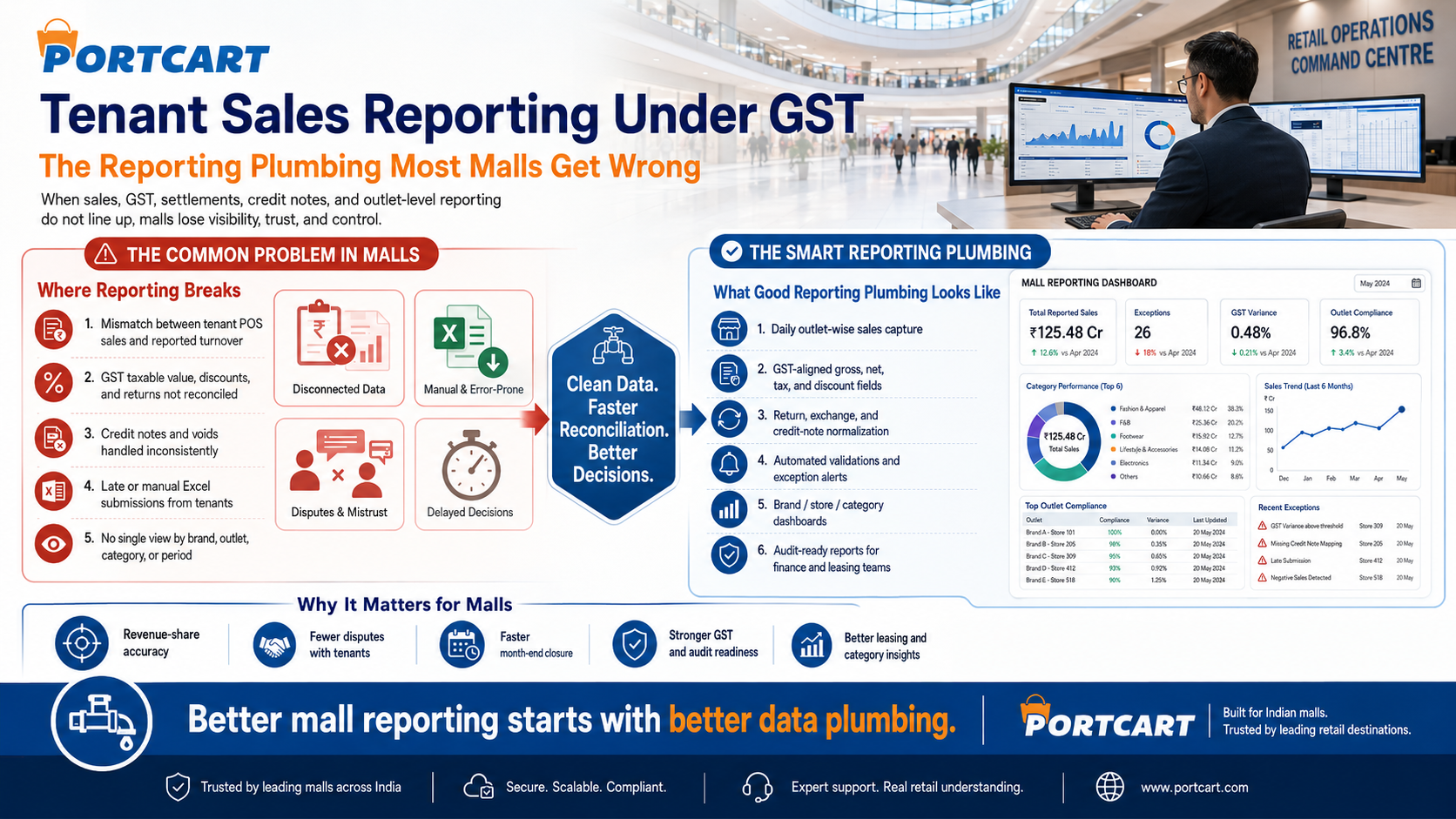
Most Indian mall operators run tenant sales reporting on the same plumbing they used in 2015. PDF or Excel attachments arrive at month-end. The finance team transcribes them into a master spreadsheet. The lease accountant cross-checks the numbers against the rent agreement's MG-vs-revenue-share clauses. Disputes emerge in 8-12 percent of tenant-months. Reconciliation closes 20-40 days after the month ends, often coinciding with the next round of disputes from the new month. This is the operational debt that compounds across the 80+ tenants of a typical mall, and the fix is not a better Excel template.
This is the operational debt that compounds across the 80+ tenants of a typical mall. The fix is not a better Excel template. It is a different operating model: standardised reporting plumbing that handles GST treatment, MG-vs-revenue-share calculation, and dispute audit trails as a single coherent flow.
Why the current state is so bad
Five compounding problems:
1. No standard schema. Each brand reports in its own format. Some send gross GST-inclusive numbers. Some send net of GST. Some include returns. Some don't. Some break out online vs in-store. Mall finance teams spend half their reconciliation time normalising the inputs before they can do any math.
2. Manual MG-vs-revenue-share math. A typical mall has 5-8 different rent structures across its tenant base (different MG floors, different revenue share rates, different exclusion clauses for online sales, different escalation clauses). The rent accountant runs these calculations manually each month per tenant. Error rate is high.
3. GST treatment varies by tenant category. Apparel is 12%. Electronics is mostly 18%. F&B with AC at 5%, without at 5%. Jewellery at 3%. The mall's revenue-share calculation has to apply different GST treatments to net out the right base. Most operators forget this and apply a uniform deduction.
4. Returns and refunds handled inconsistently. Some tenants report gross-of-returns. Some net. The variance matters because returns are 8-15% of gross in fashion and electronics, and roughly zero in F&B and jewellery. Misclassification creates persistent under or over-billing.
5. Audit trail is thin. Once the monthly rent is settled, the underlying tenant reports often get filed and forgotten. Six months later when a tenant disputes a revenue-share calculation, reconstructing the basis is painful.
What a modern reporting plumbing looks like
Five operational capabilities:
Capability 1: Tenant self-service reporting portal
Each tenant logs into a portal and either uploads a structured CSV with their monthly numbers OR connects their POS via API for automated daily reporting. The portal enforces a standard schema: gross sales, GST collected, returns, net sales, online vs in-store split, voucher redemption against the tenant.
Capability 2: Auto-calculated rent
The system stores each tenant's rent agreement structure (MG, revenue share rate, escalation, exclusions) as data. On report submission, it automatically computes:
- Revenue share at the agreed rate
- MG comparison
- Higher of the two becomes the rent
- GST on rent
- Final invoice line items
The tenant sees the calculation immediately. Disputes happen at submission, not at month-end.
Capability 3: Per-category GST handling
The system stores tenant category and applies the correct GST treatment automatically. Apparel tenants get 12% deduction logic, F&B tenants get 5%, etc. No manual lookups.
Capability 4: Voucher / loyalty redemption reconciliation
Voucher redemptions and loyalty point spend at the tenant flow into the same reporting view. The mall's voucher ledger and the tenant's POS report are reconciled per voucher. Differences flag immediately.
Capability 5: Audit-grade history
Every submission, every calculation, every dispute resolution is stored as an immutable event row. Six months later when a tenant asks "why did you bill me ₹4.2 lakh in May," the system shows the input report, the calculation, the rent invoice, and any subsequent adjustments with timestamps.
What this changes operationally
Before:
- Reports arrive month-end via email
- Finance transcribes for 5-10 days
- Rent invoices issue 12-15 days into the next month
- Disputes accumulate, get resolved 30-60 days later
- Audit any specific month requires file archaeology
After:
- Tenants submit via portal daily / weekly / monthly per their preference
- Rent invoices auto-generate the day after month-end
- Disputes happen at submission, resolved within days
- Full audit trail one-click accessible
The cycle-time compression alone is worth 3-5 working days per finance team member per month. The dispute reduction is worth 1-2 percent of total rent revenue (no more "we agreed differently" arguments two quarters later).
The DPDP overlay
Tenant reporting data is commercial, not personal. DPDP doesn't apply directly. But the mall does need to ensure the tenant's customer PII (which sometimes leaks into POS exports as customer names attached to transactions) gets stripped before storage. A well-designed reporting portal validates incoming uploads and rejects anything that looks like personal data leaking in.
GST e-invoicing: the bigger wave
India's GST e-invoicing mandate is steadily expanding. By 2026 most B2B transactions over ₹5 crore aggregate turnover require IRN-stamped e-invoices. Mall rent invoicing falls under this. A reporting plumbing built today should generate IRN-compliant invoices natively, not as a bolt-on.
Frequently asked questions
Do tenants resist a portal-based reporting approach?
Some initial resistance from tenants who prefer the opacity of monthly PDFs. But once they see faster invoice cycles and faster dispute resolution, most embrace it. Building the portal as a "free" service for tenants helps; framing it as "you must now use our system" hurts.
What's the right enforcement for tenants who don't report on time?
Late-reporting penalty clauses in the lease agreement, escalating after 7 days. Most tenants self-correct after the first penalty.
Does this work for kiosks and small-format tenants?
Yes. Kiosks should be on the same portal with simpler data entry fields (no online vs in-store split, no returns column).
How does this integrate with the mall's GST filing?
The mall's monthly GSTR-1 and GSTR-3B can pull rent invoice data directly from the reporting plumbing. Cuts compilation time by 60-80 percent.
How Portcart handles this
The reporting plumbing pattern above maps onto Portcart's leasing and reporting modules.
- [leasing pipeline](/modules): captures rent agreement structures as structured data: MG, revenue share rate, escalation clauses, exclusions, GST treatment per tenant category.
- [Voucher Management](/modules): same maker-checker audit pattern extended to tenant report submissions; every submission and calculation is immutable.
- [Loyalty Ledger](/modules): voucher and loyalty redemption per tenant reconciles automatically against the tenant's POS report.
- Tenant portal (in development): self-service report upload, real-time rent calculation, dispute submission, audit history.
If your mall finance team is still doing monthly tenant reconciliation in spreadsheets, request a demo and we'll model the cycle-time and dispute-reduction benefit on your actual tenant base.