Generating Brand Demand for Your Mall Without Exposing Inventory
Mall leasing teams want brand interest in writing without publishing rental terms or available space publicly. The discreet leasing playbook that works.
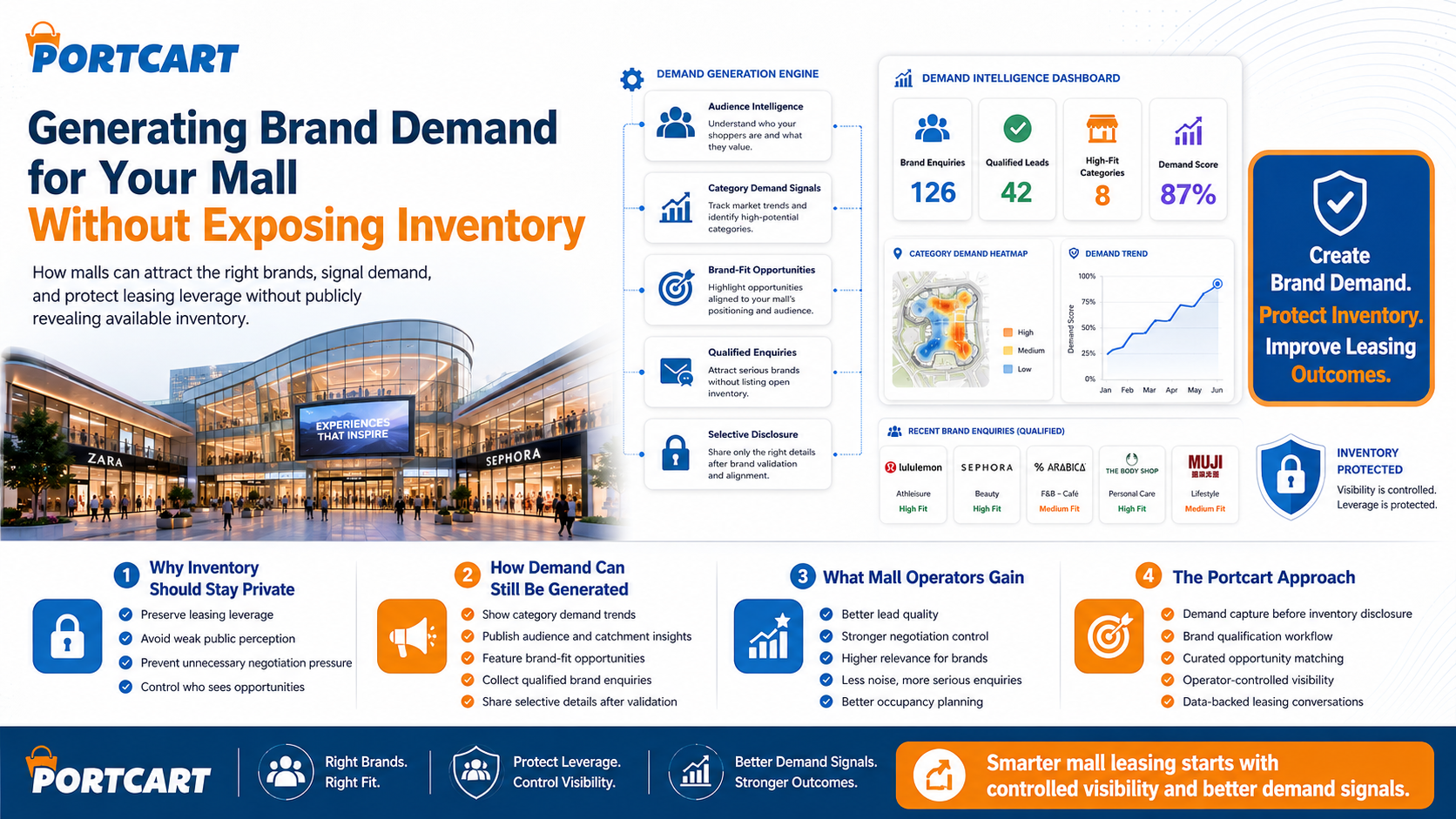
A mall leasing team is in a peculiar position. They want every brand in their target list to know about every available space, but they cannot publish either to the open web. Rental terms are commercially sensitive. Available inventory is competitively sensitive. Brand outreach lists are operationally sensitive. And yet the leasing pipeline still has to fill 60 to 100 new tenant slots over a 3-5 year mall planning cycle. The traditional outreach path is breaking, and the replacement is a structured inbound capture flow.
This piece is the discreet leasing playbook. Specifically: how to capture brand interest in writing, route it efficiently to the leasing team, and convert it to term sheets, without ever exposing commercial detail to the open web or to competing malls.
Why traditional leasing outreach is breaking
Three structural shifts in 2024-2026 are forcing a rethink:
D2C brands rarely have a retail strategy department. The traditional outreach path (call the head of retail expansion) doesn't work for brands like Boat, Mokobara, The Souled Store, Snitch, or Sleepyhead. They have a founder-led decision on physical retail. Cold outreach lands poorly because the founder isn't tracking inbound the way a corporate retail head is.
International brand entries happen through India representatives. Tim Hortons in India runs through Restaurant Brands Asia. Pret a Manger runs through Reliance Brands. The actual decision-makers are 1-2 layers removed from the global brand. Cold outreach to the global brand goes nowhere.
Smaller mall operators are competing for the same brands. The brand has 8 inbounds from 8 different mall operators, all asking for a meeting. They take meetings with the top 2. Smaller malls lose by default unless their outreach signal is stronger.
The fix is a structured inbound capture flow that does the work the outreach phone calls used to do.
The structured inbound capture flow
Five components:
Component 1: Brand-visible expression-of-interest form
A simple form, visible to anyone (brand reps, real estate agents, founders) browsing the mall's website. Three to five fields:
- Brand name
- Category (apparel, F&B, electronics, beauty, services, etc.)
- Store size preferred (range)
- City/region preference
- Notes (optional)
No "what's your budget" or "share your last 12 months sales." The form is designed for the brand to give a low-commitment signal. The conversation deepens from there.
Component 2: Routing engine that hits the leasing team within hours
Submission triggers immediate notification to the leasing director. Form data plus a complete brand profile lands in their inbox or CRM.
For top-tier brand inbounds, the SLA is a personalised reply within 4 hours during business hours, 24 hours otherwise. Speed signals seriousness.
Component 3: Private term-sheet conversation, not public listing
The mall's response to a qualifying inbound never includes rental terms in writing on first contact. The opening reply is qualitative: positioning, catchment data, footfall benchmarks, existing tenant mix, available zones in general terms. Terms come later, in person or on a call, after both sides have qualified each other.
Component 4: Selective inventory exposure
For the brands the mall actively wants, the leasing team can share specific available units with floor plans. For everyone else, the response is "we have space in your category, let's discuss." The leasing team controls the exposure.
Component 5: Pipeline tracking and follow-up cadence
Every inbound enters a pipeline with stages (new / qualified / term-sheet-shared / signed / declined). Follow-up cadence per stage prevents leads going cold. Most brand decisions take 6-18 months from first contact to opening; the leasing team needs to maintain warm contact across that window.
What this lets the leasing team stop doing
Three traditional activities that become unnecessary:
- Cold outreach phone calls. Replaced by qualified inbounds with stated category intent.
- In-person brand events to "showcase" the mall. Inbounds are pre-qualified, no need for generic outreach events.
- Publishing tenant-mix gaps to drive interest. The form does this discreetly, brand by brand.
What replaces them: shorter-form, more frequent, more qualified conversations. Same leasing team, more output.
What this lets the leasing team start doing
Three higher-leverage activities the time freed up enables:
- Deeper diligence on top-tier inbounds. When a Mokobara expression of interest lands, the leasing team can spend a full hour preparing a thoughtful response with specific store ideas, catchment data, neighbouring brand context.
- AI-assisted leasing decks for top inbounds. Auto-generated first drafts of pitch decks per brand based on inbound data plus mall positioning, polished by humans in 30 minutes instead of built from scratch over 2 days.
- Strategic outbound to fill specific gaps. When the mall identifies a missing premium dessert tenant, outbound is targeted to 5 specific brands with thoughtful pitches, not 50 with generic ones.
The brand-claim flow extension
Once the brand-interest form is in place, an adjacent capability becomes important: brand-claim flows for existing brand presence.
If a brand already operates in your mall, they should be able to claim their listing page in your discovery layer (brand directory) and manage their own content: menu, offers, photos, store hours. This isn't just operational hygiene. It's a leasing signal too. Brands managing their own listings are demonstrating engagement that aids renewal conversations.
The financial case
A metro mall doing 1.5 crore annual footfall, with a healthy leasing pipeline, signs 12 to 20 new tenants a year. Each signed tenant represents ₹40 lakh to ₹2 crore in annual base rent + revenue share over the lease term.
A discreet inbound capture flow that adds even 3 incremental signed tenants per year adds ₹1.5 to 6 crore in annual revenue. Most malls with the right operating systems and brand positioning land 5-8 incremental signs per year vs old-school outbound.
Frequently asked questions
Will brands really fill out a form?
Brands at expansion stage fill out forms when they're trying to enter multiple cities. They want a low-effort way to signal interest at scale. Yes.
Doesn't this expose the mall to spammy inbounds?
The form gets some noise. The routing engine filters obvious spam (no brand name, no category, contact details that don't validate). Real spam volume is low because the form is on the mall's own site, not a third-party aggregator.
What if a brand says yes via the form but then declines after seeing terms?
That's the normal funnel. The form captures top-of-funnel intent. The conversion to signed lease is the leasing team's work. The form just gets you to the table with more brands than cold outreach can.
Should the form be on the mall's marketing website or a separate leasing portal?
Marketing website. Higher visibility, better SEO. A "Lease Space at [Mall Name]" or "Partner With Us" link in the main footer.
How Portcart handles this
The discreet inbound capture flow maps onto Portcart's Leasing module.
- [leasing pipeline](/modules): public-facing brand interest form, automatic routing to the leasing team, pipeline tracking, private term-sheet conversation thread, selective inventory exposure controls.
- [brand pages](/modules): brand-claim flow so existing tenants can manage their own listing pages.
- [AI tenant-mix suggestions](/modules): auto-suggests matching brands from a global catalogue based on the mall's positioning and existing tenant gaps.
If your mall's leasing pipeline still runs on cold outreach and PDF brochures, request a demo and we'll model the inbound capture flow against your current pipeline conversion rates.