Mall Leasing Software in India: 11 Questions to Ask Before You Buy
The mall leasing software market in India in 2026 is crowded but uneven. Eleven specific buyer questions that separate platforms ready for Indian malls from generic CRMs with a leasing label.
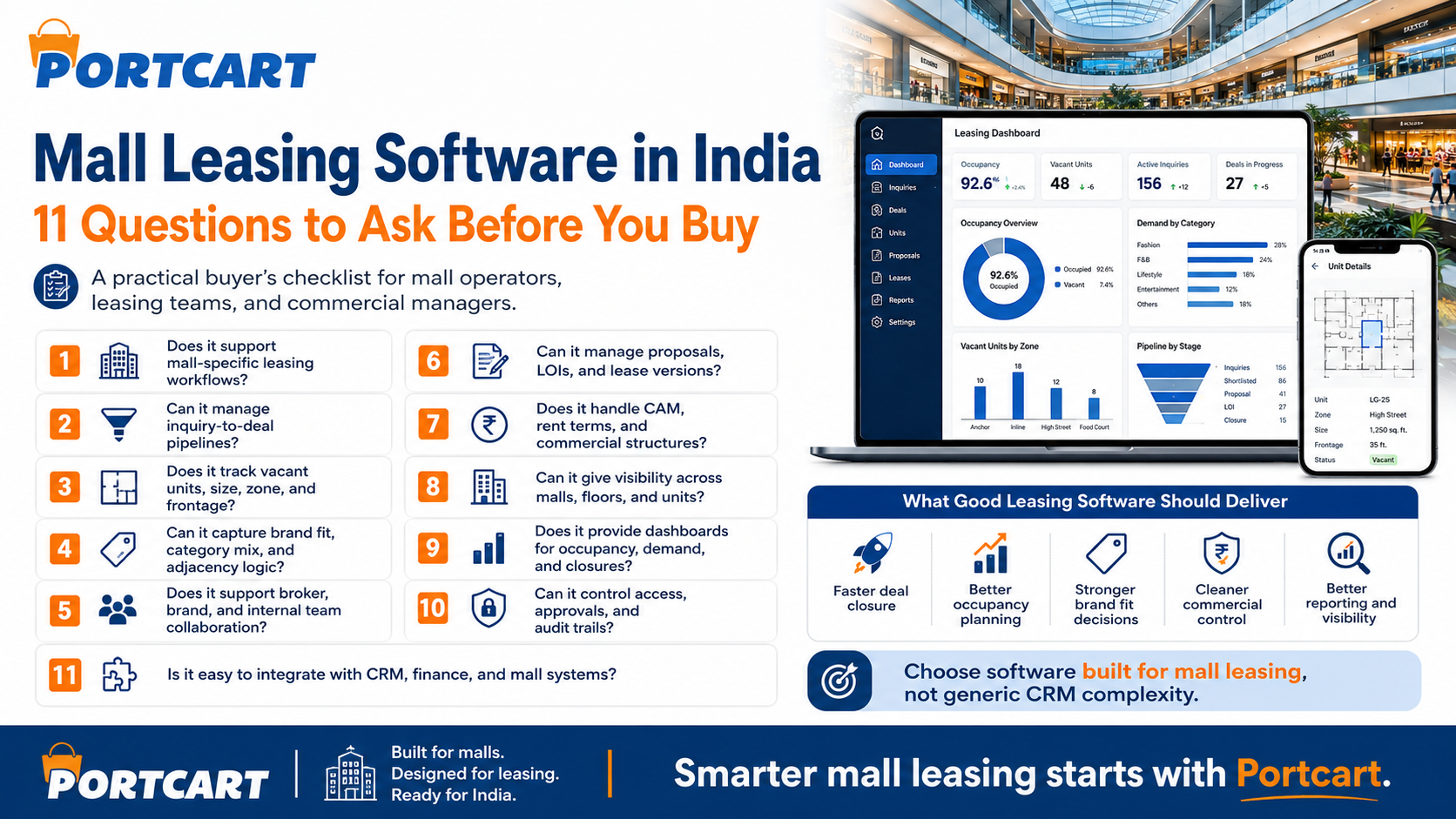
The mall leasing software market in India has three flavours of vendor: legacy enterprise CRMs with a real estate add-on, real-estate-specific platforms from global vendors, and India-built mall management platforms with leasing modules. All of them describe themselves the same way in their sales pitches. Most of them solve a different problem than the one mall leasing teams in India actually face. This is the 11 specific buyer questions that separate platforms ready for Indian malls from generic CRMs with a leasing label.
All of them describe themselves the same way in their sales pitches. Most of them solve a different problem than the one mall leasing teams in India actually face.
This piece is the 11 specific buyer questions that separate platforms ready for Indian malls from generic CRMs with a leasing label.
The questions
1. Does the platform model India's MG-vs-revenue-share rent structure as data, not as free text?
Indian mall rent is rarely flat. It's almost always: minimum guarantee floor + revenue share rate + escalation clauses + exclusions for online sales or specific categories. The platform should store all of this as structured fields per tenant, automatically compute the monthly rent invoice, and surface variance vs the prior month. If it stores rent as a single number field with a notes column, walk away.
2. Does it handle GST treatment per tenant category automatically?
Different categories carry different GST rates. The platform's rent calculation has to apply the right rate to the right tenant without manual lookup. If your leasing director ends up running spreadsheets alongside the platform to get GST right, the platform isn't doing its job.
3. Can it integrate with the tenant's POS for daily sales reporting?
The platform should support both API integration (for tenants on modern POS systems) and structured CSV upload (for tenants on older systems). Mall-level support for monthly PDF reports is acceptable as a fallback, but the platform should treat that as the legacy path, not the primary path.
4. Does it auto-route brand expressions of interest to the leasing team?
Inbound leasing inquiries from brands hitting the mall's website should flow into the platform automatically, with the brand's key details attached, with notifications to the leasing director within minutes. If lead capture requires manual data entry by an admin, half the leads will be lost in 2026.
5. Does it support a tenant-facing portal where tenants can submit sales reports, see rent invoices, and dispute charges?
Tenant self-service cuts the leasing team's operational load by 40-60 percent. The portal should expose sales report submission, rent invoice history, voucher redemption reconciliation, and dispute submission. Platforms without tenant-facing UI keep the operational load on your team forever.
6. Does it track CAM and Marketing Contribution Charge as separate first-class lines from base rent?
Indian mall billing has at least 3-5 distinct line items per tenant per month: base rent, CAM, marketing contribution, security charges, utility recovery. The platform should model these as separate billable streams with separate reconciliation logic. Platforms that lump them into "rent" create permanent reconciliation pain.
7. Does it produce audit-grade history for every rent calculation, dispute, and adjustment?
When a tenant disputes a charge from 9 months ago, the platform should one-click produce the underlying inputs, calculation, invoice, and any subsequent adjustments. If reconstructing this requires archeology across spreadsheets and emails, the platform is failing audit.
8. Does it generate IRN-compliant GST e-invoices natively?
India's e-invoicing mandate covers most B2B rent transactions. The platform should generate IRN-stamped invoices through the GSTN API, not require a separate bolt-on or post-process. Otherwise GST filing is a second monthly project.
9. Does it surface tenant performance benchmarks for leasing decisions?
When considering whether to renew a tenant or replace them, the leasing director needs comparative data: revenue per sq ft vs comparable tenants, footfall conversion, voucher campaign participation, tenant tenure. The platform should produce these views without custom reports.
10. Does it model anchor vs in-line vs kiosk differently?
Anchor tenants (Westside, Lifestyle, Pantaloons) have wildly different lease structures than in-line tenants, which differ from kiosks. The platform should let you configure all three without bolted-on workarounds.
11. Is the data exportable on demand?
You'll switch platforms eventually. Or you'll need to feed data into your accounting system. Or auditors will need flat files. The platform should let you export every entity (tenants, rents, calculations, disputes, history) as CSV or JSON without a special services engagement.
What good answers look like
A vendor that can answer "yes, here's the screenshot" or "yes, here's the API endpoint" to all 11 questions is built for Indian mall operations.
A vendor that answers "we can build that for you" or "it's on the roadmap" to more than 2 of the 11 is selling a project, not a product. The implementation cost will be larger than the licence cost, the project will run 6-18 months, and the operations team will spend the first year fighting the platform instead of using it.
Red flags in vendor pitches
Five red flags worth treating as deal-breakers:
- "We're built on Salesforce / Hubspot / NetSuite": usually means India-specific edge cases (GST, e-invoicing, MG-vs-revenue-share math) aren't first-class
- "You can configure that": usually means you'll spend 200+ hours of admin time configuring something that should work out of the box
- "We have a partner who can integrate that": usually means a 6-figure professional services engagement that they get a cut of
- "Our analytics dashboard handles that": usually means a static report, not actual operational decision support
- "We're trusted by leading retailers globally": usually means they sell to brands, not mall operators, and the operations are different
The price-to-value question
Indian mall leasing software lands in three price bands as of 2026:
- Enterprise-built (MRI, Yardi): ₹15-40 lakh annual licence + ₹20-80 lakh implementation. Powerful but slow to deploy and over-specified for Tier-2 malls.
- India-built mall platforms: ₹3-12 lakh annual licence + ₹2-8 lakh implementation. Right-sized for most Indian malls.
- Bespoke builds: ₹15-40 lakh build cost + ongoing ₹3-8 lakh maintenance. Hard to justify unless you have very unusual requirements.
Most healthy Indian malls (3-7 lakh sq ft, 60-120 tenants) get the best value from India-built platforms. The enterprise tier is over-investment unless you have an unusual scale or specific corporate requirements.
Frequently asked questions
How long should implementation take?
For an India-built platform on a mid-sized mall, 90 days from contract signing to fully live including all tenants migrated. Anything longer suggests over-customisation or under-resourced vendor.
Should we build vs buy?
Almost certainly buy. The build cost is high, the maintenance cost is higher, and the time-to-value is poor. Build only if you have very specific requirements no platform handles.
What's the right team to run it?
A leasing director (decisions), a leasing operations analyst (day-to-day), and access to a finance team member for rent calculation oversight. Most malls overstaff the leasing operations function with junior admins; better tooling means smaller, more senior team.
How Portcart handles this
Portcart's leasing capabilities answer "yes" to all 11 questions above.
- [leasing pipeline](/modules): MG-vs-revenue-share as structured data, GST per category, IRN e-invoice generation, audit-grade history.
- [brand pages](/modules): public brand-claim flow, brand-side self-service listing management.
- [Voucher Management](/modules): voucher and loyalty redemption reconciliation per tenant.
- Tenant portal (in development): self-service report submission, invoice history, dispute submission.
If you're evaluating mall leasing software in 2026, request a demo and we'll run the 11 questions against your specific operational requirements.