Restaurant Tenant Mix: QSR, Casual Dining, and Fine Dining in Indian Malls
Get the restaurant mix wrong and a mall has five burger joints and nowhere for a family dinner. The F&B tenant mix is a footfall design decision, not a leasing afterthought.
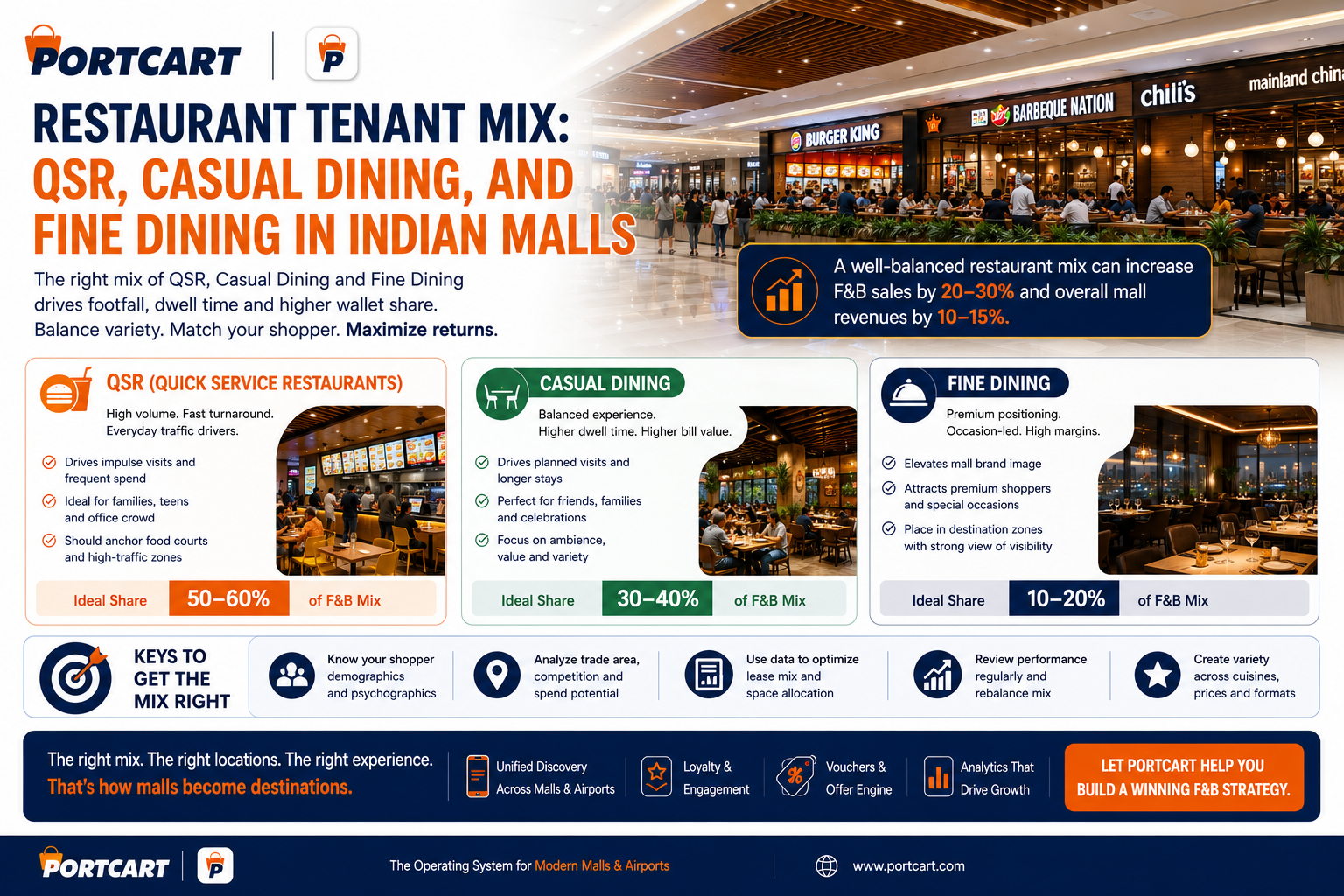
Get the restaurant mix wrong and a mall ends up with five near-identical burger counters and nowhere to take a family for dinner. Get it right and the F&B floor serves every occasion a visitor might have, from a quick bite between shops to a celebration meal, and each occasion is a reason to come and a reason to stay. The restaurant tenant mix is a footfall design decision, not a leasing afterthought, and treating it as the latter is how malls end up with a crowded, redundant, occasion-poor food offer.
Why the mix is a footfall decision
A mall does not really sell square feet to restaurants. It sells dining occasions to shoppers, and the restaurant mix is how it stocks those occasions. A teenager wants a quick, cheap bite with friends. A working couple wants a relaxed dinner. A family wants somewhere the kids will eat and the adults will enjoy. A shopper mid-trip wants a coffee and a pause. Each of those is a different format, and a mall that only stocks one or two occasions simply loses the others to the high street or to home.
Because F&B is one of the strongest reasons people choose to spend time at a mall, the mix directly drives footfall and dwell. That makes it a strategic decision owned by whoever thinks about the mall's pull, not a line-by-line leasing exercise that fills F&B space with whoever bids.
The formats, and the occasions they serve
QSR, quick-service restaurants. Fast, affordable, high-throughput. They serve the between-shops bite, the teenage hangout, the food-court speed occasion. High footfall, quick turnover, lower spend per head.
Casual dining. Sit-down, mid-priced, the workhorse of mall F&B. It serves the family meal, the catch-up with friends, the relaxed lunch. Longer dwell, higher spend, and a genuine destination occasion that brings people specifically to eat.
Fine dining. Premium, occasion-led. It anchors the mall as a place for celebrations and date nights, lifts the perception of the whole centre, and draws an affluent visitor who shops accordingly. Fewer covers, much higher spend, strong halo effect.
Cafes. The pause-and-linger format. Coffee, light bites, a place to rest and extend a visit. They lengthen dwell more than they drive a dedicated trip.
Kiosks and grab-and-go. Impulse and convenience. Ice cream, beverages, snacks placed where footfall is highest, capturing spend that needs no sit-down.
A complete mall covers all of these, because each fills an occasion the others cannot.
The common failure: over-concentration
The most frequent F&B mix mistake is over-concentration in one or two formats, usually QSR, because QSR brands are plentiful, expand aggressively, and bid for space. The result is a food offer that is busy but shallow: plenty of quick bites, nothing for a family dinner, no occasion that anchors a dedicated visit.
Over-concentration also means the outlets cannibalise each other. Five similar QSR brands compete for the same between-shops bite while the casual-dining and fine-dining occasions go unserved entirely. The mall is full of restaurants and still loses the dinner crowd to the high street. The fix is to design for occasion coverage first and let that discipline override the temptation to simply lease to the most eager bidders.
A worked mix logic
Start from the catchment and the occasions worth winning. A mall in a young, dense, value-conscious catchment may rightly weight toward QSR and casual dining, with cafes and kiosks for dwell, and one or two aspirational full-service anchors. A mall serving an affluent catchment can support more fine dining and premium casual, with QSR as the everyday layer. The arithmetic is occasion-led: list the dining occasions in your catchment, weight them by how often they happen and how much they spend, and build the mix to cover them, then check no single format is so concentrated that its outlets fight each other. Lease to fill the gaps the design reveals, not to fill space with whoever is available.
The anchor restaurant question
One decision sits above the rest of the mix: whether to court a destination restaurant as an F&B anchor, and what to give up for it. An anchor restaurant is the place people drive across the city for, the one that turns a meal into the reason for the trip rather than an add-on to shopping. It is to the F&B floor what a flagship brand is to the apparel floor.
Landing one usually costs something. The anchor will want a prime location, a generous fit-out arrangement, and often softer commercial terms than a standard outlet, because it knows it brings footfall the mall cannot generate on its own. The question for the operator is whether the dedicated trips, the dwell, and the halo on the whole centre justify the concession on terms.
The honest way to decide is the same second calculation that governs the food court: do not judge the anchor on its own rent line, judge it on the footfall and cross-category spend it pulls into the mall. An anchor that draws a thousand dedicated dining trips a month, many of which extend into shopping, can be worth more than a higher-paying outlet that draws no one specifically. The trap is to evaluate the anchor on its rent versus the next bidder and conclude it is too expensive, missing that the next bidder brings no dedicated footfall at all. Get the anchor right and it does for the F&B floor what a department store once did for the mall: it gives people a reason to come that is bigger than browsing. Get greedy on its terms and lose it, and the F&B floor becomes a collection of outlets with no gravitational centre.
A restaurant tenant mix checklist
- Design the mix around dining occasions in the catchment, not the number of outlets.
- Cover all the core formats: QSR, casual dining, fine dining, cafes, kiosks.
- Anchor with at least one or two full-service destinations that draw a dedicated dining trip.
- Avoid over-concentration: no single format so dense that outlets cannibalise each other.
- Match the weighting to the catchment, value-led versus affluent, young versus family.
- Place kiosks and grab-and-go where footfall is highest, for impulse capture.
- Review the mix against actual covers and spend, and re-balance as occasions shift.
What good looks like
A mall with the right restaurant mix can serve any reason a visitor has to eat: a fast bite, a family dinner, a celebration, a coffee break, an impulse treat. Each occasion is a reason to come and a reason to linger, and the F&B floor pulls footfall the rest of the mall converts. The leasing followed a footfall design rather than the other way round, and it shows in the dwell and the repeat visits.
If your F&B floor is heavy on quick bites and light on places for a proper meal, the first move is to map the dining occasions your catchment actually has against what you currently offer. The gaps in that map are your leasing brief, and they are almost always at the casual-dining and fine-dining end, not the QSR end.
Portcart Team. Built for mall and airport operators in India.