The Food Court P&L: Structuring F&B Economics for an Indian Mall
A food court is the busiest part of most Indian malls and, per square foot of rent, often the least profitable. That paradox is why food-court economics get misread. It is a footfall engine, not a rent play.
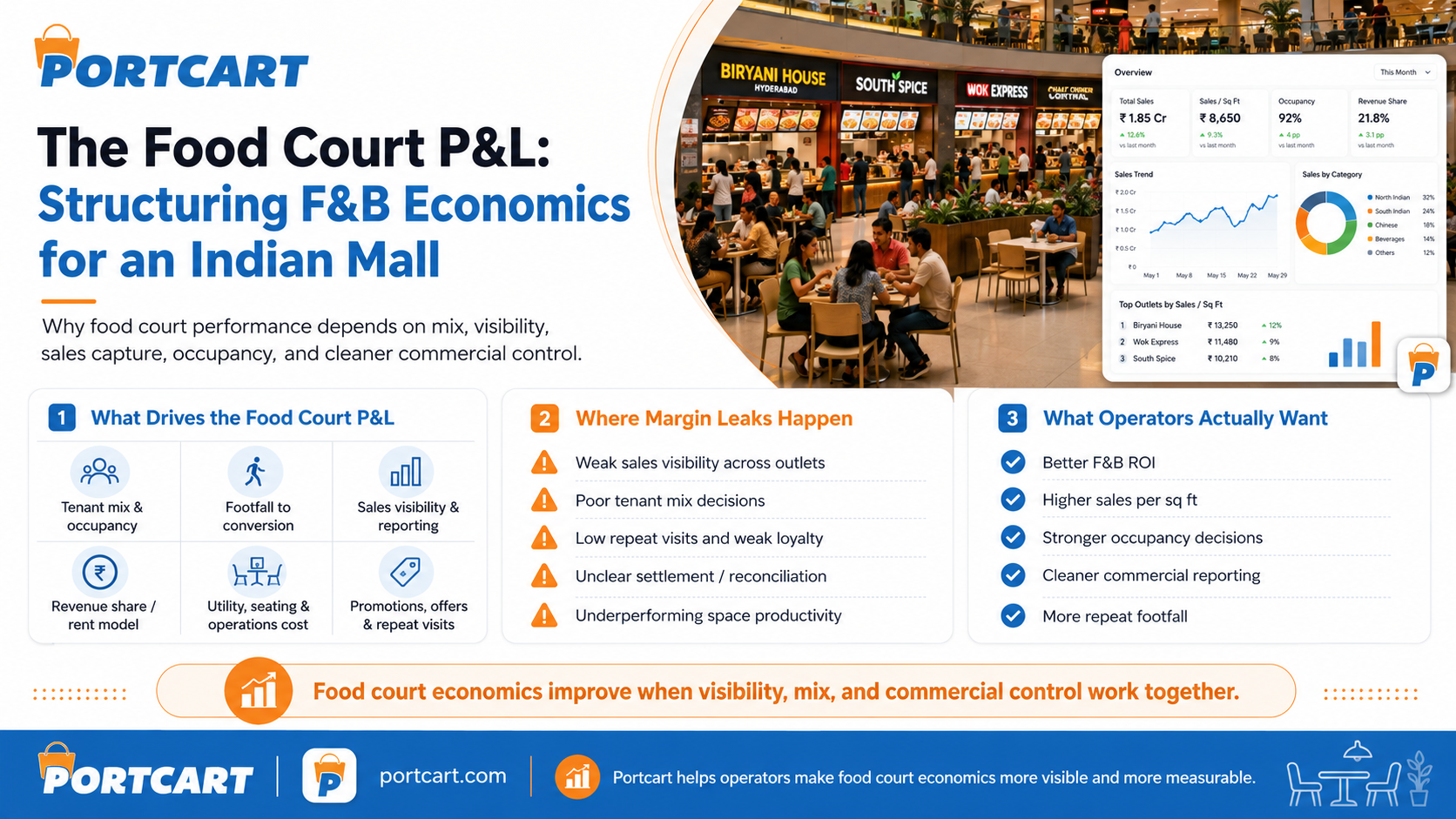
A food court is the busiest part of most Indian malls and, measured purely by rent per square foot, often one of the least profitable spaces in the building. That paradox, packed tables next to a thin rent line, is exactly why food-court economics get misread. An operator who runs the food court like the rest of the leased floor, chasing rent per square foot, will undervalue it or starve it. The food court is not a rent play. It is a footfall engine, and its P&L has to be read on different terms from the apparel floor.
The paradox: busy but low on rent per square foot
Walk any successful Indian mall at lunchtime and the food court is the densest, liveliest space in it. Now look at the rent it generates per square foot and it often trails the apparel and electronics floors. Operators who stop there conclude the food court is a necessary cost rather than a profit centre, and they treat it accordingly: minimal investment, lowest-bidder operators, tired fit-out.
That conclusion is a measurement error. The food court's value does not show up in its own rent line. It shows up in the footfall it draws, the dwell time it creates, and the spend that dwell unlocks across every other category in the mall. Judge it on its rent alone and you will systematically underfund the thing that fills the building.
How food-court tenancy is actually structured
Most Indian mall food courts do not run on the fixed rent-plus-CAM model of an apparel store. They run closer to a concession: the operator takes a share of each outlet's revenue, usually with a minimum guarantee as a floor, and often provides the common infrastructure. This aligns the operator with the outlets, when sales rise the operator earns more, and gives the operator a reason to drive footfall to the court rather than just collect rent.
It also means the food court P&L is a revenue-share P&L, not a rent roll. The operator's income moves with how well the court trades, which is why the operator has a direct stake in seating quality, cleanliness, hours, and the mix of cuisines, all of which drive court sales and therefore the operator's share.
The operator's real return: footfall and dwell
The honest way to value a food court is to ask what the mall would lose without it. The answer is not a slice of rent. It is the families who come for lunch and stay to shop, the shoppers who extend a visit because there is somewhere good to eat, the teenagers who treat the court as a hangout and spend across the mall around it. F&B is one of the strongest reasons people choose to spend an afternoon at a mall rather than order in.
That is the return: incremental footfall and longer dwell, which convert into spend across apparel, entertainment, and everything else. A food court that is funded and run well lifts the whole mall's numbers. One that is starved drags them down, quietly, in a way the food court's own P&L will never reveal.
A worked food court P&L
Put rough numbers on it to see the trap. Suppose a food court occupies space that, leased as apparel, might have fetched a certain rent, and as a revenue-share food court it returns somewhat less on its own line, say the operator's share comes to a number that looks like a discount to apparel rent. On a spreadsheet that compares only those two lines, apparel wins and the food court looks like a concession the operator is making.
Now add the second-order effect. The food court brings families who spend across the mall, extends average dwell, and is a primary reason for repeat visits. If even a modest share of that incremental, mall-wide spend is attributed to the food court's pulling power, the food court is comfortably the better use of the space. The error is never running the second calculation. The food court should be evaluated on its contribution to total mall spend, not on its standalone rent versus the apparel alternative.
Operator-run versus tenant-run food courts
There are two broad models, and the choice shapes the P&L. In an operator-run court, the mall controls the common kitchen services, seating, billing, and sometimes a shared cashless system, and outlets plug into it. In a tenant-run model, each outlet is more self-contained. Operator-run gives more control over experience and data and a cleaner revenue-share, at the cost of more operational load on the mall. Tenant-run is lighter to run but gives the operator less grip on quality and less visibility into sales.
Neither is universally right. The point is to choose deliberately, because the model decides who carries the kitchen infrastructure, who owns the seating experience, and how clean the sales data is, all of which flow straight into the P&L and into how well the court trades.
The hidden costs operators forget
A food court P&L that only counts revenue share against rent forgone misses the costs the operator actually carries. Common-area seating has to be bought, maintained, and replaced. Cleaning a food court is a constant, intensive cost far above a retail floor. Shared kitchen services, exhaust, grease management, water, and power run high. Waste handling is significant and regulated. These are real, recurring, and the operator's, and a food court that looks profitable before counting them may not be after.
The discipline is to build the full cost into the P&L, then weigh it against the footfall return. A well-run court easily justifies the cost. But the cost has to be named, not assumed away.
A food court P&L checklist
- Evaluate the court on contribution to total mall spend, not standalone rent per square foot.
- Structure tenancy as revenue share with a guarantee, so the operator is aligned with court sales.
- Choose operator-run or tenant-run deliberately, and account for who carries the kitchen infrastructure.
- Put the full hidden costs in the P&L: seating, cleaning, kitchen services, waste.
- Track footfall and dwell driven by the court, not just its own revenue.
- Fund seating and cleanliness as revenue levers, because they directly lift court sales.
- Watch cuisine mix and queue times, since both move court throughput and therefore the operator's share.
What good looks like
A mall that reads its food court correctly funds it like the footfall engine it is: good seating, genuine cleanliness, a strong cuisine mix, and a revenue-share structure that aligns the operator with the outlets. The court's own line may look modest, but the mall-wide numbers, dwell, repeat visits, total spend, tell the real story. The operators who win treat F&B as the reason people choose the mall, and they can point to the cross-category spend to prove it.
If your food court is evaluated today on rent per square foot against the apparel alternative, the first fix is the second calculation: estimate the mall-wide spend the court pulls in, and re-rank the space on total contribution. The food court almost always moves up the list, and the way you fund it should move with it.
Portcart Team. Built for mall and airport operators in India.