F&B Will Add 6 Million Sq Ft to Indian Retail by 2028: How Malls Should Plan F&B Now
JLL projects 6 million square feet of new F&B retail space in India by 2028. The malls that participate will be the ones that started restacking their F&B mix in 2025-26. A planning guide.
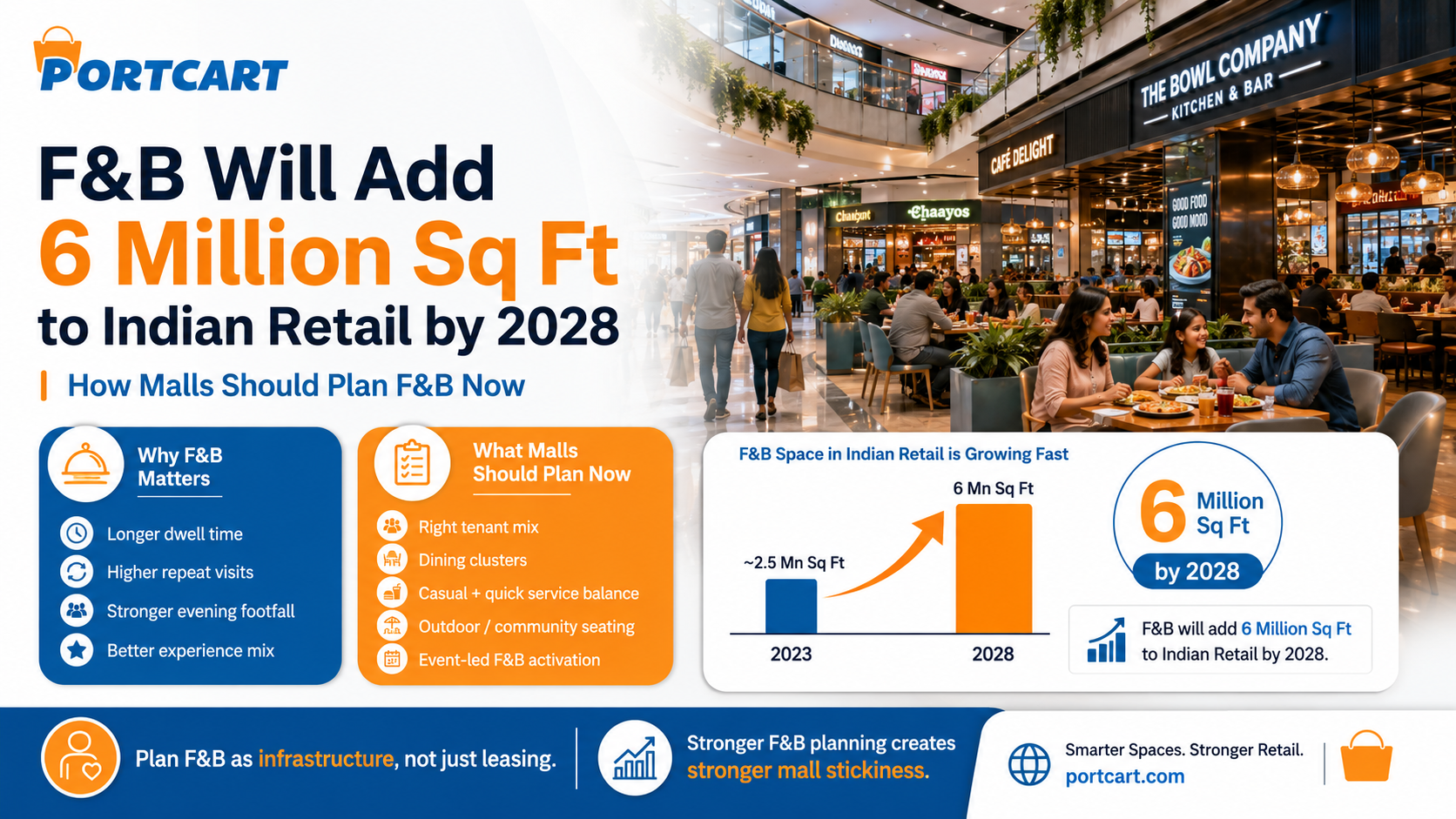
JLL's India Retail Outlook published in Q3 2025 carried a number that rewired how Indian mall operators are thinking about category allocation: 6 million square feet of new F&B retail space coming to Indian malls by 2028. That is roughly 40 additional 1.5 lakh sq ft mid-sized malls turning F&B-anchored, or 80 existing malls each expanding F&B by 25 percent. The growth is happening even as overall mall retail leasing softens. F&B is no longer a flanking category. It is becoming a primary driver of mall economics.
The growth is concentrated in metros and Tier-2 cities. The growth is happening even as overall mall retail leasing softens. The implication is straightforward: F&B is no longer a flanking category to anchor retail, it is becoming a primary driver of mall economics.
This piece is a planning guide for mall operators about to make multi-year F&B mix decisions.
What's driving the F&B explosion
Four structural shifts:
Quick commerce ate the utility F&B trip. Pickup of small food orders, biryani at lunch, ice cream at 8pm, Swiggy Instamart and Zepto handle these now. Mall food courts have lost the convenience use case, just like they lost the grocery use case. What remains is the destination food trip.
The destination food trip is growing. Couples on a date, families with kids, friends meeting after work, brand launches, birthday celebrations. The Indian middle class is dining out more often, and the mall format competes well against standalone restaurants on safety, parking, restroom access, and air conditioning.
Cloud kitchens hit a ceiling. Cloud kitchens cannibalised quick-service brands between 2020 and 2024. By 2025 the customer-acquisition costs for cloud kitchens crossed the unit economics break-even for most operators. Brands are returning to physical formats inside malls because the cost-per-acquisition is lower at a mall location than a Swiggy ad.
International brand expansion accelerated. Pret a Manger entered India in 2024. Tim Hortons doubled its footprint in 2025. Wendy's, Carl's Jr, Five Guys, and several Asian brands are scouting in 2026. Most of these initial entries land in mall locations rather than high streets because mall operators offer turn-key fit-outs.
The categories actually growing
Inside F&B, growth is uneven. Some sub-categories are taking the lion's share of new space.
Premium specialty cafes (Starbucks Reserve, Blue Tokai, Third Wave Coffee, Subko, Roastery Coffee House). These need 1,200 to 2,000 sq ft, fit in any mall's high-traffic level, and convert well during weekday afternoons. Most malls are under-allocated here.
International casual dining (Wendy's, Tim Hortons, Pret, Eggwich). 2,500 to 4,500 sq ft formats, anchor brand recognition, drive cross-shopper traffic. Most malls have room for 2 to 4 of these.
Indian premium dining (Big Chill, Indigo Delicatessen, Social, Public Connection, Soda Bottle Opener Wala). 4,000 to 7,000 sq ft, often perform best on weekends, support strong drinks revenue. Healthy malls have 4 to 8.
Dessert and beverage specialty (Theobroma, French Loaf, Frozen Bottle, Boba Bhai). 600 to 1,200 sq ft micro-formats, work well as last-station impulse stops at the mall exit or near cinema. Currently under-represented in most malls.
Fast-casual healthy (Salad Days, FreshMenu, EatSure brand stores). 1,500 to 2,500 sq ft, target weekday lunch crowd from nearby offices, premium pricing. Growing fastest in metros.
What's NOT growing: traditional QSR (McDonald's, KFC, Burger King), which is renewing existing footprints rather than expanding aggressively. And legacy fine-dining formats, which have ceded share to premium casual dining.
The 18-month operational plan for a mall
For an operator with a 6 lakh sq ft metro mall currently allocated 14 percent to F&B, the planning sequence:
Months 1-3. Audit existing F&B mix. Identify renewals coming up in the next 18 months. Categorise existing tenants by performance: top quartile, middle, bottom. Bottom-quartile renewals are your re-mix opportunities.
Months 4-6. Strategy lock. Decide target F&B share (typically 18-22 percent for a metro mall by 2028). Decide category mix targets (e.g. 4 premium cafes, 3 international casual, 6 Indian premium, 4 dessert/beverage, 2 fast-casual healthy). Begin leasing outreach to gap-fill brands.
Months 7-12. Active leasing. Term sheets out. New brand announcements (which themselves drive footfall lift before opening). Coordinate fit-out cycles with anchor lease ends.
Months 13-18. Soft launches and full launches. Each new F&B brand should land with a 90-day promotional plan integrated into the mall's loyalty programme.
Operational systems that scale F&B
Five operational capabilities a well-run mall F&B operation needs in 2026:
- Reservation integration. EazyDiner, Dineout, Zomato Pro for premium dining brands. Mall operators should make these integrations a leasing condition for top tenants.
- Wait-time visibility. Public-facing wait times for popular restaurants drive shopper distribution across the mall. Easy to build with a tablet-at-the-host stand approach.
- POS reconciliation across the food court. Food court tenants share infrastructure (seating, cleaning, point-of-sale terminals). Reconciliation has to handle voucher redemptions that span multiple brands.
- Loyalty integration with mall programme. F&B spend should earn mall loyalty points without each brand needing custom integration. Invoice-upload or QR-scan-receipt patterns work well.
- Event programming tied to F&B. Food festivals, brand launch tastings, chef-table evenings, regional food weeks. These pull footfall during soft windows and lift F&B revenue 30 to 60 percent during the event period.
The financial case
A 6 lakh sq ft metro mall doing 1.5 crore annual visits currently does roughly:
- 23% F&B revenue share (₹40 crore)
- Average revenue per F&B sq ft: ₹35,000
The same mall, 18 months into a well-executed F&B re-mix:
- 31% F&B revenue share (₹62 crore: a ₹22 crore lift)
- Average revenue per F&B sq ft: ₹42,000
That's the prize the JLL number is pointing at. Roughly half the lift comes from new space allocation, half from per-square-foot productivity improvement driven by better tenant mix.
Frequently asked questions
How fast can a mall re-mix F&B in practice?
Aggressive re-mix can move 4 percentage points in 18 months. Passive renewals see 1 to 2 percentage points in the same window. Most malls are passive.
Does F&B re-mix hurt anchor retail rents?
The opposite. Better F&B mix increases mall traffic, which lifts anchor retail conversion, which supports higher renewal rents. The malls that lose anchor rent are the ones with weak F&B and falling foot traffic.
What's the right minimum guarantee structure for new F&B tenants?
For premium tenants with strong brand pull, lower MG with higher revenue share works. For lower-recognition brands, higher MG with lower revenue share aligns risk. Match the structure to the brand's pulling power.
How Portcart handles this
The F&B-driven mall operating model maps cleanly onto Portcart capabilities.
- [brand pages](/modules): first-class F&B brand pages with menu, hours, average price-per-cover, reservation links, dietary tags. SEO-indexed individually so Google surfaces them for "best biryani in [city]" queries.
- [Loyalty Layer](/modules): invoice-upload and QR-receipt mechanics that earn mall loyalty on F&B spend without each tenant needing POS integration.
- [Events and Ticketing](/modules): food festivals, chef-table evenings, brand launch tastings programmed and ticketed inside the mall calendar.
- [Voucher Management](/modules): campaign vouchers usable across the food court with maker-checker audit per redemption.
If your mall's F&B re-mix is on the 2026-27 roadmap, request a demo and we'll model the revenue impact of the operating systems above on your actual tenant mix.