Your Biggest Crowd Between Now and Diwali Arrives This Saturday.
Independence Day falls on a Saturday this year, and Teej lands the same day. Your mall will be full. Operations is ready. On Monday you will hold a footfall number and nothing else, then pay festive rates in October to reach the same people.
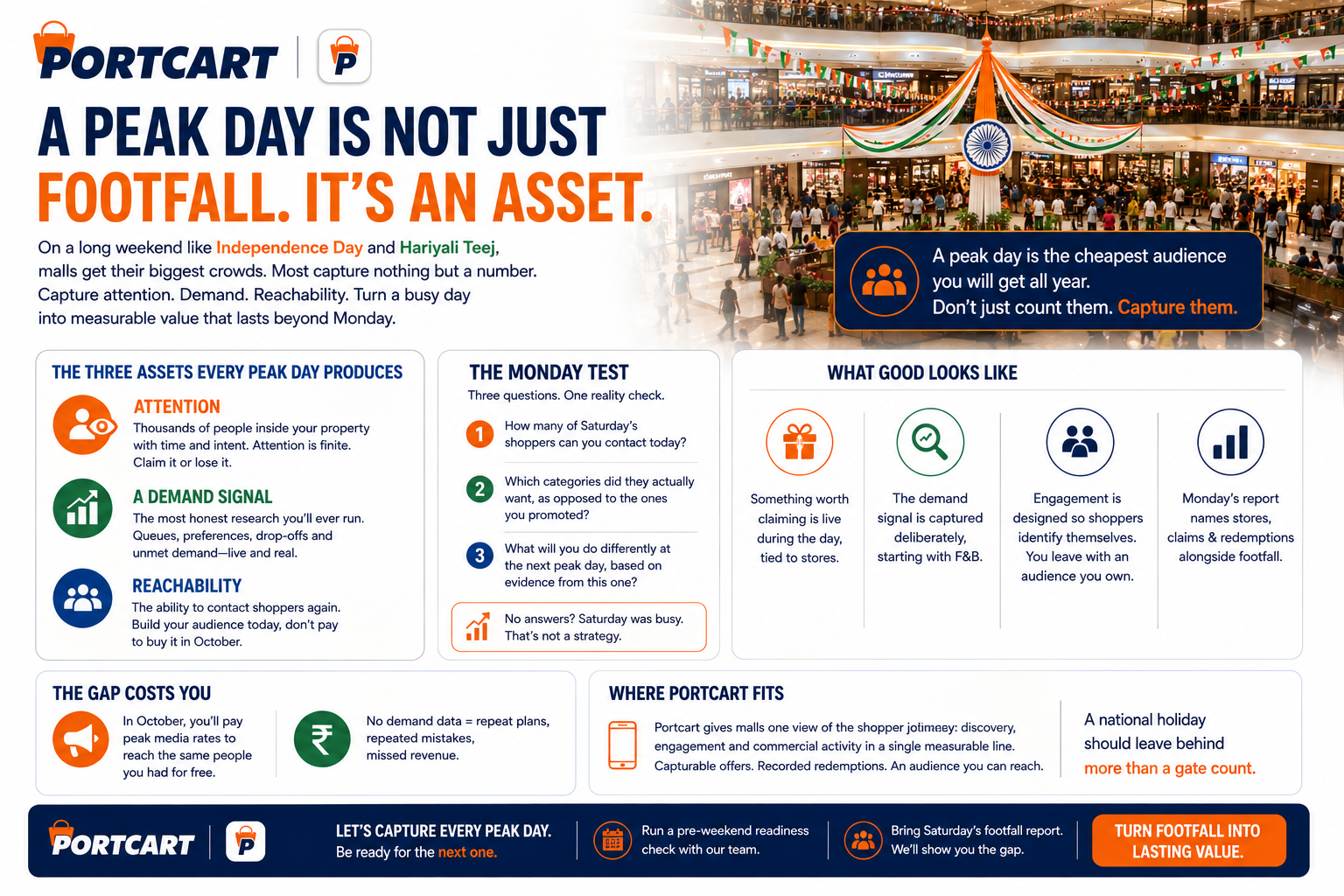
Saturday is 15 August. Independence Day on a weekend, with Hariyali Teej the same day across North Indian catchments. Schools are shut, families are out, and your mall is about to have its densest day since the sale season ended.
The mall is ready. Extra security at the entries. Additional housekeeping shifts. Parking marshals briefed. The atrium decor went up on Wednesday, the F&B tenants have stocked for it, and the duty roster has been checked twice.
That preparation is genuinely good work. It is also, in most malls, the entire plan.
So here is Monday morning. The crowd came, the day passed safely, and the mall now holds one number: footfall, up sharply on a normal Saturday. Nothing else. Not who came. Not what they wanted and could not find. Not one way to reach any of them again.
In October, when the festive campaign starts, the mall will pay peak-season media rates to reach that same catchment. It had them standing inside the building, for free, in August.
A peak day is the cheapest audience you will get all year
Ordinary marketing spends money to bring people in. A national holiday on a Saturday does it for you. The calendar delivered the audience; the mall's only job is to keep something from it.
Most malls keep nothing, because a peak day belongs to operations and is judged the way operations should be judged: safely, smoothly, no incidents, throughput handled. That is the correct standard for safety and throughput. It produces no commercial asset at all.
This is not an argument against the operational plan. It is an argument that the operational plan is the only plan, and the day is bigger than that.
The three assets a peak day produces, and where they go
Every crowded day generates three things worth keeping. Count how many your mall will still hold on Monday.
Attention. For a few hours, thousands of people are inside your property with time to spare and money budgeted. That attention is real and it is finite. If nothing is claimable during those hours, the attention simply expires.
A demand signal. This is the one malls throw away most casually. The food court at 2pm on a holiday is the most honest research the mall will ever run: hundreds of people showing you exactly which cuisines they queue for, how long they will wait before giving up, which counters they walk past, and what they ask for that nobody sells. That is a live map of unmet demand in your catchment, and in most malls it is recorded nowhere. By Monday it exists only as an impression: "F&B was busy."
Reachability. The ability to contact a shopper again. On a normal day this costs money to build. On a peak day, with a reason to engage and a crowd already inside, it is at its cheapest. If the day ends without it, every festive message in October starts from zero and gets bought at auction.
A mall that keeps all three has turned a holiday into an asset. A mall that keeps none has had a busy day.
What the gap actually costs
Put an illustrative shape on it. Say the long weekend brings 90,000 visits, and say the mall can engage a modest 3 percent of them with something worth claiming. That is 2,700 reachable shoppers, gathered at zero media cost, six weeks before the biggest campaign of the year.
Treat those numbers as arithmetic, not a benchmark. Your catchment and your engagement rate will differ. The point is not the total. The point is the comparison: in October, building the same reachable audience means buying it, in the most expensive media weeks of the Indian calendar, competing with every brand in the country.
There is a second cost, quieter. Without the demand signal, next year's peak-day plan is a copy of this year's. The same decor, the same activity, the same tenants featured, because no evidence exists to suggest anything different. Malls repeat peak days by default, not by decision.
The Monday test
Three questions, on Monday morning, about Saturday:
- How many of Saturday's shoppers can you contact today?
- Which categories did they actually want, as opposed to the ones you promoted?
- What will you do differently at the next peak day, based on evidence from this one?
If all three have answers, your peak days are commercial events and this article owes you nothing. If none do, the problem is not the team. Operations delivered exactly what it was asked for, and marketing was handed a day that was already fully planned by the time it could have been made commercial.
The familiar signs travel together: the peak-day plan is written entirely by operations; the day is reported as a footfall percentage; nothing was claimable on the floor; the food court's queue lives only in a WhatsApp photo; and the October media plan assumes the audience must be bought from scratch.
What good looks like
A captured peak day is not a more complicated day. Most of it is set up in the week before and then runs by itself, because nobody should be distracted on the floor when the mall is full.
- Something worth claiming is live during the day, tied to stores, so attention converts into a recorded action.
- The demand signal is captured deliberately, starting with F&B, the densest and most honest source in the building.
- Engagement is designed so a shopper has a reason to identify themselves, and the mall ends the day with an audience it owns rather than rents.
- Monday's report names stores, claims and redemptions alongside the footfall number, so the next peak day can be planned on evidence.
None of this competes with safety. It is wired by Friday and read on Monday.
Where Portcart fits
Portcart is built to give malls one view of the shopper journey: discovery, engagement and commercial activity in a single measurable line. On a peak day that means offers a shopper can claim on the floor, redemptions recorded at the store, and an audience the mall can reach again afterwards, so a national holiday leaves behind more than a gate count.
The meeting worth having
Saturday is close. If capture is not already wired, this weekend will be an operations success and a commercial blank, and that is an acceptable outcome once.
What is not acceptable is repeating it through the festive quarter, which has several more of these days: the Ganesh Chaturthi weekend, Navratri, the Diwali run. Each one is another free audience.
Before the next one, run a pre-weekend readiness check with us: what your mall could capture on a peak day, what it currently captures, and the short list of things that need to be live by the Friday before. Bring Saturday's footfall report. It makes the gap obvious in about ten minutes.