The Diwali Quarter Is Decided This Month.
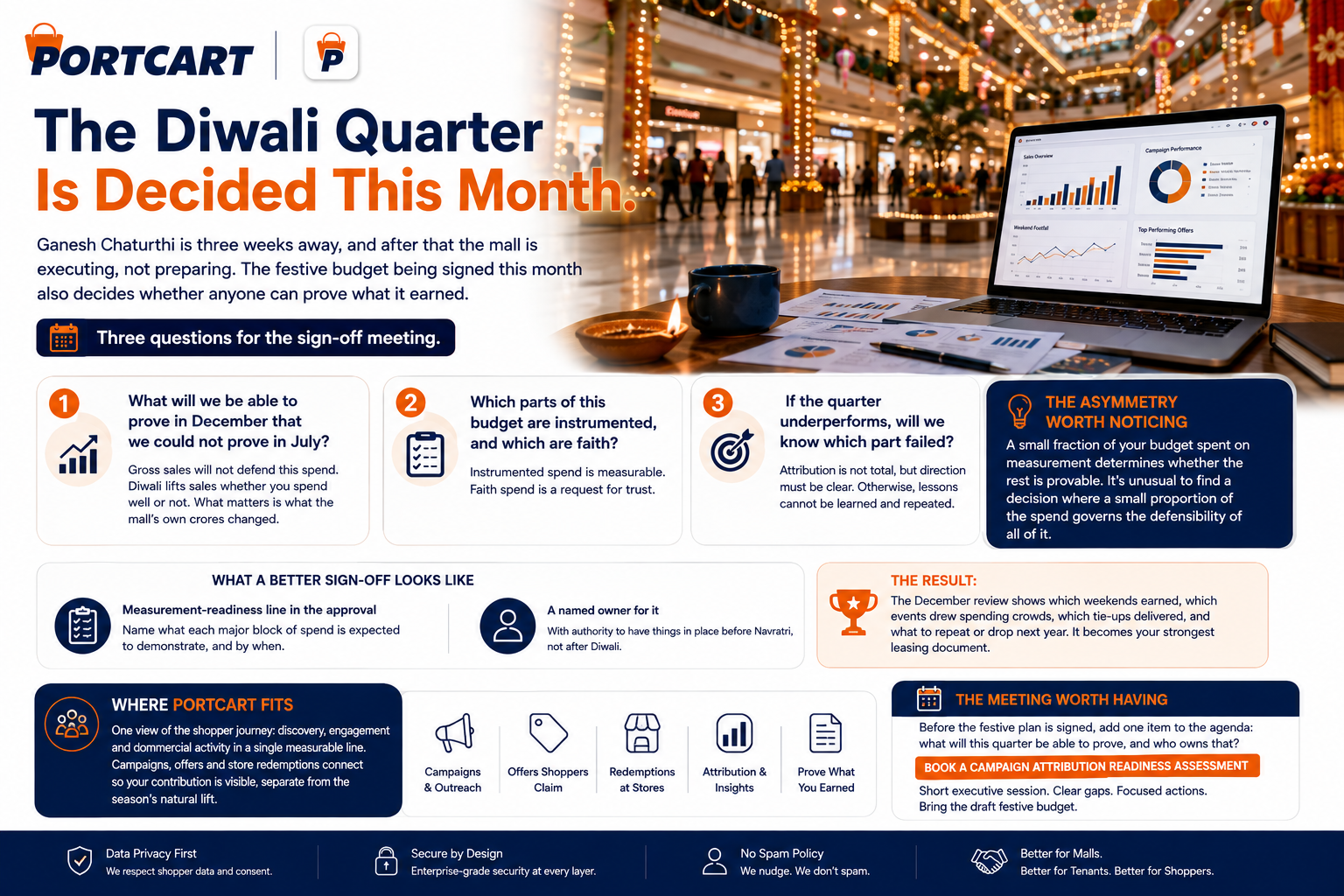
Ganesh Chaturthi is three weeks away, and after that the mall is executing, not preparing. The festive budget being signed this month also decides whether anyone can prove what it earned. Three questions for the sign-off meeting.
Somewhere this month, in most Indian malls, a room full of people will approve the largest marketing spend of the year.
The papers will be detailed. A festive calendar from Ganesh Chaturthi through Navratri, Durga Puja, Diwali and into the wedding season. Event vendors quoted. Media allocated. Brand tie-ups drafted. Decor concepts approved. Tenant participation mapped.
Every line will describe an activity. Almost none will describe what the mall will be able to prove afterwards.
That is the decision being made this month, whether or not it appears on the agenda. Not just what the mall will spend, but whether anyone will be able to say what the spend did.
After Ganesh Chaturthi, you are executing
The practical reason August matters is simple. Ganesh Chaturthi falls on Monday 14 September. From that point the mall is in delivery: events running, campaigns live, tenants activated, teams stretched. Nobody instruments a quarter while running it.
So whatever the mall can measure on the first of September is what it will be able to prove in December. The window for that decision is now, and it closes quietly, in a meeting about budgets rather than a meeting about measurement.
Gross sales will not defend this spend
There is a comfortable answer available in January: festive sales were up on last year.
It will be true, and it will not survive a serious question, because the season lifts sales whether or not the mall spent well. Diwali does not require good marketing to produce a good month. That is precisely why the seasonal number cannot be used as evidence for the marketing.
The board's question, or the asset manager's, is narrower and harder: what did the mall's own crores change? If the only answer is a figure the season would have produced anyway, the spend is being defended with something that was never a defence.
This is the same conversation that just happened after the sale season, when July's report could not separate the mall's contribution from tenant markdowns and the calendar. The difference is scale. The festive quarter runs the same measurement chain across a much larger number, in the quarter the whole year is judged on.
You are not approving one budget this month. You are approving two.
Here is the part that makes this an executive decision rather than a marketing one.
The festive budget being signed now will be spent between September and December. But it also sets the evidence base for the ask that comes after it. Next year's budget conversation, the one about a larger allocation or a new capability or a bigger event programme, will be argued from whatever this quarter can demonstrate.
If the quarter produces activity and gross sales, next year's ask is a request for trust. If it produces attributable outcomes, next year's ask is a business case.
Every unmeasured rupee is therefore spent twice: once on the campaign, and once again on the credibility it failed to build.
The asymmetry worth noticing
Instrumenting a quarter is not a large line item relative to the quarter. Media, events, decor and production dominate a festive budget. The measurement layer is a fraction of it.
What that fraction determines is whether the rest is provable. It is unusual to find a decision where a small proportion of the spend governs the defensibility of all of it, and it is the reason this belongs in the sign-off meeting rather than in a marketing workstream after it.
Three questions for the sign-off meeting
- What will we be able to prove in December that we could not prove in July?
- Which parts of this budget are instrumented, and which are faith?
- If the quarter underperforms, will we know which part failed?
If the room can answer all three, the plan is sound and this article owes you nothing. If it cannot answer any of them, that is not a failure of the marketing team. They cannot instrument a quarter that is approved without instrumentation, and they will be the ones asked to explain it in January.
The signs are usually visible in the papers themselves: the plan is a calendar of activities with no measurement line; no individual owns what the quarter will prove; last year's festive review was a comparison of gross sales; the media allocation repeats last year's because nothing showed what worked; and brand tie-ups are priced on footfall estimates alone, which is also why partners negotiate hard on them.
What a better sign-off looks like
It does not require re-planning the quarter. It requires two additions.
- A measurement-readiness line in the approval, naming what each major block of spend is expected to demonstrate, and by when.
- A named owner for it, with the authority to have things in place before Navratri rather than after Diwali.
Then the December review changes character. Instead of a seasonal comparison, it can say which weekends earned, which events drew crowds that spent, which tie-ups delivered, and what should be repeated or dropped next year. That review is also the strongest leasing document a mall can hold, because it shows tenants what the mall's own spend brought them.
Where Portcart fits
Portcart is built to give malls one view of the shopper journey: discovery, engagement and commercial activity in a single measurable line. For a festive quarter that means campaigns, the offers shoppers claim, and redemptions at stores connect, so the mall's contribution is visible separately from the season's natural lift. Attribution is never total, and no honest system claims otherwise. The useful shift is from a quarter that cannot be explained to one that can be discussed with evidence.
The meeting worth having
Before the festive plan is signed, add one item to the agenda: what will this quarter be able to prove, and who owns that?
If the room cannot answer it, book a Campaign Attribution Readiness Assessment with us before the sign-off. It is a short executive session, not an implementation project: what your current chain can prove, where the festive plan will go dark, and the small number of things that need to be in place before Navratri. Bring the draft festive budget. That is the document the conversation is really about.