Mall Loyalty Trends in India for 2026 and Beyond
Indian mall loyalty in 2026 is at an inflection point. Subscription loyalty is emerging, AI personalisation is in early production, DPDP compliance is rewriting consent flows. A trend report for operators.
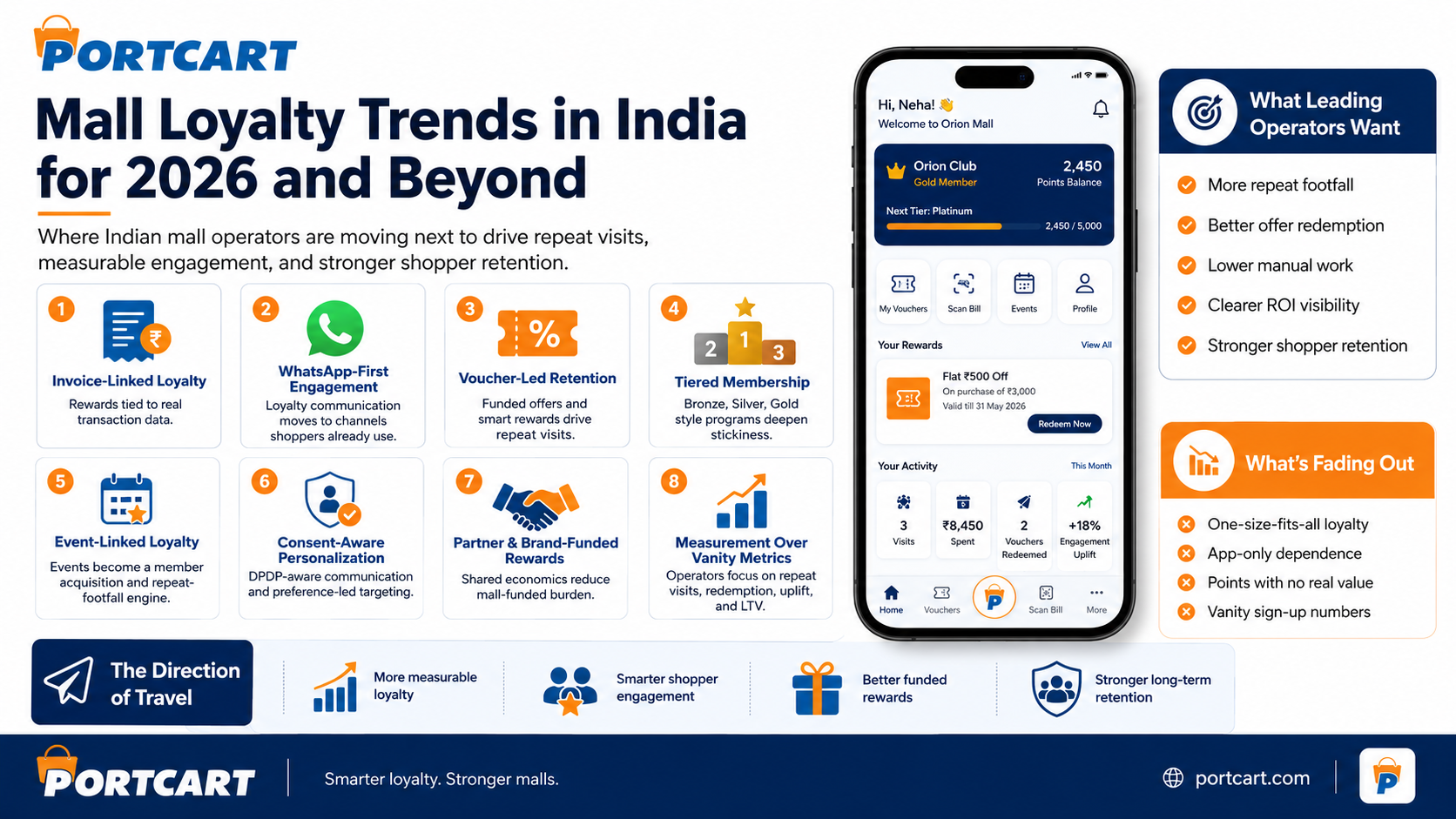
Indian mall loyalty in 2026 is at an inflection point. The mechanics that worked in 2018 (plastic cards, app-only enrollment, generic newsletters) underperform now. The mechanics emerging today (subscription tiers, AI personalisation, WhatsApp-first engagement, consent-aware design) are starting to differentiate the operators who get loyalty right from the ones still running it as a marketing afterthought. This is the trend report for 2026 into 2027-28.
This is the trend report for Indian mall loyalty programmes for 2026 and into 2027-28. Five shifts worth planning around.
Trend 1: Subscription loyalty hits 3-7 percent of engaged shoppers
Paid loyalty tiers (₹999-2,499 per year for elevated benefits) are emerging as a real revenue line at metro Indian malls. Early data from 2025 pilots showed adoption rates of 3-7 percent among engaged shoppers, and the per-subscriber revenue lift compared to free-tier engaged shoppers is 80-120 percent in monthly visit count and 60-95 percent in monthly spend.
The benefits that drive subscription pickup:
- Guaranteed parking on weekends
- Priority event access (movie previews, IPL viewing, kids workshops)
- Double points permanently
- Exclusive brand previews and member-only F&B specials
- Complimentary services (one free shoe shine, one free haircut, etc.)
Operators considering subscription loyalty in 2026-27 should test pricing in the ₹1,499 range with a clear 4-6 benefit package. Higher prices need much stronger benefits.
Trend 2: AI personalisation moves from pilot to production
In 2025, AI personalisation in Indian mall loyalty was mostly proof-of-concept. In 2026 it's entering production in 8-12 mall operators across the country. The capabilities being deployed:
- Per-shopper offer recommendations based on transaction history
- Birthday and anniversary triggers with category-relevant offers
- Day-of-week timing optimisation for individual shoppers
- Cross-brand affinity scoring ("shoppers who bought from Westside often shop at Vero Moda")
- Lifecycle automation (welcome series, win-back, tier-up celebration)
The operators who get this right see 18-30 percent lifts in campaign conversion compared to broadcast equivalents. The operators who treat it as a feature toggle without operational discipline see no measurable lift.
What separates the two: consent capture is granular, the data feeding the AI is clean, the marketing team reviews AI-suggested campaigns before sending, and frequency caps are respected.
Trend 3: DPDP rewrites consent flows
The DPDP Rules notified in November 2025 are the single biggest regulatory change to Indian retail loyalty in a decade. Phase 3 enforcement (May 2027) is the hard deadline. Operators who haven't started restructuring their consent capture by mid-2026 are already running behind.
The structural changes underway across most operators:
- Single-tickbox consent replaced with 4-6 granular consents at enrollment
- Re-consent campaigns for legacy enrollments (12-18 month rolling project)
- Consent ledger infrastructure (immutable timestamped grants and withdrawals)
- Unified suppression list across WhatsApp, SMS, email, push
- Data principal request flows (shopper-side data download and deletion)
The operators who treat DPDP as a programme (not a feature) are differentiating themselves on shopper trust. The ones who treat it as a checklist are accumulating risk.
Trend 4: WhatsApp-first replaces app-first
Mall apps in India never reached the engagement rates operators hoped for. Average download rates: 3-18 percent of footfall depending on mall positioning. Average active usage among those who downloaded: 25-45 percent within 90 days, dropping to 8-20 percent within 12 months.
WhatsApp engagement: 90-100 percent of loyalty members have WhatsApp, message read rates of 85-95 percent, two-way response rates of 30-50 percent.
The implication: stop investing in mall-specific app development. Build the loyalty programme around WhatsApp as the primary channel, with a PWA / web fallback. Native apps remain useful for premium subscribers or specific feature surfaces (event ticketing with QR check-in) but not as the default engagement layer.
Operators making this shift in 2026 are seeing 40-70 percent higher campaign engagement vs comparable app-led peers.
Trend 5: Event redemption joins voucher redemption as a top mechanic
In 2024-25, voucher unlock was the dominant loyalty redemption mechanic (5,000 points = ₹500 brand voucher). In 2026, event access is joining it as an equally valuable mechanic in malls with strong events programming.
Examples that work:
- Cinema preview screening (3,000 points for a Friday-night premiere)
- IPL viewing party (1,500 points for tickets to mall's Saturday viewing event)
- Kids workshop access (2,000 points for a Sunday craft session)
- Brand activation early access (1,500 points for first-day access to a fashion brand pop-up)
Event redemption works because it creates emotional value plus drives footfall on the event day. The shopper redeems, brings family, attends event, has F&B + retail experience during event window. Mall captures revenue across all four streams (covered in our event ROI piece).
Operators without permanent event programming can't use this mechanic. Operators with it should be assigning roughly 25-35 percent of total redemption volume to event access.
What's NOT changing
Three loyalty design choices that have been stable since 2018 and will remain stable through 2028:
- Tier names (Bronze, Silver, Gold, Platinum). Familiar to shoppers across loyalty programmes globally. Don't reinvent.
- Voucher-unlock redemption pattern. Operationally clean, shopper-friendly. Subscription loyalty layers on top, doesn't replace.
- Points-per-rupee mechanic at 2 percent effective. Predictable, easy to communicate, supported by tenant rebate economics.
Innovation belongs in the layers above these primitives, not in replacing the primitives.
The 2027-28 horizon
Two trends to watch in 2027-28 that aren't fully formed yet:
- Cross-mall loyalty roaming. Multi-property operators (DLF, Phoenix, Inorbit, Nexus) experimenting with single-loyalty-programme-across-properties. Operationally complex but commercially logical.
- Loyalty data as a tenant-facing service. Selling anonymised aggregate shopper insights back to tenant brands as a data product. Early experimentation in 2026. Will be a meaningful revenue line by 2028 for the largest operators.
Smaller operators don't need to plan for these yet. Single-property loyalty done well is plenty for 2026-27.
Frequently asked questions
Should our mall launch subscription loyalty in 2026?
If you have 15,000+ engaged loyalty members and 8+ months of consistent operations, yes. Below that scale, free-tier optimisation produces better ROI.
How much should we invest in loyalty engineering in 2026-27?
For a metro mall: ₹40-90 lakh annual platform + ₹2-5 crore annual loyalty programme spend (vouchers, events, marketing). For a Tier-2 mall: ₹15-35 lakh platform + ₹50 lakh-1.5 crore programme spend. Roughly 0.5-1 percent of annual mall revenue.
How do we measure loyalty programme success?
Four metrics matter: enrollment as % of monthly footfall, active engagement (used loyalty in past 90 days), repeat-visit lift among enrolled vs unenrolled, and incremental annual spend per enrolled shopper. Optimise all four, not just enrollment.
What's the right team to run mall loyalty?
For metro malls: a dedicated loyalty programme manager + 1-2 campaign operations folks + access to the marketing team. For Tier-2 / Tier-3 malls: one person owning loyalty as a primary responsibility, with platform vendor handling most operational work.
How Portcart handles this
The trends above all land on Portcart's loyalty module as configurable patterns.
- [Loyalty Layer](/modules): subscription tiers, tier-based mechanics, event redemption, AI-driven personalisation, DPDP-aligned consent capture, WhatsApp-first engagement, single-source-of-truth ledger.
- [Shopper Wallet](/modules): consent ledger, data principal request export, granular preferences.
- [Communication Engine](/modules): WhatsApp template management, frequency caps, unified suppression list.
- [Events and Ticketing](/modules): event redemption integration with loyalty.
If your mall's loyalty programme hasn't been re-architected since 2019-20, request a demo and we'll model the 2026-trend-aligned version on your specific operations.