Coalition Loyalty Across Mall Tenants: How to Build a Shared Points Program in India
A shopper carries a points card for one brand, a wallet for another, and a forgotten SMS from the mall, and none of them talk. Coalition loyalty is the mall owning one programme the whole visit earns into.
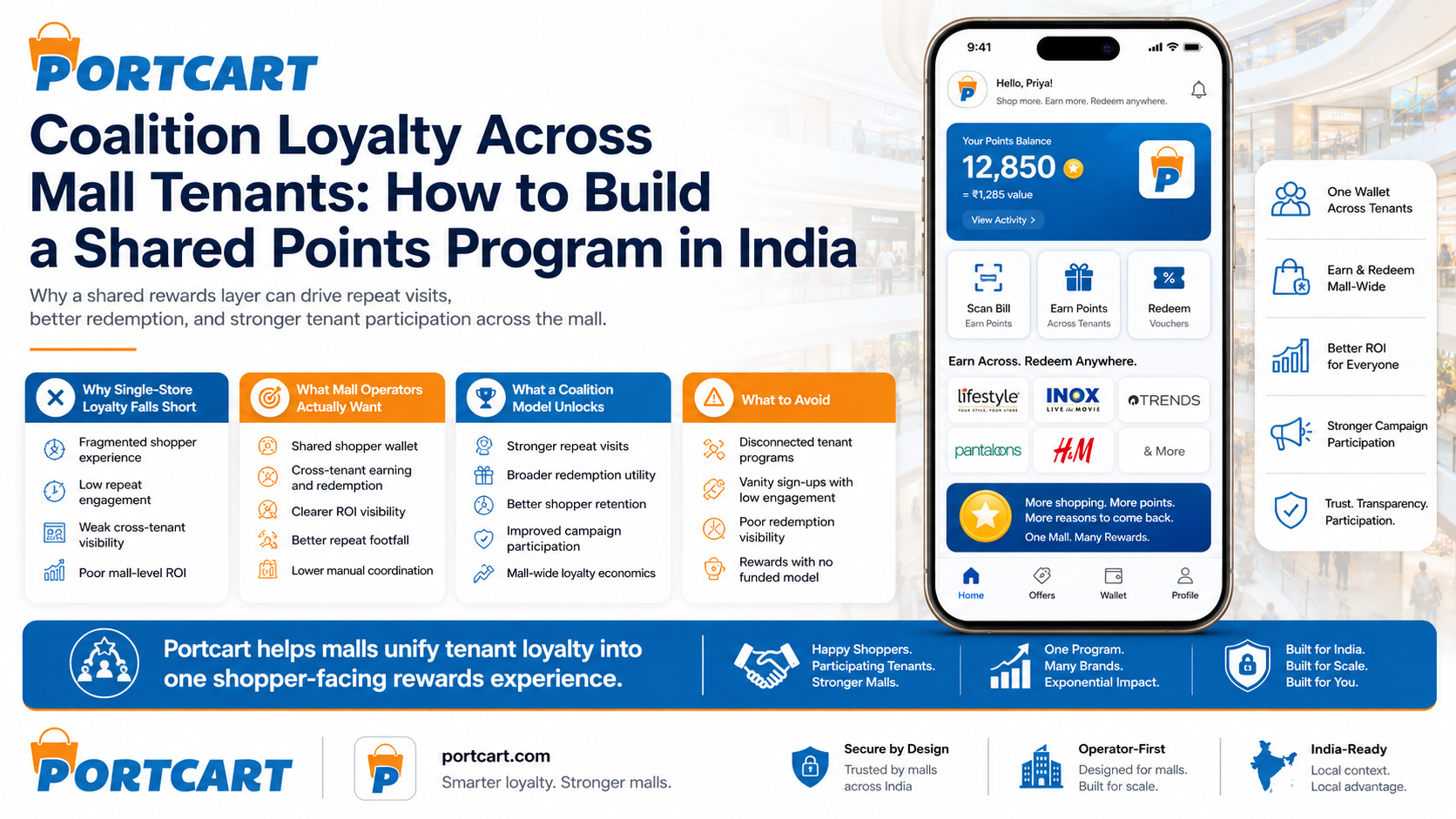
A mall runs a loyalty programme. So do thirty of its tenants. A shopper carries a points card for the apparel brand, a wallet for the coffee chain, and a forgotten enrolment SMS from the mall, and none of them talk to each other. Coalition loyalty is the idea that the mall, not each brand, owns one programme that the whole shopper visit earns into. It is harder to build than it sounds, and more valuable than most operators realise.
What coalition loyalty actually is
In a per-brand programme, every tenant runs its own loyalty in a silo. The apparel store knows what you bought from it. The coffee chain knows your usual. Neither knows you are the same person, and the mall, which owns the relationship with the building, knows least of all.
Coalition loyalty flips that. The mall runs one programme. A shopper earns points for spending anywhere in the centre and redeems them anywhere that accepts them. India has seen this model at the multi-brand level for years, so shoppers already understand the idea of one currency across many merchants (the specifics of any particular programme are worth verifying before you cite them). The mall version is narrower and, for the operator, more powerful, because it is scoped to one building the operator controls.
Why a mall is the natural coalition owner
A brand only ever sees its own till. The mall sees the whole visit: the family that parked, ate, watched a film, and shopped two stores. That whole-visit view is the mall's unique asset, and coalition loyalty is how it turns that view into a programme.
The strategic point is cross-shopping. A mall does not really compete with its own tenants. It competes with the next mall, the high street, and quick commerce. A loyalty programme that rewards a shopper for spreading spend across the centre, rather than loading one brand, grows the metric the mall is actually paid on, total centre spend per visit, not any single store's till.
The commercial model: who funds the points
This is where coalition programmes live or die. The clean model: each tenant funds the points earned at its own till, because those points are a marketing cost against a sale it made. When a shopper redeems points at a tenant, that tenant honours the redemption and is settled for the value from the points pool.
The complication is cross-redemption. A shopper earns points at the apparel store and burns them at the food court. The food court gave up real value to a shopper who spent nothing there today. So the programme needs a settlement layer: a shared pool that the earning tenant pays into and the redeeming tenant draws from, reconciled on a cycle. Without that settlement, the redeeming tenants subsidise the earning ones, resentment builds, and the coalition falls apart.
A worked earn-and-burn example
Say the programme awards one point per hundred rupees, and a point is worth one rupee on redemption. A shopper spends 4,000 rupees at the apparel store and earns 40 points. The apparel tenant funds those 40 rupees of value into the pool. Two weeks later the shopper redeems 40 points against a 600 rupee bill at the food court. The food court gives a 40 rupee discount and draws 40 rupees from the pool in settlement. Net, the apparel tenant paid for a reward that pulled the shopper back into the mall and into a second tenant. That second visit, and the 560 rupees of new spend around it, is the whole point. Every tenant in the coalition wins from a shopper who keeps coming back, as long as the settlement keeps the funding fair.
The data problem: one shopper view, DPDP-safe
Coalition loyalty needs one identity for the shopper across tenants, otherwise it is just disconnected silos again. That unified view is also exactly what the Digital Personal Data Protection Act, 2023 governs. The mall becomes a data fiduciary: it needs consent for the programme, it can use the data only for the purposes the shopper agreed to, and it cannot hand a tenant the raw personal data of shoppers who bought elsewhere.
The resolution is to keep identity and analysis at the mall level and give tenants aggregate insight, not raw records. A tenant can learn that a segment of its buyers also shops a category nearby, without ever receiving a list of names and numbers. Design this in from the start. Retrofitting privacy onto a programme that already over-shared is far harder than building it correctly once.
Managing points liability across a coalition
A single-brand programme can be casual about points liability, because the brand both issues and honours its own points. A coalition cannot, because the tenant that issues a point is often not the tenant that honours it, and the gap between the two is where the financial risk sits.
Every point issued is a promise of future value that someone has to fund. In a coalition that funding flows through the shared pool: issuers pay in, redeemers draw out. So the pool balance is the liability, made visible. If issuance outruns redemption, the pool grows and the programme is sitting on a rising obligation. If a popular earning tenant leaves the coalition, its members still hold points that other tenants must honour, and the pool has to be solvent enough to cover them.
Three rules keep this sane. Set a clear expiry on points, no shorter than any minimum that applies and no so long that the liability never clears. Reconcile the pool on a fixed cycle, so the outstanding balance is always a known number rather than a surprise. And write the exit terms into the tenant agreement up front: what happens to outstanding points if a tenant joins or leaves, so a departure does not strand members or unbalance the pool. A coalition that treats the pool as real money, with an owner and a monthly close, scales. One that treats points as free marketing discovers the liability the hard way.
Where coalition programmes fail
- Free-rider tenants who accept redemptions but never fund points. The settlement model has to make funding mandatory for participation.
- Unmanaged points liability. Points are a promise of future value. Issue them faster than they are redeemed or expire and the liability quietly grows.
- No settlement layer, so redeeming tenants subsidise earning ones until they quit.
- Over-broad data sharing that turns a marketing programme into a DPDP exposure.
- Launching with all eighty tenants at once, so nothing is tuned and every problem hits simultaneously.
How to start: a coalition of the willing
Do not launch mall-wide. Start with three to five anchor tenants who already believe in cross-shopping, agree the funding and settlement rules with them, and run it for a season. Prove the one number that matters, incremental cross-shop visits and spend among members, and use that proof to bring the next tier of tenants in. A small coalition that works is far more convincing to a sceptical tenant than a mall-wide launch that is still finding its feet.
What good looks like
In a mall that has this right, a shopper carries one programme, earns it across the whole visit, and redeems it anywhere in the centre. Tenants see incremental cross-shop traffic they could not have generated alone, the funding stays fair because settlement is automatic, and the mall owns a direct relationship with the shopper that no single tenant can replicate. The programme is invisible plumbing to the shopper and a growth engine to the operator.
If you are weighing coalition loyalty, the first question is not the points rate. It is whether three of your tenants will agree on who funds a point and who honours it. Settle that with a willing few, prove the cross-shop lift, and the rest of the centre follows the evidence.
Portcart Team. Built for mall and airport operators in India.