Mall Loyalty Programs in India: 9 Patterns That Actually Drive Repeat Footfall
Nine field-tested loyalty mechanics from Indian mall operators between 2023 and 2026. Which ones produced measurable repeat-visit lift, which fizzled, and the math behind both.
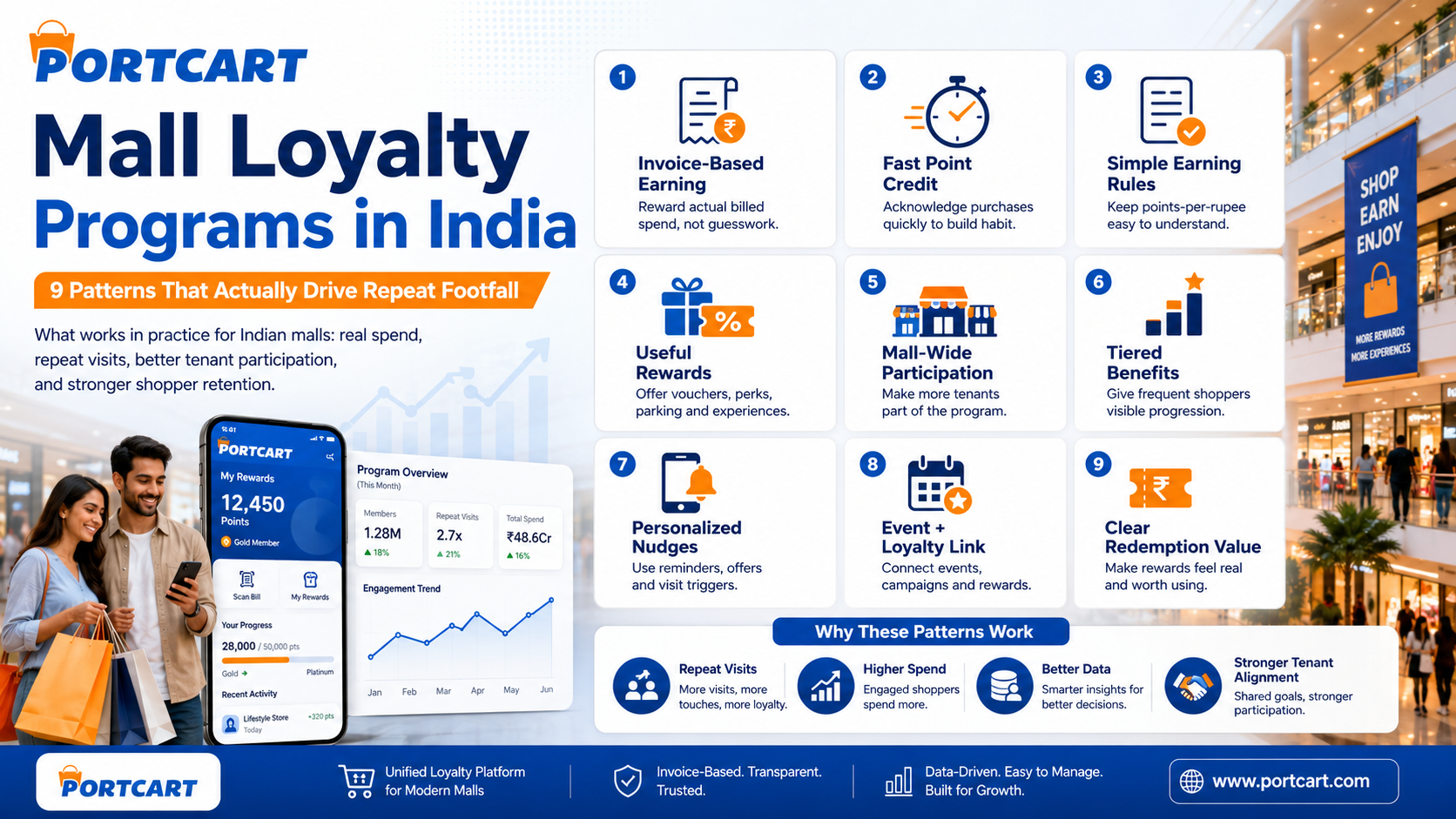
Loyalty programmes in Indian malls have evolved through three generations. The first was the plastic card era. The second was the app era. The third, where most operators sit today, is the WhatsApp era. This piece is not about generations. It is about nine specific mechanics that consistently surfaced across mall pilots and live programmes between 2023 and 2026, the ones that produced measurable repeat-visit lift and the ones that absorbed budget without moving the metric. The list is field-tested, the math is real, and the difference between operators who get loyalty right and the rest comes down to which patterns they pick.
This piece is not about generations. It is about specific mechanics. Across mall pilots and live programmes between 2023 and 2026, nine distinct loyalty patterns consistently surfaced. Some produced measurable repeat-visit lift. Some absorbed budget without moving the metric. Below is the field-tested list, with the math behind each.
1. Per-visit base points (the floor mechanic)
How it works: every verified visit (loyalty card scan, invoice upload, or POS-linked purchase) earns base points regardless of spend.
What we saw: visit-count lift of 4–7% in the first quarter, peaking by month 6. Underlying spend per visit stays flat. The mechanic anchors the loyalty habit but does not drive incremental spend.
Best paired with: tier progression. Useful as a floor, ineffective alone.
2. Per-rupee points (the volume mechanic)
How it works: shoppers earn 2 points per ₹100 spent, redeemable as voucher unlocks.
What we saw: 14–22% lift in average basket size among enrolled shoppers vs unenrolled control. Strong at top tiers, weak at bottom tiers. The shoppers who already spend most respond most.
Best paired with: per-brand multipliers (3x at new tenants, 2x at strategic categories) to redirect spend.
3. Tier progression with public ladders
How it works: Bronze, Silver, Gold, Platinum tiers visible to the shopper, with annual thresholds (₹40k Silver, ₹1L Gold, ₹3L Platinum is a common Indian mall calibration).
What we saw: powerful when tiers are publicly visible in WhatsApp and the mall page. Shoppers within 15% of the next tier increase their spend by 18–28% in the qualifying window. Shoppers below the bottom of any tier ignore the mechanic.
Best paired with: tier-up celebration messages (WhatsApp "Congrats, you have reached Gold" with a small voucher attached). Adds 3–5% to retention.
4. Voucher-unlock redemption (currency-free redemption)
How it works: shoppers spend points on specific vouchers (5,000 points = ₹500 brand voucher), not as direct cash equivalent at the till.
What we saw: 55–70% voucher redemption rate within 90 days of issuance. Operationally clean (no settlement with tenant brands), shopper-friendly (vouchers feel like wins), and budget-controllable (mall sets the points-to-voucher conversion).
Best paired with: rotating voucher catalogue (changes monthly) to maintain novelty. Static catalogues see redemption decline 30% over 6 months.
5. Day-of-week targeted campaigns
How it works: double points on Tuesday-to-Thursday, exclusive shopper-only events on Wednesday evenings, weekday-only offers from F&B tenants.
What we saw: 6–10% lift in weekday footfall among enrolled shoppers within 6 months. The strongest move against the weekday-soft footfall pattern that has persisted since Q-commerce reshaped utility trips.
Best paired with: weather-triggered campaigns (extra points when temperatures cross 38°C in Delhi summer). Logistically simple, emotionally resonant.
6. Birthday and anniversary triggers
How it works: shopper's birth date captured at enrollment; on the birthday and birthday-month, automated WhatsApp triggers with category-relevant offers.
What we saw: 38–52% redemption rate on birthday vouchers (vs 15–20% on generic vouchers). One of the highest-ROI mechanics in the entire programme.
Best paired with: spouse/child birthday (where consented) for parents. Triples the trigger volume without diluting redemption.
7. Tenant brand co-loyalty
How it works: mall loyalty integrated with a specific tenant brand's loyalty (Marks & Spencer Sparks, Tanishq Encircle, etc.). Points earned at the tenant count both at the brand and the mall.
What we saw: powerful for the top 5–8 tenants of a mall (anchor jewellery, anchor fashion, anchor electronics). Below that, integration cost exceeds value.
Best paired with: maker-checker reconciliation discipline. Without it, point disputes between mall and brand programs create monthly arguments.
8. Event-access redemption
How it works: redeem points for exclusive event access (Friday cinema previews, weekend kids workshops, IP-licensed activations).
What we saw: drives repeat-visit lift specifically among the under-35 family segment. 25–40% of redemption volume in malls that programmed events regularly.
Best paired with: the mall events function described in our event ticketing piece. Without permanent event programming, this mechanic has nothing to redeem against.
9. Subscription loyalty (the new frontier)
How it works: shoppers pay an annual fee (₹999 to ₹2,499) for elevated benefits, guaranteed parking, priority event access, double points permanently, exclusive brand previews, complimentary services.
What we saw: in early 2026 pilots, paid-subscriber lift over free-tier engaged shoppers was 80–120% in monthly visit count and 60–95% in monthly spend. Adoption rate is the limiting factor, 3–7% of engaged shoppers take the subscription.
Best paired with: clear differentiation from free tier. If free Gold-tier already includes most benefits, paid subscription does not gain traction.
What did not work
Three mechanics that consistently underperformed:
- Lottery and gamification. Spin-the-wheel mechanics drive enrollment volume but produce no meaningful spend lift. Engagement is a vanity metric.
- Refer-a-friend cash rewards. Indian referral programmes attract fraud (multiple accounts) more than they attract net-new shoppers. Disable.
- NFT-based loyalty. Tried in two metro pilots in 2024. Confusing for the user, expensive operationally, zero retention impact. Abandoned.
The math behind the math
A 6 lakh sq ft mall with 1.5 crore annual visits and 45,000 enrolled loyalty members tends to break down something like:
- Free-tier members: 42,000 (93%). Generate 22% of mall revenue uplift attributable to the loyalty programme.
- Paid-tier subscribers: 3,000 (7%). Generate 78% of mall revenue uplift.
The 3,000 paid subscribers are 0.02% of total mall visits but a meaningful share of incremental revenue. The economics work because subscribers visit 4-5x more often than the average shopper, spend 60-100% more per visit, and refer at much higher rates.
Programme breakeven typically comes at month 9–12, with full ROI by month 18–24. Malls expecting Year 1 payback are usually disappointed; malls patient enough for the curve are not.
The Indian context tilt
Three structural tilts that matter:
- WhatsApp-first wins. Native app adoption in Indian mall shoppers is 11–18%; WhatsApp adoption is effectively 100%. Loyalty programmes that require an app download lose 70–80% of potential enrollees in the friction.
- Family-shared accounts are real. Two-thirds of Indian mall loyalty accounts are used by more than one family member. Design for this rather than fighting it.
- Festival-season skewing matters. Diwali, Eid, Christmas, Pongal, Onam, and the wedding season drive 35–45% of full-year mall spend. Loyalty mechanics should map to these calendars, not to a uniform monthly cadence.
How Portcart handles this
The nine patterns above all run on the same underlying ledger. That ledger is the architecture behind the Portcart loyalty module shipped in mid-May 2026.
- [Loyalty Layer](/modules): single-source-of-truth ledger across invoice-based, POS-linked, manual award, birthday, event-reward, and ADSR-visit sources. Source-type discriminator on every transaction.
- [Voucher Management](/modules): voucher-unlock redemption with maker-checker, multi-source settlement, day-of-week targeting.
- [Events and Ticketing](/modules): the events module that the event-access redemption mechanic redeems against.
- [Communication Engine](/modules): WhatsApp-first triggers for birthdays, tier-up celebrations, weekday campaigns, with DPDP-compliant consent.
The same module is running with 30 seeded ledger rows across 6 source types on Portcart demos. Request a demo to see the patterns above run on real Indian-mall demo data.