CAM Reconciliation for Malls: A No-Nonsense Operating Guide
Common Area Maintenance reconciliation is one of the noisiest parts of mall finance operations. A clear operating model and a few data discipline rules cut the noise by 80%.
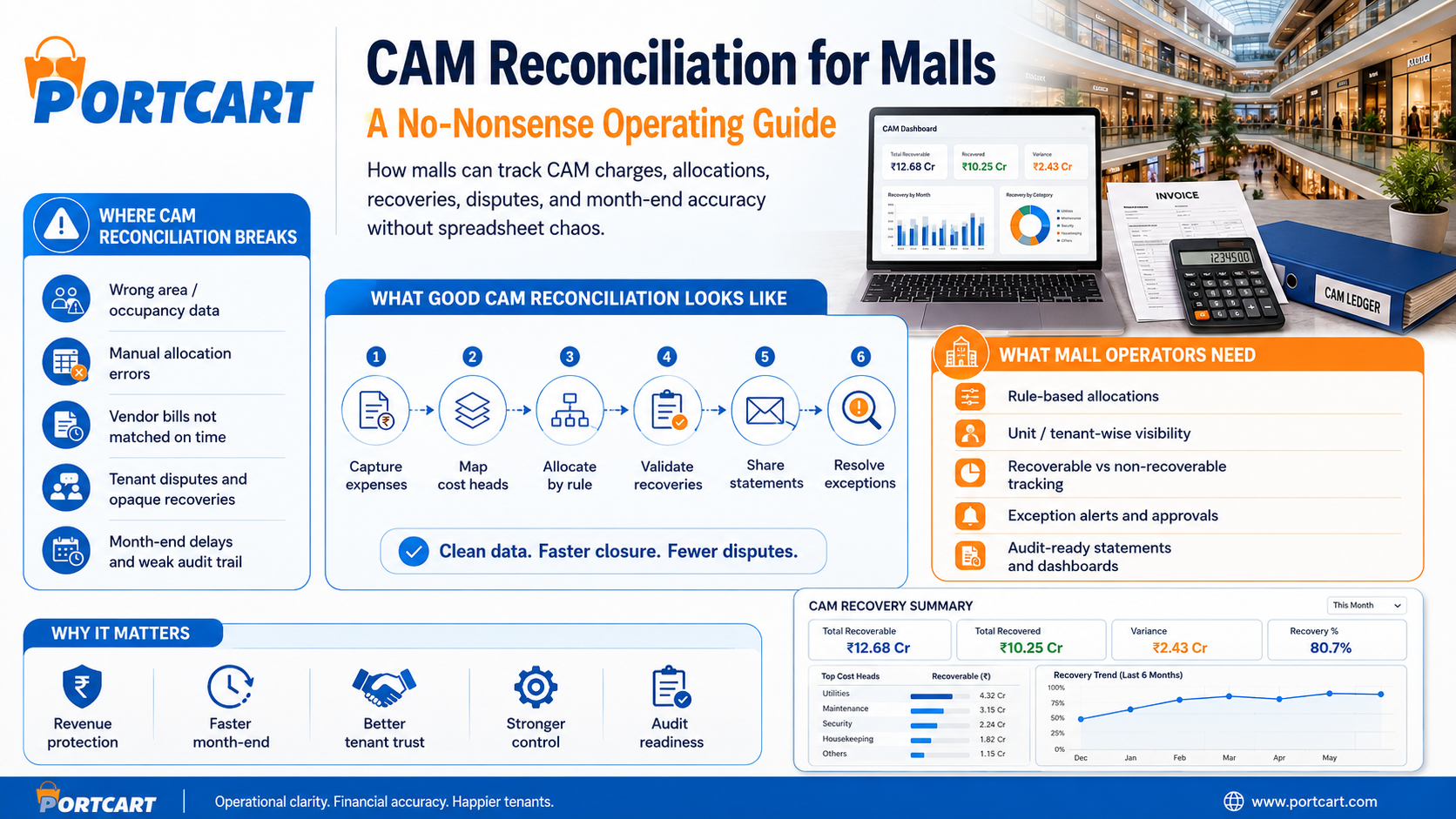
Common Area Maintenance reconciliation is the quietest source of operational pain at most Indian malls. The absolute rupee amounts are modest compared to base rent and revenue share. It rarely makes the senior team's quarterly review agenda. And yet it generates the highest volume of tenant complaints, eats more finance team hours per rupee than any other line, and creates lasting trust damage when handled poorly. This is the no-nonsense operating guide for the mall ops head, the lease accountant, and the leasing director who keeps fielding "we don't agree with this CAM charge" emails.
This piece is a no-nonsense operating guide. The audience is the mall operations head, the lease accountant, and the leasing director who keeps fielding "we don't agree with this CAM charge" emails from tenants.
What CAM actually covers
Common Area Maintenance charges, as typically structured in Indian mall lease agreements, cover the operating costs of areas shared by all tenants. The standard scope:
- Common-area electricity (lighting, escalators, lifts, HVAC)
- Common-area housekeeping (cleaning, restroom supplies, waste removal)
- Security manpower
- Building maintenance (preventive plus reactive)
- Lift and escalator AMCs
- Generator fuel
- Insurance on common areas
- Property tax allocated to common space
- Pest control
- Landscaping where applicable
- Atrium decoration / event setup (sometimes split)
Each tenant pays a CAM share proportional to their leased area, typically calculated on a per-sq-ft-per-month basis with quarterly true-up to actual costs.
The five sources of CAM disputes
1. Allocation methodology disagreement
The lease agreement usually says "pro rata by leasable area." Sounds clean. Edge cases ruin it. Does the food court tenant pay a higher share because food court housekeeping costs more? Does the anchor pay a lower share because they negotiated a discount? Does the kiosk pay a flat share because the math gets silly at 60 sq ft? Each mall ends up with 3-7 different CAM bands across its tenant base, and tenants compare notes.
2. Cost inclusion / exclusion ambiguity
A lift breakdown in March: is the repair cost in CAM, or capex billed separately to all tenants, or absorbed by the mall? Each mall has its own convention. Each lease agreement has its own definition. Reconciliation gets messy when reality doesn't match either.
3. Quarterly true-up shocks
CAM is usually billed monthly based on a budgeted rate, with quarterly or annual true-up to actual costs. When actual costs spike (generator fuel during a long power cut, emergency lift repairs, a fire alarm system upgrade), the true-up bill arrives and tenants react badly.
4. Vacant space cost absorption
Empty units don't pay CAM. So the cost of operating the common areas serving those empty units gets absorbed by paying tenants. A mall with 15% vacancy has 15% higher per-sq-ft CAM for paying tenants than the same mall at full occupancy. This is fair by the lease agreement but feels unfair to tenants. Disputes follow.
5. Audit-trail thinness
When a tenant disputes a CAM bill, the mall finance team scrambles to assemble invoices, vendor agreements, and allocation calculations. The longer this takes, the more the tenant suspects something's wrong. Some disputes that would close in a week stretch to months because the operator can't quickly produce the supporting docs.
The five disciplines that fix CAM
Discipline 1: Lock the allocation methodology in writing
Standard schedule, published to all tenants, updated annually. The schedule specifies:
- Per-sq-ft base rate by tenant category
- Adjustment factors (food court +30%, kiosk flat ₹X per month, anchor discount per agreement)
- What's IN scope
- What's OUT of scope (capex above ₹X, one-time events the mall absorbs)
Once published, deviations need documented exception approval.
Discipline 2: Quarterly true-up cadence with rolling forecasts
Don't surprise tenants with annual true-ups. Run quarterly. Share a rolling 12-month forecast each quarter so tenants can see what's coming. Big variance items (generator fuel forecast going up because of monsoon power outages) get communicated with the budget.
Discipline 3: Per-cost-line audit at month-end
Each line item (electricity, housekeeping, security) gets its own monthly review. Variance vs budget flagged. Three months of consistent overruns triggers a budget revision conversation, not a quiet absorption.
Discipline 4: Tenant portal for CAM transparency
Tenants log in and see:
- Their current month's CAM rate calculation
- Year-to-date actual vs budgeted with variance
- Quarterly true-up forecast
- Annual budget for the next year
- Audit trail of historical bills with supporting docs one click away
Transparency cuts dispute volume by 60-80 percent because tenants stop fearing hidden charges.
Discipline 5: Dispute resolution SLA
Every dispute gets a ticket. Ticket SLA: first response in 2 working days, resolution proposal in 7 working days, closure in 14 working days. Senior accountability for any ticket open beyond 14 days. Most disputes close cleanly inside this window. The ones that don't escalate to a documented decision the tenant can take to their lease counsel if they choose.
What good looks like
A mall running this operating model hits:
- CAM disputes drop from 8-15 per month to 1-3 per month
- Average dispute resolution time drops from 35-60 days to 8-15
- Tenant satisfaction with mall finance team measurably improves
- Annual CAM audit by external auditors moves from a 3-week project to a 1-week project
- Renewal conversations focus on rent, not CAM grievances
The vacancy problem: bigger than CAM
CAM disputes are often a symptom of broader tenant unhappiness about vacancy-driven per-sq-ft cost inflation. The structural fix is leasing the vacant space, not adjusting the CAM math. If your mall has 15+ percent vacancy persistently, no amount of CAM transparency will offset the financial pain to remaining tenants. Address vacancy first.
Frequently asked questions
Should CAM be revenue-share-linked or fixed?
Mostly fixed (per-sq-ft). Revenue-share-linked CAM exists but creates perverse incentives (tenants want to under-report to lower CAM, contradicting their separate revenue-share rent agreement). Stick with fixed unless specific tenant categories justify exception.
What's the right CAM rate for a metro mall?
Wide range. Premium metro malls: ₹40-90 per sq ft per month. Mid-tier: ₹25-50. Tier-2: ₹18-35. Tier-3: ₹15-25. The right number is whatever covers actual costs at expected occupancy.
How transparent should the CAM cost breakup be to tenants?
As transparent as you can be. Most operators hide cost detail thinking it gives them flexibility. In practice it just generates suspicion. Open books on cost categories, hold detail on specific vendor contracts (legitimate vendor relationship confidentiality).
Does CAM include marketing contributions?
Usually separate. Marketing Contribution Charge (MCC) or similar is a different line, typically used to fund mall-wide promotions and events. Don't blend with CAM or both become opaque.
How Portcart handles this
The CAM operating model maps onto Portcart's leasing and audit modules.
- [leasing pipeline](/modules): stores per-tenant rent agreement including CAM allocation rules, escalation, and exclusions as structured data, so monthly calculations are automatic.
- [Voucher Management](/modules): the same maker-checker audit pattern applied to CAM cost line approvals and quarterly true-up calculations.
- Tenant portal (in development): tenant-side visibility of CAM rate, variance, forecast, and audit history.
If your mall is still answering "why is my CAM bill higher this month" via 1:1 finance team emails, request a demo and we will walk you through a model that cuts dispute volume by an order of magnitude.