How to Design an Invoice-Based Loyalty Program for an Indian Mall
Most Indian malls cannot integrate with all 80 of their tenants' POS systems on day one. Invoice-based loyalty is the bridge that gets every tenant participating without forcing integration. Here is how to design it properly.
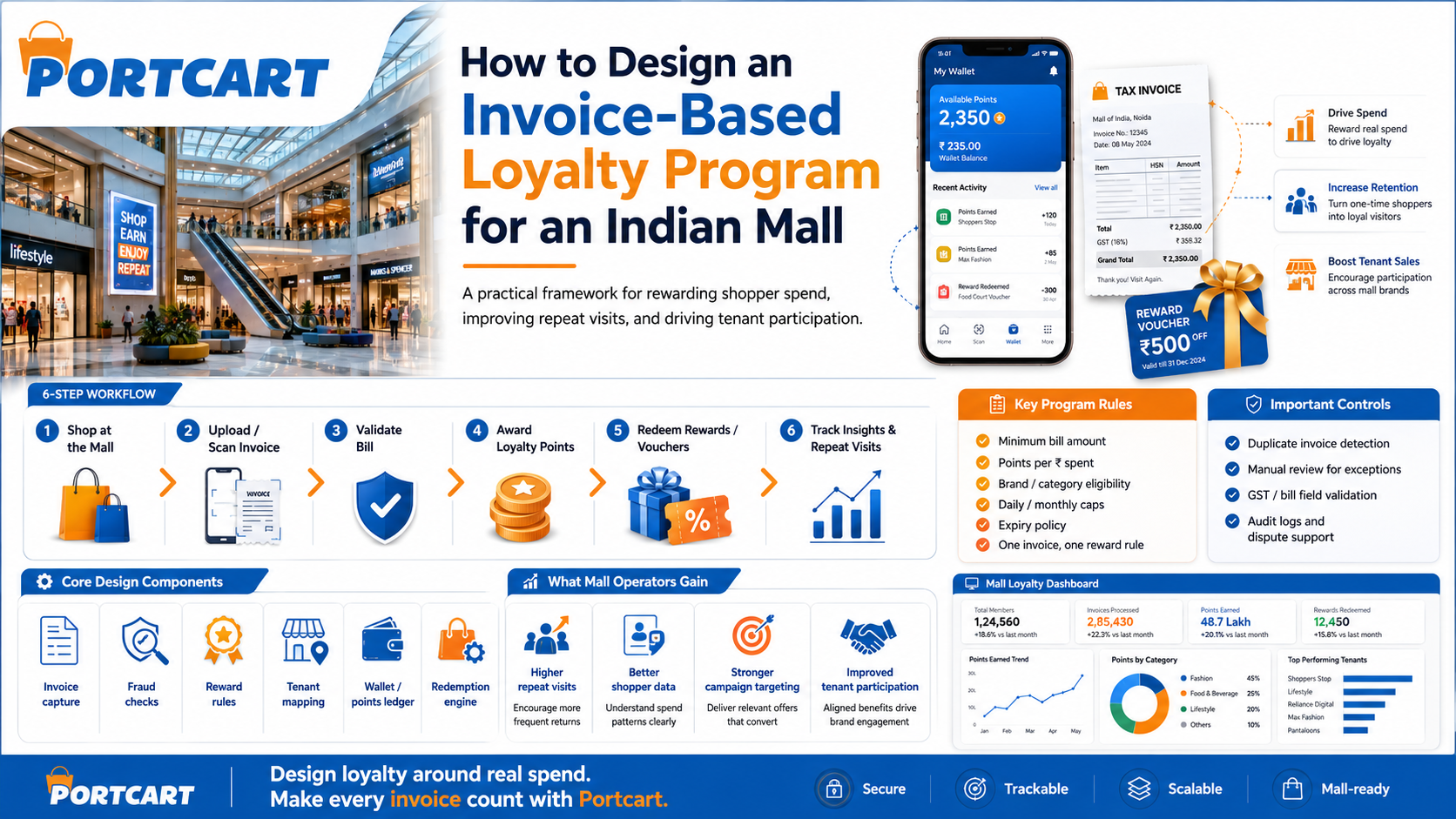
# How to Design an Invoice-Based Loyalty Programme for an Indian Mall
Most mall loyalty programmes fail before shoppers lose interest. They fail because the operator tries to integrate every tenant POS from day one. Invoice-based loyalty solves this differently: let shoppers upload bills, verify them intelligently, issue points, unlock vouchers, and bring POS integration later only where it makes commercial sense.
The loyalty mistake many malls make
Mall loyalty sounds simple.
A shopper spends money inside the mall. The shopper earns points. The points unlock rewards. The shopper returns. Tenants benefit. The mall gets better data.
But in practice, many Indian mall loyalty programmes get stuck before they scale.
The reason is usually the same:
The mall starts with POS integration as the only path.
On paper, POS integration looks perfect.
Every purchase is captured automatically. Points are credited instantly. The shopper does not need to upload anything. The mall gets clean transaction data. Tenant sales visibility improves.
But the reality is harder.
A mall may have 70, 100, 150, or 250 tenants.
Each tenant may use a different POS system. Some brands are national chains. Some are franchisees. Some use central billing systems. Some are food counters. Some are kiosks. Some are temporary pop-ups. Some do not want to share sales data. Some need head-office approval. Some agree but delay integration. Some integrate and then break after a POS update.
So the mall launches a loyalty programme, but only a small percentage of tenants are actually connected.
The shopper buys from five stores, but earns points from only one.
That is when trust breaks.
The shopper does not care about POS integration complexity. The shopper only knows this:
“I spent money in the mall, but I did not get points.”
That is the moment a loyalty programme starts becoming a complaint programme.
The better starting point: invoice-based loyalty
Invoice-based loyalty is simple.
A shopper buys from any tenant inside the mall.
Then the shopper uploads the bill through:
- Mall website
- Mall app
- QR code link
- Customer service desk
- Campaign landing page
The system reads the bill, verifies the tenant, checks the amount, applies rules, credits points, and shows the reward in the shopper wallet.
The tenant does not need to do anything.
The brand continues using its existing POS. The cashier continues billing normally. The shopper receives the invoice as usual. The mall loyalty engine works on top of the invoice.
That is the operational unlock.
Instead of waiting months or years for tenant integrations, the mall can launch loyalty across every participating tenant from day one.
Why invoice-based loyalty fits Indian malls
Indian malls are operationally complex.
A single mall may include:
- Anchor stores
- Fashion brands
- Beauty brands
- Electronics stores
- Food court outlets
- Cafes
- Restaurants
- Hypermarkets
- Kiosks
- Entertainment zones
- Kids’ play areas
- Salons
- Pop-ups
- Event counters
- Seasonal stalls
Expecting every tenant to integrate with one loyalty system at launch is unrealistic.
Invoice-based loyalty works because it respects the ground reality.
It does not force tenants to change their systems. It does not require every brand head office to approve API integration. It does not depend on a perfect POS ecosystem. It does not make the shopper wait for the mall’s backend strategy to mature.
It starts with what already exists:
The bill.
The bill is the common object across almost every tenant.
That is why invoice-based loyalty is the right starting layer.
What invoice-based loyalty actually does
A well-designed invoice-based loyalty system has five jobs.
1. Capture the bill
The shopper uploads a photo or PDF of the bill.
The upload flow should ask for minimum information:
- Bill image
- Bill amount
- Store name, if not detected
- Purchase date, if not detected
- Mobile number or loyalty ID
- Consent for loyalty processing
- Separate consent for marketing, if required
The flow should be short.
If uploading the bill feels like filling an insurance claim, shoppers will drop off.
2. Read the bill
The system should capture:
- Store name
- Invoice number
- Invoice date
- Bill amount
- GST number, where available
- Payment mode, where visible
- Line items, if needed
- Mall location, if printed
- Duplicate identifiers
OCR will not be perfect.
Indian invoices are messy.
Some are thermal prints. Some are faded. Some are tilted. Some use short store names. Some have local GST names instead of brand names. Some have multiple taxes. Some have handwritten corrections. Some are screenshots.
So the system should not depend blindly on OCR.
OCR should assist verification, not replace operational judgement.
3. Verify the claim
Verification should happen in tiers.
Small, low-risk claims can be approved quickly.
Medium claims can go through OCR and rule-based checks.
Large or suspicious claims can go to human review.
This keeps the programme fast for genuine shoppers and strict for high-risk cases.
4. Credit points
Once the bill is approved, the shopper should receive points in a loyalty ledger.
The ledger should show:
- Date
- Store
- Bill amount
- Points earned
- Approval status
- Source type
- Rejection reason, if rejected
- Expiry date, if applicable
The shopper should not need to call customer service to understand what happened.
The wallet should explain it clearly.
5. Unlock redemption
Points should not sit dead in the wallet.
They should unlock useful mall benefits.
For example:
- F&B voucher
- Parking benefit
- Birthday reward
- Event access
- Brand coupon
- Tier upgrade
- Weekend offer
- Family entertainment voucher
- Festival campaign reward
The loyalty programme becomes powerful only when points convert into action.
# The four design decisions that matter
1. Points formula
The first decision is the earning formula.
The formula must be simple enough for shoppers and customer service staff to understand.
Examples:
- 1 point per ₹100 spent
- 2 points per ₹100 spent
- 5 points per ₹100 spent during launch month
- 2x points for new stores
- 3x points during festival campaigns
- Lower earning rate for hypermarkets or low-margin categories
Avoid overly complex formulas.
Do not create a system where every category has a different rule unless the mall has the team to manage it.
A confused shopper does not become loyal.
A confused customer service team creates more complaints.
The safest starting point is:
One simple base formula plus limited campaign multipliers.
2. Verification model
Not every bill needs the same level of verification.
A practical model uses three tiers.
Tier 1: Auto-approval for low-risk claims
Low-value bills can be auto-approved if the system detects:
- Known tenant
- Valid-looking invoice
- Reasonable amount
- No duplicate image
- No unusual claim pattern
- No account risk flag
This keeps the shopper experience fast.
A loyalty programme that takes three days to approve a ₹450 coffee bill will lose momentum.
Tier 2: AI-assisted review for mid-value claims
Mid-value bills should go through OCR and rule checks.
The system can check:
- Store name match
- Date validity
- Amount extraction
- Duplicate invoice number
- Image duplicate
- GST or merchant identifier
- Purchase location
- Claim velocity
- Account history
If confidence is high, approve.
If confidence is low, move to review.
Tier 3: Human review for high-risk claims
Human review should be used for:
- High-value bills
- Repeated claims
- Poor image quality
- Duplicate suspicion
- Brand mismatch
- Disputed claims
- Suspicious account behaviour
- Unusual claim frequency
- Manual override cases
The review dashboard should show the bill image, extracted values, account history, and recommended action.
The reviewer should be able to approve, reject, or ask for clarification.
Every decision should leave an audit trail.
3. Fraud controls
Invoice-based loyalty will attract fraud attempts.
That is normal.
The goal is not to eliminate every possible fraud case on day one.
The goal is to create enough controls that fraud becomes difficult, visible, and manageable without hurting genuine shoppers.
Key controls include:
Velocity checks
Set limits on how many bills one shopper can submit.
For example:
- Daily claim limit
- Weekly claim limit
- Monthly claim limit
- Maximum value per day
- Maximum value per month
- Review trigger after unusual activity
A genuine shopper may submit two or three bills after a mall visit.
A suspicious user may submit many bills in a short time.
Velocity checks catch this early.
Duplicate detection
The system should check for duplicate submissions.
Duplicate detection can use:
- Image hash
- Invoice number
- Store name
- Bill amount
- Date
- GST number
- Uploaded file similarity
- Account history
If the same bill is uploaded twice, the second claim should be flagged.
If the same bill is uploaded from two different accounts, both should be reviewed.
Tenant validation
The system should verify whether the bill belongs to a valid mall tenant.
This requires a tenant master.
The tenant master should include:
- Brand name
- Legal entity name
- Store code
- Floor
- Zone
- GST number, where available
- Common invoice name variations
- Category
- Loyalty eligibility
- Multiplier rules
This is important because the brand name on the shop board and the name on the invoice may not match exactly.
For example, the store may be known publicly by one brand name, but the invoice may show the franchise entity name.
Your system must understand this.
Amount reasonability checks
A bill amount should be checked against typical behaviour.
For example:
- ₹250 at a coffee shop may be normal.
- ₹45,000 at a coffee shop may require review.
- ₹7,000 at an electronics store may be normal.
- ₹7,000 at a small snack kiosk may require review.
This does not mean rejecting automatically.
It means routing unusual claims to review.
Category-specific rules
Different categories need different loyalty rules.
For example:
- Hypermarkets may need lower points because margins are lower.
- Jewellery may need capped points because ticket size is high.
- Electronics may need review above a threshold.
- Food court bills may be auto-approved more often.
- Entertainment bills may be linked to event campaigns.
- Parking may be excluded or separately rewarded.
One loyalty formula for all categories may be simple, but not always financially wise.
Manual override audit
Customer service teams will need manual override.
That is fine.
But every override should record:
- Who changed the status
- What was changed
- Why it was changed
- When it was changed
- Whether the shopper was notified
- Whether manager approval was needed
Manual override without audit is a fraud risk.
4. Redemption mechanics
Earning points is only half the programme.
The bigger decision is how points get redeemed.
There are three common models.
Model A: Points as currency
Example:
100 points = ₹100 discount
This is easy for shoppers to understand.
But it creates operational complexity.
If points are used like money across tenants, the mall must handle settlement, tenant reimbursement, accounting rules, expiry, reversals, and disputes.
This can become difficult in year one.
Model B: Voucher unlocks
Example:
5,000 points unlock a ₹500 F&B voucher
This is usually cleaner for malls.
Voucher unlocks allow the operator to control:
- Reward budget
- Eligible tenants
- Expiry date
- Campaign period
- Redemption category
- Sponsor-funded rewards
- Tenant-specific offers
- Festival campaigns
Voucher unlocks are traceable and easier to reconcile.
For most Indian malls, this is the better starting model.
Model C: Access-based rewards
Example:
- Free event pass
- Free parking
- Kids’ zone access
- Cinema discount
- Lounge access
- Weekend activity entry
- Birthday benefit
This is useful because it connects loyalty to mall experiences, not just discounts.
A mall should ideally use a mix of voucher unlocks and access-based rewards.
That makes loyalty feel alive.
# The recommended shopper journey
The best loyalty journey is simple.
Step 1: Shopper buys inside the mall
The shopper purchases from any participating tenant.
The cashier gives the normal bill.
No tenant-side change is required.
Step 2: Shopper scans QR or opens WhatsApp
The bill-upload route should be visible through:
- Mall posters
- Table tents
- Lift lobby signs
- Food court screens
- Customer service desk
- Parking receipts
- Tenant counter cards
- Website
- App
- WhatsApp link
The shopper should not need to search for the loyalty programme.
Step 3: Shopper uploads bill
The upload flow should be fast.
Ideal flow:
- Upload bill photo.
- Confirm store name.
- Confirm amount.
- Confirm mobile number or loyalty ID.
- Accept loyalty terms.
- Submit.
Marketing consent should be separate from loyalty participation.
Do not force the shopper into marketing just because they want points.
Step 4: System verifies claim
The system runs OCR, tenant match, duplicate checks, velocity checks, and risk rules.
The claim is either:
- Approved
- Auto-approved
- Sent for review
- Rejected with reason
- Sent back for clarification
The shopper should receive a clear status message.
Step 5: Points are credited
If approved, points are credited to the wallet.
The message should say:
- Bill approved
- Points credited
- Current balance
- Expiry, if applicable
- Available reward or voucher
- Link to wallet
A good loyalty message does not just say “approved”.
It tells the shopper what to do next.
Step 6: Shopper redeems
The shopper can redeem points for:
- Voucher
- Parking benefit
- Event entry
- Store offer
- F&B reward
- Birthday benefit
- Festival reward
Redemption should be easy.
If earning points is simple but redemption is confusing, the programme will fail.
# Why WhatsApp-first matters
In India, asking every shopper to download a mall app before earning loyalty points creates friction.
Some loyal shoppers will download the app.
Most casual shoppers will not.
That is why the best starting flow is usually:
WhatsApp-first, web-second, app-third.
WhatsApp works because:
- Shoppers already use it
- It feels familiar
- It supports reminders
- It supports bill upload
- It supports status updates
- It supports voucher links
- It reduces app-download friction
The app can still be useful for power users.
But the first version of invoice-based loyalty should not depend completely on app adoption.
A mall loyalty programme should meet shoppers where they already are.
# DPDP-aware loyalty design
Invoice-based loyalty collects personal data.
This may include:
- Name
- Mobile number
- Bill image
- Purchase amount
- Store name
- Invoice number
- Purchase date
- Loyalty ID
- Voucher redemption
- Payment reference, if visible
- Complaint or dispute record
Under India’s DPDP framework, the mall should treat loyalty as a structured data programme, not a casual marketing database.
A safer design should include:
Separate loyalty consent from marketing consent
A shopper may want points without wanting promotional messages.
So keep these separate:
- Loyalty participation consent
- SMS marketing consent
- WhatsApp marketing consent
- Email marketing consent
- Partner-brand offer consent
- Personalised-offer consent
Do not bundle everything into one tickbox.
Explain why the bill is being collected
The notice should explain that the bill is collected to:
- Verify purchase
- Credit loyalty points
- Prevent duplicate claims
- Manage rewards
- Handle disputes
- Maintain audit trail
Do not collect unnecessary information if it is not needed.
Define retention
The mall should define how long it keeps:
- Uploaded bill images
- Extracted invoice data
- Points ledger
- Redemption history
- Rejected claims
- Dispute records
- Fraud flags
Not all data needs the same retention period.
For example, the points ledger may need longer retention than the uploaded image.
Give a withdrawal route
The shopper should be able to withdraw marketing consent easily.
If loyalty account deletion is requested, the mall should have a process to handle it while preserving records needed for legal, tax, fraud, accounting, or dispute purposes.
Maintain an audit trail
Every claim should have an audit trail.
The audit trail should record:
- Submission date
- Verification status
- Approval or rejection
- Reviewer, if any
- Reason for decision
- Points credited
- Voucher issued
- Manual override, if any
This protects both the shopper and the mall.
# Build vs buy: what mall operators should understand
A mall can build invoice-based loyalty internally.
But the work is bigger than it looks.
The system needs:
- Bill upload
- OCR
- Tenant matching
- Fraud rules
- Loyalty ledger
- Voucher engine
- WhatsApp integration
- Customer service queue
- DPDP-aware consent
- Rejection workflow
- Dispute workflow
- Admin dashboard
- Shopper wallet
- Analytics
- Export reports
- POS integration readiness
None of these are impossible.
But assembling them properly takes time.
If a mall builds it internally, it should plan the project as a serious product build, not a small IT task.
If the mall buys a platform, it should check whether the platform already supports the operational reality of Indian malls.
# What to ask a loyalty platform vendor
Before choosing a loyalty platform, ask these questions.
Invoice upload
- Can shoppers upload bills through WhatsApp?
- Can they upload through web and app also?
- Can the system read Indian invoice formats?
- Can it handle thermal bills and low-quality photos?
- Can the shopper correct extracted values before submission?
- Can the system detect duplicate bills?
Tenant master
- Can the system map brand names to legal invoice names?
- Can it store GST numbers?
- Can it manage floor, zone, and store code?
- Can different tenants have different earning rules?
- Can temporary pop-ups be added quickly?
- Can some tenants be excluded from loyalty?
Verification
- Does the platform support auto-approval?
- Does it support AI-assisted review?
- Does it support human review?
- Can thresholds be set by amount, category, tenant, or shopper risk?
- Can rejected claims show clear reasons?
- Is every decision audited?
Fraud controls
- Does it detect duplicate images?
- Does it detect duplicate invoice numbers?
- Does it apply velocity limits?
- Does it flag suspicious claim frequency?
- Does it flag tenant mismatch?
- Does it support account-level risk scoring?
- Can manual overrides be reviewed later?
Loyalty ledger
- Is every transaction recorded in a proper ledger?
- Can the ledger handle invoice-based points, POS-linked points, manual points, birthday rewards, event rewards, and voucher redemptions?
- Can shoppers see their points history?
- Can the mall export the ledger?
- Can points expire by rule?
- Can reversals be handled?
Voucher redemption
- Can points unlock vouchers?
- Can vouchers be tenant-specific?
- Can vouchers be category-specific?
- Can voucher expiry be controlled?
- Can redemption be tracked?
- Can maker-checker approval be used for voucher issuance?
- Can sponsor-funded vouchers be separated from mall-funded vouchers?
Communication
- Can the platform send claim received messages?
- Can it send points credited messages?
- Can it send rejection reasons?
- Can it send voucher unlock reminders?
- Can it send expiry reminders?
- Can it separate transactional communication from marketing communication?
Compliance
- Is loyalty consent separate from marketing consent?
- Can the shopper withdraw marketing consent?
- Is there a consent ledger?
- Is there a data retention policy?
- Can data requests be handled?
- Are vendor roles clearly documented?
- Is there an audit trail for approvals and disputes?
If most answers are “we can build that later,” the mall is buying a custom project, not a ready loyalty operating layer.
# The 18-month migration path
Invoice-based loyalty should not block future POS integration.
It should prepare for it.
The best approach is phased.
Months 1 to 3: Launch invoice-based loyalty for all tenants
Start with universal participation.
Goals:
- Enrol shoppers
- Build awareness
- Train customer service team
- Test bill-upload flow
- Tune OCR and tenant matching
- Identify common fraud attempts
- Launch first reward catalogue
- Build points ledger discipline
At this stage, speed matters.
Do not wait for perfect integrations.
Months 4 to 6: Integrate top tenants
Identify the highest-impact tenants by:
- Footfall
- Sales value
- Category importance
- Customer demand
- Brand cooperation
- Technical readiness
Start POS integration with a small group.
For example:
- Top fashion anchor
- Top F&B brand
- Top hypermarket
- Top electronics store
- Top entertainment tenant
The goal is to prove the integration pattern before scaling.
Months 7 to 12: Expand integration to high-value tenants
Move to the next set of tenants where ROI justifies the work.
Keep invoice upload active for everyone else.
Do not punish shoppers because a tenant is not integrated.
A shopper should still be able to earn points by uploading the bill.
Months 13 to 18: Keep the long tail invoice-based
Not every tenant needs POS integration.
For small kiosks, seasonal pop-ups, low-volume stores, or technically weak tenants, invoice upload may remain the better model permanently.
This is not failure.
This is practical architecture.
The mall gets the best of both worlds:
- POS integration where it matters
- Invoice upload where integration does not justify the effort
# What to measure
Do not judge loyalty only by registrations.
Registrations are easy.
Active behaviour matters.
Track these metrics.
1. Active loyalty users
Measure how many enrolled shoppers actually earn or redeem points every month.
A large inactive database is not loyalty.
It is just a contact list.
2. Claim conversion
Track how many uploaded bills become approved claims.
If too many claims are rejected, the flow may be too strict or the instructions may be unclear.
If everything is approved, fraud risk may be too high.
3. Time to credit
Measure how quickly points are credited after bill upload.
Fast approval builds trust.
Slow approval creates support calls.
Track:
- Auto-approved time
- AI-assisted time
- Human-review time
- Average approval time
- Rejection time
4. Rejection reasons
Common rejection reasons should be tracked.
Examples:
- Bill unclear
- Store not found
- Duplicate bill
- Date invalid
- Outside mall
- Amount mismatch
- Ineligible category
- Already claimed
This helps improve instructions, signage, OCR, and tenant master data.
5. Voucher unlock rate
Measure how many shoppers actually unlock vouchers after earning points.
If people earn but do not redeem, the reward catalogue may not be attractive.
6. Voucher redemption rate
This is more important than voucher issuance.
A voucher that is issued but never redeemed does not drive tenant value.
Track redemption by:
- Tenant
- Category
- Campaign
- Shopper segment
- Expiry period
- Reward type
7. Repeat visit lift
The real loyalty test is whether enrolled shoppers come back more often.
Compare:
- Enrolled shoppers
- Non-enrolled shoppers
- Active earners
- Active redeemers
- Voucher redeemers
- Event-linked shoppers
The best loyalty programmes increase repeat visits, not just database size.
8. Tenant participation
Track tenant-level performance:
- Bills submitted by tenant
- Claims approved by tenant
- Points issued by tenant
- Vouchers redeemed by tenant
- Disputes by tenant
- Fraud flags by tenant
- POS integration readiness
This helps the mall understand which tenants benefit most from the programme.
# Example loyalty economics
Here is a simple illustrative model.
Assume a mall gets 10,000 loyalty bill submissions in a month.
| Metric | Assumption | Result | |---|---:|---:| | Average bill value | ₹1,200 | ₹1.2 crore captured purchase value | | Points cost | 2% equivalent | ₹2.4 lakh reward liability | | Voucher unlock rate | 35% | 3,500 shoppers unlock rewards | | Voucher redemption rate | 45% | 1,575 redemptions | | Average additional spend on redemption visit | ₹600 | ₹9.45 lakh potential repeat-visit spend |
This is only an illustrative model.
Actual results depend on:
- Mall category mix
- Tenant participation
- Reward attractiveness
- Voucher expiry
- Customer service quality
- Fraud controls
- Campaign communication
- F&B strength
- Parking convenience
- Repeat-visit behaviour
The point is simple.
Invoice-based loyalty can become a measurable commercial engine if it is linked to vouchers, repeat visits, and tenant reporting.
If it only gives points without redemption, it becomes a liability.
# Where Portcart fits
Portcart is being built as a mall and airport operating layer, not just a loyalty tool.
For invoice-based loyalty, Portcart’s direction is to support:
- Bill upload
- OCR-assisted claim reading
- Tenant master matching
- Invoice-based point earning
- POS-linked point earning where available
- Manual award entries
- Birthday rewards
- Event rewards
- Voucher unlocks
- Loyalty ledger
- Shopper wallet
- Claim review queue
- Fraud flags
- Consent capture
- Communication workflows
- Operator-side reporting
The important idea is this:
Invoice-based loyalty should not be a temporary hack. It should be the first layer of a long-term loyalty architecture.
When POS integrations are ready, they can be added.
When tenants are not ready, invoice upload continues.
When events happen, event rewards can enter the same ledger.
When vouchers are issued, redemption can be tracked.
When shoppers ask for their history, the wallet can show it.
That is the difference between a loyalty campaign and a loyalty operating system.
# Recommended launch plan for a mall
Week 1: Prepare the base
- Build tenant master
- Define earning formula
- Define excluded categories
- Define upload flow
- Define approval thresholds
- Define fraud rules
- Define consent wording
- Define reward catalogue
- Train customer service team
Week 2: Launch with limited audience
- Start with employees, select shoppers, or loyalty beta users
- Test bill uploads
- Test OCR quality
- Test tenant name matching
- Test rejection reasons
- Test WhatsApp messages
- Test voucher unlocks
- Test manual review queue
Do not launch publicly before testing the operational flow.
Week 3: Public launch
- Promote through mall posters
- Add QR codes near billing counters
- Train tenants to tell shoppers
- Promote on Instagram
- Promote through WhatsApp
- Add website landing page
- Add customer service desk support
- Run first bonus-points campaign
Week 4: Review and tune
- Review claim volume
- Review approval time
- Review rejection reasons
- Review fraud flags
- Review tenant-wise bills
- Review voucher unlocks
- Review customer complaints
- Adjust thresholds
- Improve communication
- Fix tenant master issues
The first month should be treated as a tuning month.
Do not expect perfection.
Expect learning.
# Common mistakes to avoid
Mistake 1: Making app download compulsory
If app download is mandatory, many casual shoppers will drop off.
Use WhatsApp or web upload as the first layer.
Let the app become useful later for power users.
Mistake 2: Approving everything manually
Manual approval for every bill will slow the programme and overload staff.
Use tiered verification.
Mistake 3: Making rewards unattractive
If rewards are weak, shoppers will stop caring.
Points must lead to something useful.
Mistake 4: Ignoring tenant invoice-name variations
The name on the bill may not match the store name on the signboard.
Build a proper tenant alias table.
Mistake 5: Treating fraud controls as an afterthought
Fraud controls must exist from day one.
Otherwise, the mall will either lose money or become too strict later and upset genuine shoppers.
Mistake 6: Not separating marketing consent
Do not force marketing consent into loyalty enrolment.
Keep the consent design clean.
Mistake 7: Launching without customer service training
The customer service desk will get questions.
Train them before launch.
They should know:
- How to upload a bill
- How points are calculated
- Why a claim may be rejected
- How long approval takes
- How vouchers work
- How to handle complaints
# Final word
The future of mall loyalty in India should not start with 100 tenant POS integrations.
That is too slow.
It should start with the shopper.
Let the shopper upload the bill. Verify it intelligently. Credit points quickly. Unlock vouchers. Bring the shopper back. Use the data to understand tenant performance. Integrate POS later where it makes sense.
That is the practical path.
The best loyalty architecture for Indian malls is not:
“Integrate every tenant first, then launch loyalty.”
It is:
“Launch invoice-based loyalty for everyone, build shopper momentum, then integrate the highest-value tenants over time.”
That is how malls can move from loyalty theory to loyalty operations.
Suggested SEO Details
Meta title: How to Design an Invoice-Based Loyalty Programme for an Indian Mall
Meta description: A practical guide for Indian mall operators on invoice-based loyalty, bill uploads, OCR verification, fraud controls, voucher redemption, DPDP-aware consent, and phased POS integration.
Suggested slug: invoice-based-loyalty-programme-indian-mall
Hero image alt text: Invoice-based loyalty programme dashboard for Indian shopping mall operators
Suggested excerpt: Full POS integration across every tenant is the wrong starting point for many Indian malls. Invoice-based loyalty lets shoppers upload bills, earn points, unlock vouchers, and participate from day one while POS integration is phased in later.
Suggested disclaimer: The examples and economics in this article are illustrative. Actual loyalty performance depends on mall size, tenant mix, footfall, category margins, shopper behaviour, reward design, fraud controls, and execution quality.