Loyalty for Airport Retail: Why It Is Different from Mall Loyalty
Airport retail loyalty has different mechanics from mall loyalty. Verified passenger data, currency-pricing edge cases, and short purchase windows all change the design. Here is what to borrow from mall loyalty and what to rebuild.
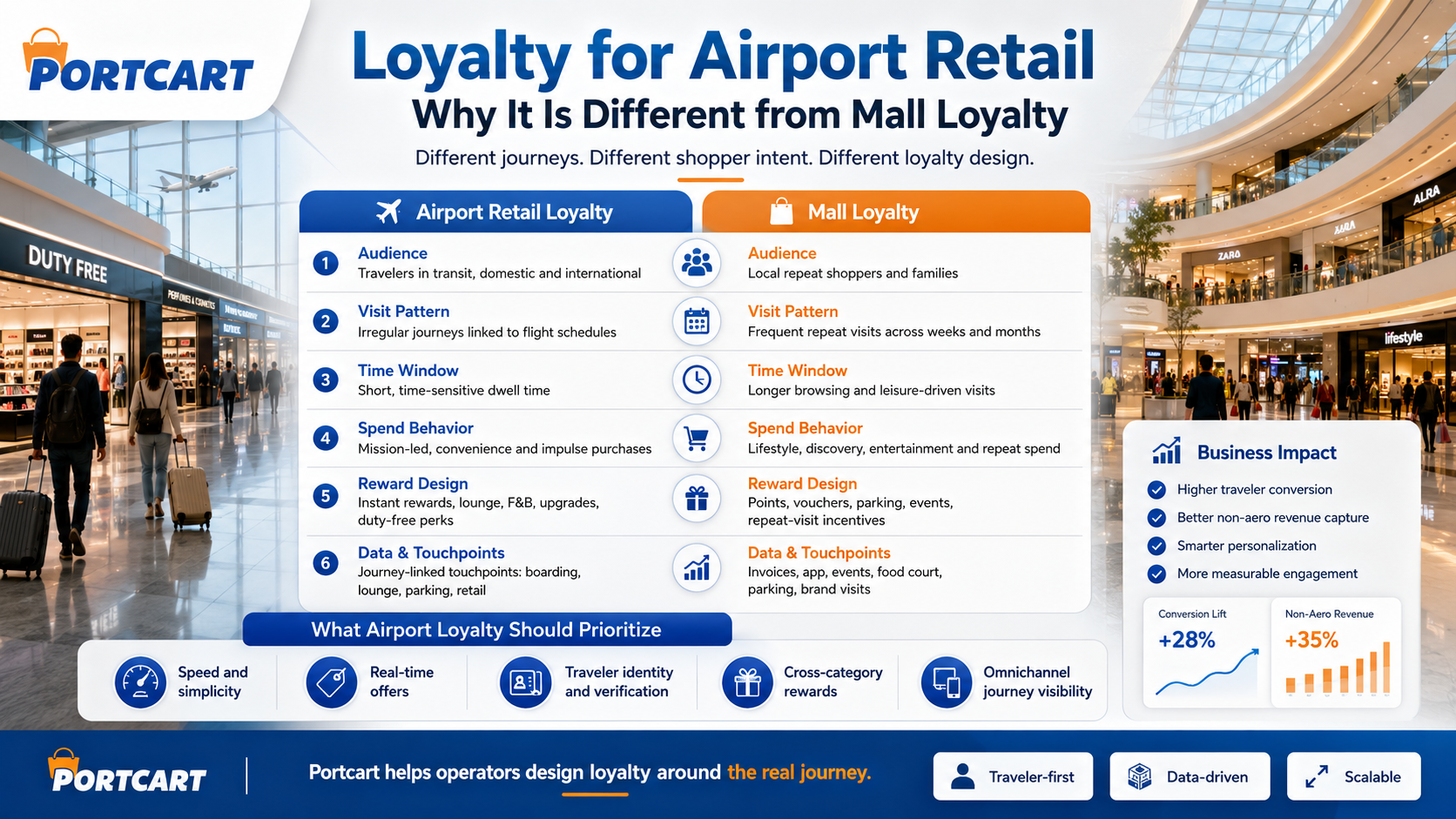
A loyalty programme built for a shopping mall almost never translates cleanly to an airport terminal. The shopper segments overlap. The brands overlap. The retail formats overlap. But the underlying purchase context is profoundly different, and operators who copy-paste a mall loyalty design into an airport concession end up with low enrolment, poor redemption, and confused passengers. Seven structural differences explain it, and once you see them the design changes are obvious.
This piece walks through the seven structural differences between mall and airport retail loyalty in India, what to borrow from one for the other, and what has to be rebuilt from scratch.
The structural differences
1. Identity verification is different
A mall shopper enrolling in loyalty provides a phone number, agrees to consent, and walks out. The mall trusts the phone number with a one-time OTP. That is enough.
An airport passenger can provide the same data, but at the duty-free counter the operator also wants to verify that the passenger is actually departing. A return-traveller who buys a bottle of Scotch on a domestic flight and then tries to claim duty-free pricing on the same purchase later is a fraud vector mall operators do not deal with. Airport loyalty needs ADSR-style verification (Advanced Shopper Data Registry) tied to boarding pass data.
2. Purchase windows are short and one-off
The average mall shopper visits the same mall 18 to 30 times a year. The average airport passenger visits the same terminal 2 to 6 times a year. Mall loyalty mechanics that depend on visit frequency (tier progression, weekly cumulative campaigns) lose their pull at airports.
Airport loyalty mechanics need to maximise value extraction from a single 60-to-90-minute window. Pre-arrival app push notifications, in-terminal beacons, lounge-tied offers, gate-area flash sales, and post-flight "you missed this offer, claim it on your next trip" emails are the dominant patterns.
3. Currency pricing is dual
Mall retail prices in INR with GST baked in. Airport duty-free prices in USD (typically), with conversion to INR shown alongside, and no GST on international-departure-area transactions. A loyalty programme that earns points on INR spend needs explicit rules for converting USD-denominated duty-free purchases into the points ledger. Skip this and finance reconciliation breaks every month.
4. Brand catalogues overlap with mall but not identically
A mall has Zara, Westside, Lifestyle, Pantaloons, Marks and Spencer. An airport often has a tighter version of the same set plus travel-specific brands (Victoria's Secret travel concepts, smaller-format luxury, regional gifting, premium snacks). Loyalty programmes that pull brand metadata from a master need to handle the airport subset cleanly, with proper category tagging for travel-essentials.
5. The premium segment converts at different multiples
Mall loyalty programmes typically see 30 to 60 percent of total value redeemed by the top 15 percent of enrolled shoppers. Airport loyalty programmes see 60 to 80 percent of value from the top 5 percent, because frequent flyers and premium credit card holders dominate duty-free spend. Subscription loyalty tiers work harder at airports than at malls.
6. NRI passenger flow is its own segment
Indian airports handle a meaningful NRI passenger flow, especially through Mumbai, Bengaluru, Delhi, Kochi, Hyderabad, and increasingly Ahmedabad and Lucknow. These shoppers visit India 1 to 4 times a year, often buy substantial value per visit, and respond to different communication patterns than domestic shoppers. Airport loyalty design should treat NRI as a first-class segment, not an afterthought.
7. Consent capture is regulatorily heavier
Airport-side personal data sits inside an already-regulated aviation environment. Adding DPDP-compliance overlays for loyalty data creates a thicker consent flow than mall loyalty. Tooling that defaults to consent-required for every data use case (purchase tracking, personalisation, partner sharing, lounge access verification) will earn the operator a much easier audit cycle.
What transfers cleanly from mall to airport
Three things from the mall loyalty playbook drop into airport contexts with minor adaptation:
- Points-per-rupee mechanic (with USD conversion rule for duty-free). Simple to explain, easy to administer, works at any retail format.
- Voucher-unlock redemption pattern. Points spent on specific vouchers (5,000 points for a ₹500 lounge credit, 10,000 points for a duty-free voucher) is cleaner than direct cash equivalent.
- WhatsApp-first communication. Even more important at airports than malls because passengers consistently keep WhatsApp open and rarely download terminal-specific apps.
What has to be rebuilt
Five things from mall loyalty need redesigning before they work at an airport:
- Tier progression. Visit-frequency thresholds calibrated for mall shoppers (12+ visits a year for Gold) are meaningless to a passenger visiting twice. Use rupee-spend thresholds instead, with explicit tier-up triggers tied to per-trip value.
- Birthday and anniversary campaigns. The shopper is rarely at the airport on their birthday. Either drop these mechanics or shift them to "birthday-month bonus on your next departure."
- Day-of-week targeting. Airport spend doesn't have the same weekday-weekend pattern as malls. Tuesday-Thursday voucher campaigns at airports do not move the needle.
- Tenant brand co-loyalty. Tighter at airports because each duty-free brand is operated by Heinemann / Avolta / similar concessionaire, not the brand itself. Co-loyalty has to integrate with the concessionaire's stack, not the brand's.
- Event-access redemption. Airports rarely host the kind of events malls do. Substitute lounge access, priority security clearance, premium parking, or partner-hotel benefits.
Operational reality
A typical Indian metro airport in 2026 handles 30 to 70 million passengers a year across all terminals. Loyalty enrolment ratios at well-run programmes sit at 1 to 3 percent of passenger throughput. Active engagement (passengers who use loyalty within 90 days of enrolment) sits at 35 to 55 percent of enrolees. These benchmarks are much lower than mall equivalents (10 to 15 percent enrolment as a share of footfall, 55 to 70 percent active) because passengers are less invested in any single airport.
But the per-enrollee value is much higher. A loyalty-active passenger spends 2 to 4 times the average duty-free basket. A loyalty-active mall shopper spends 1.3 to 1.8 times the average mall basket. The economics favour quality over quantity at airports.
Frequently asked questions
Should an airport launch its own loyalty programme or partner with a credit card?
Most Indian airports start with credit card partnerships (HDFC Diners, ICICI Emeralde, Axis Magnus) because acquisition is free and the segment is already loyalty-conditioned. A first-party airport loyalty programme makes sense once the operator has 1 million+ annual frequent-flyer-tier passengers and a path to integrate with airline tier statuses.
Do duty-free brands accept airport loyalty redemption?
They have to be set up to. Most major Indian airports have negotiated duty-free voucher acceptance with their primary operator (Heinemann at Bengaluru and Hyderabad, multiple operators at Mumbai and Delhi). Smaller brand outlets accept loyalty redemption variably.
How does GST work for loyalty redemption at airports?
Domestic airport spend follows normal mall GST rules. International departure area spend is zero-rated (no GST). Loyalty mechanics that redeem in the international zone need to handle this without the customer being charged GST twice or missing it entirely.
How Portcart handles this
The airport-specific differences above each map to capabilities we built into Portcart for travel retail operations.
- [ADSR (Advanced Shopper Data Registry)](/modules): boarding-pass-verified duty-free claim registry with audit trail, so loyalty earns only on verified-departure purchases.
- [Loyalty Layer](/modules): points-per-rupee with explicit USD-to-INR conversion rules for duty-free spend, tier mechanics calibrated for low-frequency high-value purchase windows.
- [Communication Engine](/modules): WhatsApp-first, DPDP-consent-aware messaging tuned for departure-day timing and post-trip nudges.
- [amenity and services mapping](/modules): first-class entries for lounges, forex, parking, transport so loyalty redemption against these services is operationally clean.
If you run an Indian airport retail operation, request a demo and we will run the stack against your terminal's concession portfolio and frequent-flyer mix.