Tier-2 Cities Are India's New Retail Heartland: A Tech Stack Playbook
Knight Frank put Chandigarh at the top of the International Brand Penetration Rankings for 2026. Mangaluru leads on density. Lucknow leads on unique-brand breadth. A practical tech stack playbook for mall operators in India's emerging retail capitals.
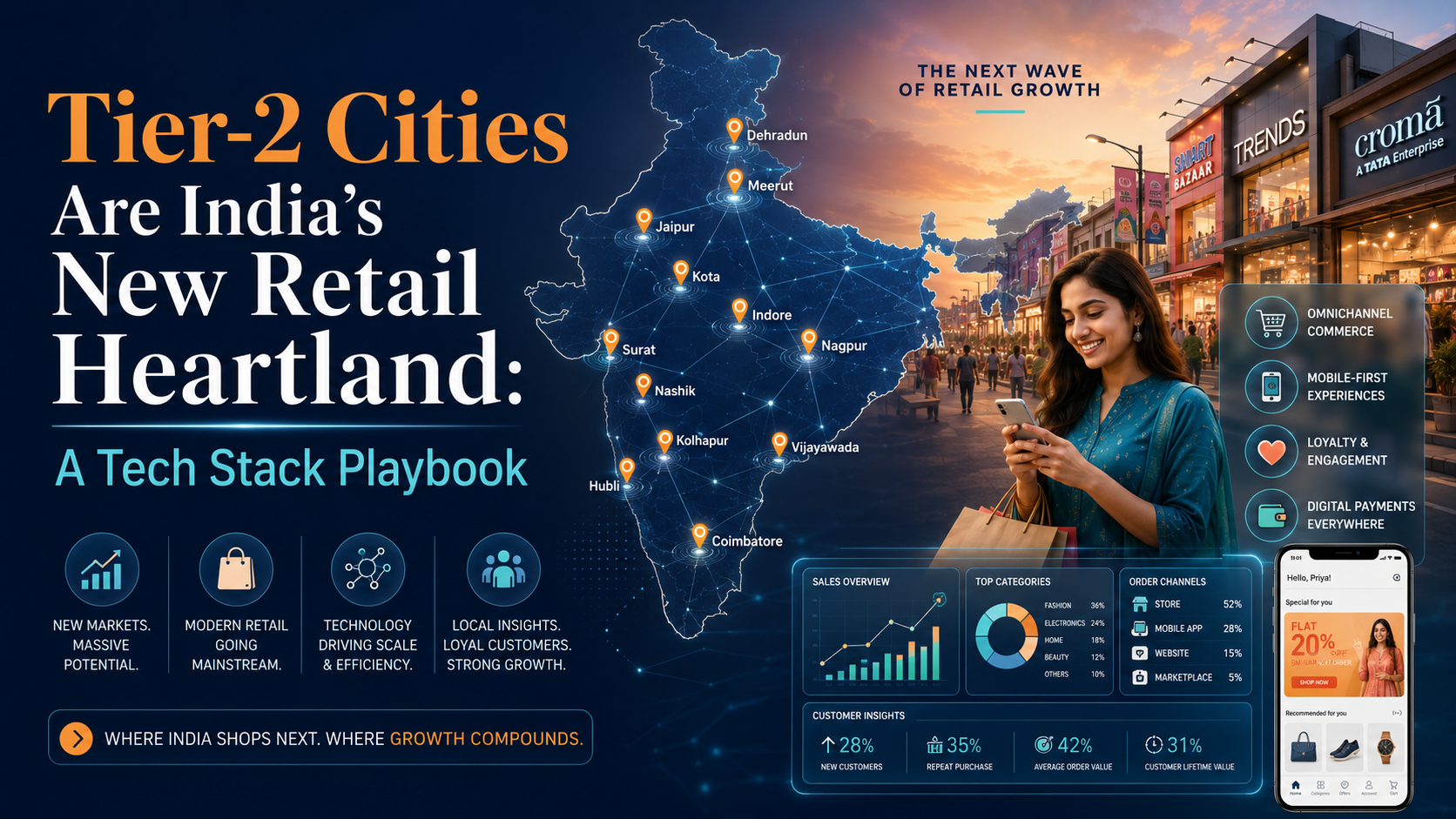
In early 2026, Knight Frank put Chandigarh at the top of India's International Brand Penetration Rankings. Mangaluru clocked 102 international brand stores per million residents. Lucknow housed 112 unique international brands. None of those cities would have made the list five years ago. They're where the next decade of Indian retail growth is happening, and the metro mall tech template does not fit them cleanly.
This is not a story about catchment displacement away from Delhi, Mumbai, and Bengaluru. Those metros continue to grow. The story is about a parallel surge in cities the industry historically called Tier-2 and Tier-3. The implication for mall operators is direct: the playbook that worked in Connaught Place or BKC will not transplant cleanly to Chandigarh, Mangaluru, or Lucknow. Operators who copy-paste their metro tech stack into a Tier-2 expansion will overspend on capabilities that do not matter locally and underspend on the ones that do.
This piece lays out the tech stack a mall in a Tier-2 city actually needs in 2026, what to defer, and how the build order changes from a metro template.
What the Knight Frank rankings actually say
The 2026 Knight Frank rankings are worth reading carefully before drawing conclusions. The headline numbers tell a particular story.
Chandigarh tops the International Brand Penetration index. The city's catchment includes Punjab, Haryana, and a measurable share of Himachal. Its mall format is dominated by Elante Mall and a handful of high-street clusters. The city has consistently over-indexed on brand density relative to its population.
Mangaluru's 102 international brand stores per million residents is a density number, not a count. It says that for the population the city supports, a remarkable share of international brand presence has shown up. Mangaluru's catchment includes coastal Karnataka, parts of Kerala, and a Gulf NRI shopper segment that travels heavily through the city's airport.
Lucknow's 112 unique international brands is breadth, not depth. The city has a long memory of consumption, deep pockets in nawabi and trader segments, and recently picked up real-estate-backed wealth. Brand portfolios that would have stayed in metros five years ago are now opening their first Lucknow store.
ANAROCK's RELEAP 2026 added context. India absorbed 4.3 million square feet of retail space in H2 2025. The 2026 to 2031 pipeline is 45 million square feet. Delhi-NCR and Hyderabad account for roughly seventy percent of the metro share. Tier-2 cities account for a fast-growing remainder. JLL Q1 2026 numbers showed domestic retailers driving seventy-nine percent of leasing, with international retailers up forty-eight percent year on year. The mix is shifting, but the absolute India retail growth is being shared between metros and Tier-2 cities.
The operational implication: the next generation of malls being built and planned across India will not be in Mumbai and Bengaluru alone. They will be in Indore, Jaipur, Coimbatore, Kochi, Vishakhapatnam, Bhubaneswar, Lucknow, Chandigarh, and Mangaluru. The tech stack discussion has to widen.
Why the metro tech stack does not transplant
A typical Tier-1 mall in 2026 runs an integrated retail tech stack that includes a loyalty CRM (often Capillary or a custom build), enterprise voucher platforms (Qwikcilver or Pine Labs), people-counting hardware, parking ANPR with ticket-less flows, branded marketing automation, integrated POS with all 80 to 200 tenant brands, a partner channel CMS, and a digital signage network.
The total stack runs upwards of ₹4 to ₹8 crore in software and integration spend, plus ongoing ₹1 to ₹2 crore in annual subscriptions and operations. For an Inorbit Mall, a Phoenix Marketcity, or a DLF Mall of India, the spend is justified by footfall, tenant rents, and the scale of operations.
For a 4 lakh square feet mall in Bhubaneswar or a 6 lakh square feet mall in Coimbatore, the same stack overspecifies. Tenants do not need (and often cannot operationally support) the same depth of integration. Shoppers do not respond to the same loyalty mechanics. The mall ops team is smaller. Marketing budgets are tighter. Vendor relationships are different. Pasting the metro stack creates a system that is technically powerful and operationally idle.
A Tier-2 mall in 2026 needs the same core capability surface (discovery, activation, measurement) but delivered through a stack that is faster to deploy, cheaper to operate, and shaped to the local catchment's actual behaviour.
The Tier-2 mall tech stack: six modules to start with
Based on conversations with mall operators across Chandigarh, Lucknow, Indore, and Vishakhapatnam during late 2025 and early 2026, the following six modules are the right starting point for a Tier-2 mall going live in 2026 or 2027. Defer the rest until the operating tempo justifies them.
1. Discovery layer with SEO-friendly arena landing pages
Tier-2 shoppers research more before they visit. WhatsApp groups, Instagram reels, and Google searches drive a higher share of pre-visit research than in metros where the mall is a default weekend destination. An SEO-friendly public discovery layer that surfaces brands, restaurants, services, and events for the mall is the highest-leverage first module.
The discovery layer should publish indexable pages for every brand and restaurant the mall hosts. Page templates with structured data, clean URLs, and server-rendered content matter. The objective is to be visible on Google for searches like "best Chinese restaurants in mall in Lucknow" or "Zara store Bhubaneswar".
Portcart's arena landing pages and Brand Directory module are designed for this layer. The brand-claim flow lets brands themselves keep their listing current once they are open, which keeps content fresh without burning marketing team time.
2. Voucher and coupon activation, with maker-checker
Tier-2 shoppers respond strongly to value campaigns. Diwali, Eid, Pongal, Onam, Durga Puja, Navratri, the academic year start, and the marriage season are all catalysts. Coupons that drive footfall during these windows are operationally cheap and emotionally well-received.
The voucher module needs to handle issuance and redemption cleanly from day one. The maker-checker pattern matters even more in Tier-2 contexts because mall finance teams are leaner and audit trails reduce the operational overhead of every voucher meeting.
3. Loyalty layer, lightweight to start
Loyalty in Tier-2 cities should start lightweight. A points-on-invoice mechanic, four tiers with reasonable thresholds, and quarterly campaign rewards is enough for the first 18 months. Subscription loyalty, gamification mechanics, and tier-jump simulations can come later.
The right model for most Tier-2 malls is invoice-based loyalty (shoppers upload bills from any mall tenant for points), supplemented by direct POS integration with the top five to ten tenants by footfall. Direct POS integration with all 80 tenants is not justified in the first phase.
4. Leasing and tenant management
Tier-2 mall leasing teams handle a different rhythm. International brand interest in Chandigarh, Lucknow, and Mangaluru is real but selective. D2C brands are exploring physical presence in these cities for the first time. Demand needs to be captured discreetly without exposing terms.
A leasing request flow where brands signal interest, the mall responds privately, and term sheets are tracked through a simple pipeline is the operational pattern. Heavy CRM functionality is overkill at this stage.
5. Service master and zone mapping
The service master (parking, washrooms, lounges, Wi-Fi, prayer rooms, medical, baby care, ATMs, forex) is operationally critical and often the first thing Tier-2 shoppers ask about on WhatsApp. Publishing this clearly on the mall's discovery layer and inside the shopper-facing app drives perception of professionalism more than any marketing campaign.
Zone and floor mapping pairs with service master to enable indoor navigation. For a 4 to 8 lakh square feet mall, the navigation does not need to be a heavy 3D model. A clean zone map with floor toggles and search-by-brand or search-by-service is enough.
6. WhatsApp-led communication
The single highest-ROI marketing channel in Tier-2 India is WhatsApp Business. SMS still works for older shopper segments. Email is largely ignored. App push is helpful for the small share of shoppers who download the mall app, but app penetration in Tier-2 is lower than metros.
A unified communication engine that drafts one campaign brief and generates WhatsApp, SMS, and email variants is the practical answer. The DPDP compliance work outlined in our compliance checklist becomes load-bearing here. WhatsApp campaigns without explicit consent are an immediate liability under the 2025 Rules.
What to defer (and what to actively avoid) in Tier-2
The temptation in any new mall is to over-build the tech stack at opening. Resist it. The following capabilities, all useful eventually, are not Day 1 priorities for a Tier-2 mall.
Footfall counters at every entry point. Useful for tenant rent negotiations and marketing attribution, but a Wi-Fi-based estimate plus parking transaction counts gives a workable proxy at one-tenth the cost. Add hardware footfall counters in year two when negotiating tenant rent uplifts becomes more frequent.
Heat-mapping and dwell-time analytics. Largely a metro-mall feature. Tier-2 shopper behaviour is more predictable. The marketing team should not spend headcount on dwell-time micro-optimisation when the bigger problem is whether their voucher campaign for next month is even configured correctly.
ADSR-style visit verification. Useful for airports and very high-footfall malls. Not Day 1 for a Tier-2 mall. Defer.
Custom mobile app. Tier-2 shoppers do not download yet-another mall app. A PWA off the discovery layer plus WhatsApp engagement covers the same ground. App development can come in year three when retention data justifies it.
Custom integrations with niche POS systems. Standardise on the two or three POS systems that the top 20 tenants by footfall already use. Push other tenants towards the invoice-upload flow. Custom POS integrations cost more than the loyalty conversion they unlock for two years.
Enterprise BI dashboards. A simple dashboard that shows footfall, voucher issuance, loyalty enrollment, leasing pipeline, and revenue per square foot is enough. Tableau and Power BI custom builds are an expense the mall does not need yet.
City-specific tweaks
Three short tweaks based on the cities the Knight Frank ranking highlighted.
Chandigarh
The catchment is wealthy and culturally distinctive. Punjabi shopper segments respond well to high-value voucher campaigns around weddings, Lohri, Vaisakhi, and harvest seasons. International brand interest is high and the leasing team should be set up to handle inbound brand enquiries seriously from Day 1. The customer service desk should be staffed bilingual. The discovery layer should index in both Punjabi and English where feasible.
Mangaluru
The catchment spans coastal Karnataka, parts of Kerala, and a meaningful Gulf NRI segment. Loyalty programs need to account for shoppers who visit twice a year but spend heavily per visit. The discovery layer should include airport-adjacency content (Mangaluru International Airport is twenty kilometres out) and travel-retail-style positioning for some brand storefronts. Coastal weather drives seasonality differently from northern India.
Lucknow
Old wealth, deep cultural pride, and a fast-growing real-estate-backed second wave of consumers. Hospitality-driven mall positioning works here. F&B will be a higher share of mall revenue than in metro malls. Heritage-brand collaborations and chikankari-led local activations during Eid and the wedding season drive measurable footfall lifts. The marketing team should be set up to run hyperlocal storytelling, not just national campaigns repackaged.
A realistic 12-month deployment plan
For a Tier-2 mall opening in Q1 2027, working backwards.
Month -12 (Q1 2026): commit to the platform. Sign vendor contracts. Begin tenant onboarding for the discovery layer.
Month -9: discovery layer goes live in beta with a confirmed brand lineup. Pre-launch SEO work starts. WhatsApp Business account is provisioned and consent flows are tested.
Month -6: loyalty program design is locked. Voucher campaign templates are pre-built for the first three quarters. CCTV and DPDP signage is finalised.
Month -3: pilot voucher campaign with the operator's existing properties or affiliated brands. Soft launch of WhatsApp engagement. Service master is published.
Month 0 (mall opens): all six core modules are live. Loyalty enrollment runs at the customer service desk and via QR codes at every brand storefront. Voucher campaigns are active. Discovery layer is indexed on Google.
Month +3: footfall counters added at the top three entry points. Tenant POS integrations rolled to the top five brands by footfall.
Month +6: leasing pipeline review. AI-assisted brand profile generation deployed for the Brand Directory. Communication engine extended to add push notifications for the share of shoppers who downloaded the PWA.
Month +12: review the full stack with operating data. Decide which deferred modules (heat-mapping, ADSR-style verification, custom app, BI dashboards) to add based on actual mall tempo, not Day 1 assumptions.
What this means for vendor selection
If you are evaluating mall management platforms for a Tier-2 mall in 2026, the questions to ask are different from the metro RFP.
Ask whether the platform can stand up the discovery layer and brand directory inside 90 days of contract signing. Ask whether the loyalty module supports invoice-based enrollment from Day 1. Ask whether the voucher module enforces maker-checker out of the box. Ask whether the communication engine produces channel-specific copy for WhatsApp, SMS, and email from one brief. Ask whether the leasing pipeline keeps inventory private until the mall chooses to expose it.
If the platform requires custom development for any of these, the vendor is not Tier-2 ready. They are an enterprise vendor expecting a metro implementation team to wrap their product. That implementation team does not exist at most Tier-2 malls and the platform will spend years half-deployed.
Portcart is built to be deployed by a small mall ops team without an integrator. The same platform supports metros and Tier-2 malls. The difference is which modules turn on first and what is deferred.
Frequently asked questions
Is Tier-2 only worth pursuing if the mall is large?
No. A 3 lakh square feet mall in a Tier-2 city with the right tenant mix and the right tech stack can outperform a 6 lakh square feet mall in the same city operating with metro-template overhead. Scale is not destiny.
What is the right loyalty enrollment target for a Tier-2 mall in year one?
For a mall doing 1.5 lakh monthly footfall, 12,000 to 18,000 active loyalty enrollments in year one is a defensible target. Above 20,000 is excellent. Below 8,000 suggests the enrollment flow is friction-heavy.
How important is local-language UI?
Critical for the shopper-facing layer. Less critical for the operator dashboards. Hindi, Punjabi, Marathi, Telugu, Kannada, Malayalam, and Bengali coverage on the discovery layer materially affects engagement. English-only operator dashboards work fine for now.
Should we wait for the metro mall plan to be proven before going Tier-2?
The Knight Frank and ANAROCK 2026 data suggests not. The Tier-2 share of India retail growth is accelerating now. Operators who wait for the metro template to be perfected risk missing the cycle.
The Tier-2 retail story is not a smaller version of the metro story. It is its own story, with its own catchments, its own seasonality, and its own operating tempo. The mall operators who get it right in the next 18 months will set the template that everyone else copies in 2028.
How Portcart handles this
The Tier-2 mall stack we sketched above maps almost one-to-one onto Portcart modules that are already in production.
- [Brand Directory and Arena Landing Pages](/platform/brand-directory): SEO-friendly indexable pages for every brand, restaurant, and service inside your mall. Stand up your first 80 brands in days, not months.
- [Loyalty Layer](/platform/loyalty): invoice-based and POS-linked, with tier mechanics calibrated for Indian shopper segments and a single ledger across both flows.
- [Voucher Management](/platform/vouchers): maker-checker workflows, multi-source settlement, and tenant-side visibility, so your campaigns close clean every quarter.
- [Communication Engine](/platform/communication): WhatsApp, SMS, email, and push from one campaign brief, with DPDP-compliant consent built in.
Want to see the stack live for your catchment? Request a demo and we will walk you through it on a Tier-2 mall already running on Portcart.