A Static Directory Is Not a Shopper-Discovery Strategy
Search your top 20 tenants right now. Count how many results your mall owns. That number is your discovery strategy, and for most Indian malls it is close to zero. Why the tenant list fails at the moment of intent, and what a directory that sells looks like.
Here is a test you can run before you finish your coffee.
Open your phone. Search for your anchor fashion tenant's name along with your city. Then your most-asked-about restaurant. Then "birthday gift shop near me" from the parking lot. Do this for your top 20 tenants.
Now count how many of those results your mall owns.
For most Indian malls the honest answer is close to zero. The results belong to aggregators, map listings the brand manages, food-delivery apps, and review sites. The mall that houses the store, pays to market it, and lives off its rent is nowhere on the page.
That is the moment of intent. Someone within driving distance wanted exactly what your tenant sells, and a third party decided where they went next.
The tenant list was never built for this
Almost every mall website has a directory. Alphabetical tenant names, a category filter, maybe a floor plan. It gets updated when someone remembers.
Notice what that page actually is: a reference for people already inside the building. It answers "where is the store." It answers nothing for the person outside the building deciding where to go, which is where the commercial battle actually happens.
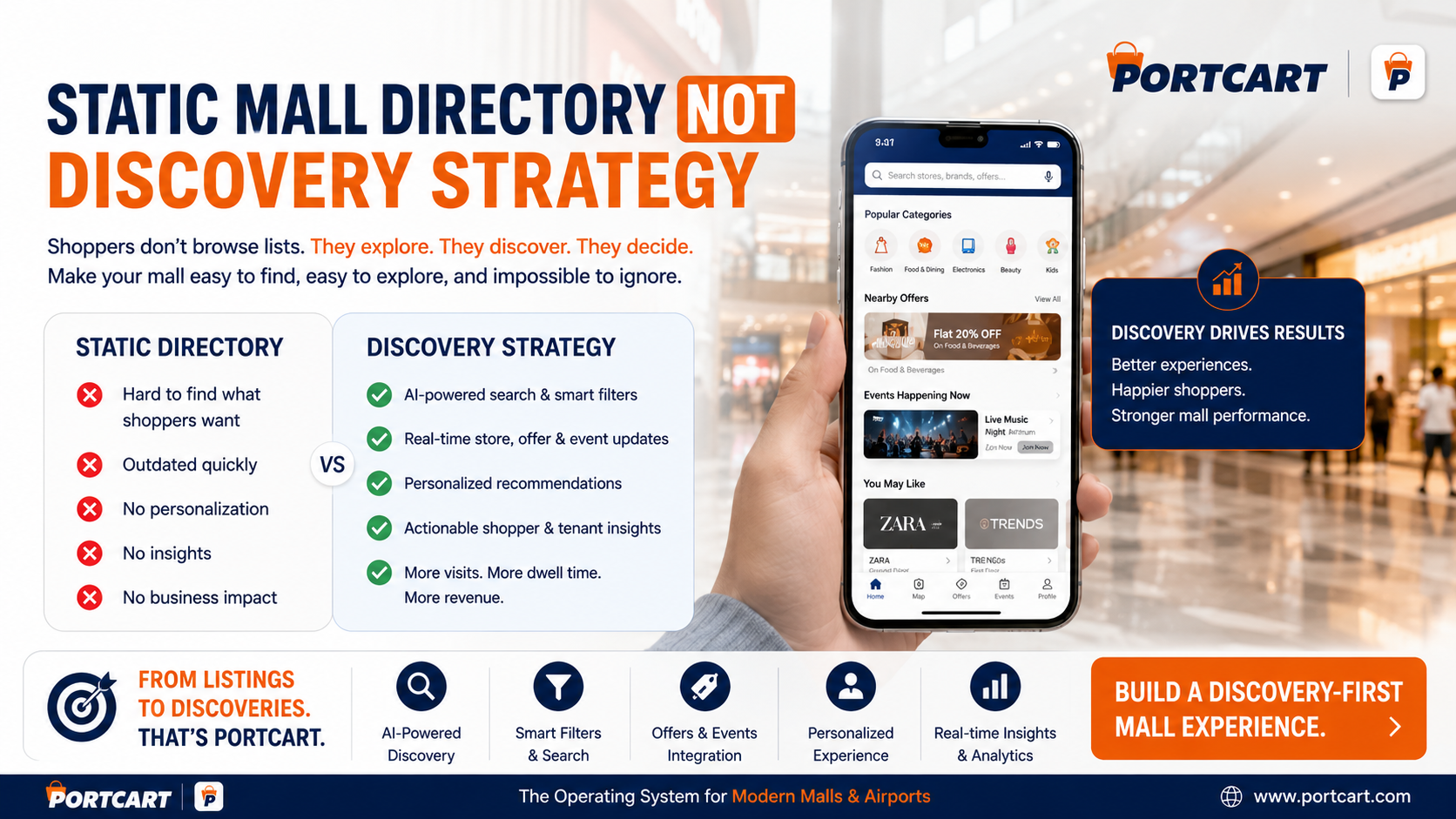
This is the assumption worth challenging: that a published list is a discovery strategy. It is not. A static directory is to shopper discovery what a printed phone book is to sales. Technically complete, commercially silent.
"Shoppers find stores on Google anyway" is the problem, not the excuse
The common defence of the status quo is that discovery happens on search engines and social apps, so the mall site does not matter.
Read that argument again, because it concedes everything. The searches happen either way. Thousands of them, every week, for the exact brands sitting in your building. The only open question is whether the mall owns any of the answers.
Every answer the mall does not own is demand the mall helped create and can never prove. The shopper still may visit your building. But the visit gets attributed to nothing, teaches you nothing, and builds no case for anyone.
What invisibility costs, and who pays it
No traffic percentages here. The cost shows up in three places you can check yourself.
At renewal. Leasing negotiates with tenants using footfall and rent history. The tenant's team looks at their own numbers and asks what the mall actually did for them. A mall that owns the discovery moment can answer with demand it generated, store by store. A mall with a static list has photographs and goodwill.
In the marketing budget. Digital gets judged on "what the website contributes." A reference page contributes nothing measurable, so the honest report is weak, so the budget shrinks, so the page stays weak. The loop closes on its own.
At the aggregators. The intent your mall does not capture is not lost. It is collected, monetised and sometimes sold back to your own tenants as advertising. The mall built the demand; someone else runs the toll booth.
Five symptoms of a directory that lists but does not sell
- Nobody owns the directory as a channel. It has an updater, not an owner.
- Store pages answer names only. Search "running shoes" or "kids birthday gift" plus your city and the mall appears for none of it.
- New tenants go live in the building weeks before they exist on the website.
- The directory has no number attached to it. Nobody can say what demand it produced last month, for any store.
- Leasing has never once used the website in a renewal conversation.
Three or more and the directory is a reference document. The digital team is not failing. The model they inherited was never designed to sell.
What a directory that captures demand looks like
The fix is a different job description for the same page:
- Every tenant findable by name, by category, and by need, from outside the building.
- A store page that actually answers the searcher: what it sells, where it is, what is on, why today.
- New stores visible online the week they open, without a request queue.
- Demand measured per tenant, so the mall can hand any brand a simple statement: this is what we generated for you.
- And leasing walking into renewals with that statement in the pack.
That is the whole shift. From "a list of who is here" to "the place where nearby intent gets answered, and counted."
Where Portcart fits
Portcart is built to give malls and airports one view of the shopper journey: discovery, engagement, and commercial activity. The discovery layer is the front of that: Portcart runs live, structured directory and store pages for Indian malls and airports, built so every tenant can be found at the moment of intent, and so the demand each store receives is visible to the operator. The outcome is the sentence leasing has been missing: we can show you what we send you.
Run the test, then have the meeting
Do the 20-tenant test this week. Bring the count to your next digital and leasing sync, because the number belongs to both of them.
If the count embarrasses you, book a Mall Directory Performance Audit with us. It is a walkthrough on your own tenants and your own search results: where the mall is visible, where aggregators own you, which stores are invisible entirely, and what it would take to own the answers. Ten minutes of searching started it. One working session tells you what it is worth.