Food Court POS Reconciliation: The Hidden Operations Problem at Indian Malls
A 1,200-cover food court with 18 brands runs as 18 independent POS systems. The mall trying to compute true food-court revenue per square foot ends up doing a manual reconciliation every month. Why this is a tractable problem.
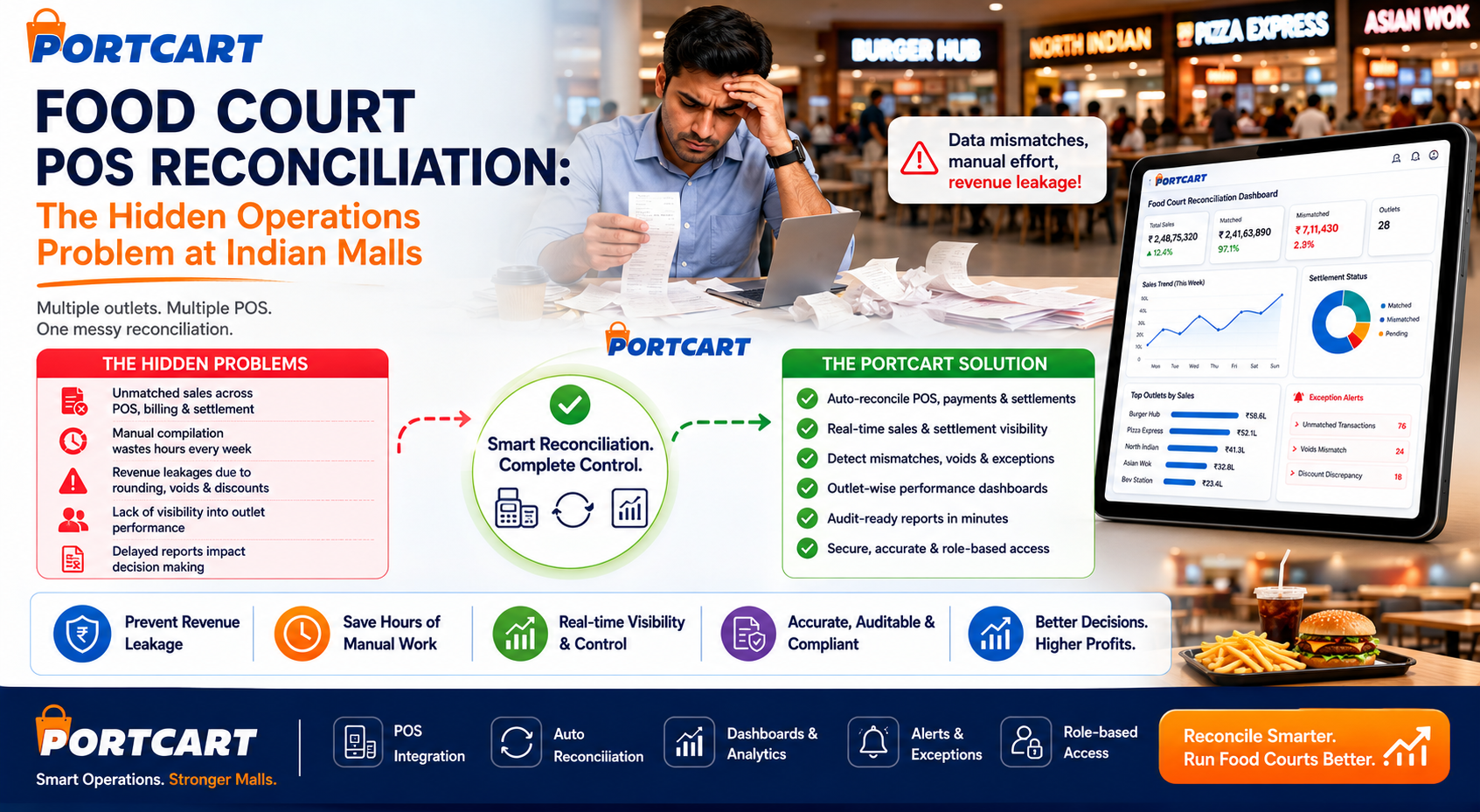
Walk into any large Indian mall food court on a Saturday evening. Count the brands. Eighteen, twenty-four, sometimes thirty-five. Each one runs its own point-of-sale system. Some Petpooja, some Posist, some Restroworks. A handful run on Tally with bespoke billing. One or two are still using printed receipt books. Now ask the mall's finance team to tell you, right now, what the food court did in revenue last Saturday. The answer involves chasing eighteen vendors for reports, reconciling them against the voucher redemption log, and producing a number that everyone agrees might be five to eight percent off the truth. This is one of the most under-discussed operational problems in Indian mall management.
Now ask the mall's finance team to tell you, right now, what the food court did in revenue last Saturday. The answer involves chasing eighteen vendors for individual reports, reconciling them against the mall's voucher redemption log, and producing a number that everyone agrees might be five to eight percent off the truth.
This is one of the most under-discussed operational problems in Indian mall management. It is also one of the most tractable. This piece explains the problem in detail and the unified-ledger pattern that fixes it.
Why food court reconciliation is harder than tenant retail reconciliation
A standalone Zara store inside a mall reports its monthly revenue to the mall once. The number is large, the brand has incentive to report accurately (revenue share affects rent), and the variance is small.
A food court tenant operates inside shared infrastructure. The mall provides the seating, the cleaning, the housekeeping, the common kitchen exhaust, the dishwashing, and often subsidises the rent because food courts drive footfall to anchor retail. In exchange, the food court tenant typically pays:
- A lower base rent than equivalent retail
- A higher revenue share (sometimes 12-18 percent vs 5-10 percent for retail)
- A contribution to common kitchen / housekeeping costs
This structure means accurate revenue reporting matters more for food court tenants than retail. And yet the reporting is almost always less accurate. The reasons compound.
The five reconciliation gaps
1. Multiple POS systems, no shared schema
A mall with 18 food court brands and 8 different POS vendors will receive monthly reports in 8 different formats. Some come as Excel. Some as PDF. Some as printed sheets. The mall finance team manually transcribes into a master spreadsheet, introducing typos. Even matching brand names across files requires fuzzy logic ("Subway" vs "SUBWAY" vs "Subway Sandwiches" vs "Subway India").
2. Voucher redemption ambiguity
Mall vouchers (festival promotions, employee Diwali gifting, loyalty redemption) are often valid across all food court brands. A shopper redeems a ₹500 voucher at Pizza Hut. Pizza Hut's POS records a ₹500 transaction with payment method = "Mall Voucher." At month end, Pizza Hut reports ₹500 in revenue. The mall expects to settle ₹500 against the voucher pool. But did the shopper top up cash? Was the voucher partially redeemed? Did Pizza Hut take VAT off the voucher value before crediting it? Three different conventions across 18 brands.
3. Online aggregator order splits
Zomato, Swiggy, and DotPe orders placed for pickup inside the mall food court create a separate revenue stream. The aggregator takes a cut, the brand reports a net number, and the mall has no way to verify the gross. If a brand reports ₹50,000 in aggregator revenue, the mall sees no third-party validation.
4. Cash transactions and shrinkage
Indian food courts still run 15-30 percent cash transactions. Cash reporting depends on tenant honesty plus operational rigour. POS-recorded cash and actual deposited cash diverge regularly. Shrinkage in cash flows is the single biggest source of revenue under-reporting.
5. Refund handling
Bad meal, slow service, wrong order: refunds get processed in different ways across POS systems. Some void the original transaction. Some create a separate negative entry. Some happen off-system as cash returns. None of these consistently flow into the mall's monthly reconciliation.
The unified-ledger pattern
The fix is the same architectural pattern that works for voucher and loyalty reconciliation: every food-court transaction lands in a single shared events table the mall owns, regardless of which POS system originated it.
Four implementation paths in order of effort:
Path A, POS API integration. For tenants on modern POS systems (Petpooja, Posist, Restroworks), the POS exposes an API. The mall builds a connector that polls or webhooks every transaction in real time. Cleanest. Most accurate. Requires the tenant to grant API access (some resist).
Path B, Daily POS export upload. Each brand uploads a structured CSV at end of day. The mall ingests via a portal that auto-flags missing days, duplicate uploads, and revenue anomalies vs the rolling average. Catches 90% of revenue accurately without API integration.
Path C, QR-scan receipts. A QR code at each food court counter. Shoppers scan the receipt, the mall's app captures the bill image and parses via OCR. Crowd-sourced reconciliation. Works for the 50-70% of shoppers who participate (loyalty members usually). Captures cash transactions that POS often misses.
Path D, Voucher-only reconciliation. At minimum, the mall should have its own ledger of every mall-issued voucher used at the food court, independent of the brand's reporting. This is the maker-checker pattern from voucher management applied to food court redemption.
Most well-run malls run Paths B + C + D together. Path A for the top 4-6 brands by revenue, Paths B-D for the rest.
What good looks like
A mall food court running this pattern hits these benchmarks:
- Monthly reconciliation closes within 5 working days (vs the typical 20-30)
- Revenue accuracy within 1-2% (vs typical 5-8% drift)
- Voucher leakage under 0.5% (vs typical 3-5%)
- Tenant rent disputes drop by 60-80% because both sides see the same numbers
- F&B revenue per sq ft visibility on a per-week (not per-month) basis
The 5-8 percent revenue drift the typical food court accepts represents real money. For a mall doing ₹40 crore annual food court revenue, that's ₹2-3 crore of unreconciled value flowing somewhere, usually a mix of tenant under-reporting, voucher double-counting, and shrinkage. Closing the gap goes straight to bottom line.
Frequently asked questions
Do food court tenants accept the unified-ledger approach?
Reluctance from a few, but most accept once the operational benefits land. Faster month-end close, cleaner GST filing, fewer mall-tenant arguments. Resisters tend to be the ones with the worst shrinkage problems.
Does this work for cloud kitchen brands in the food court?
Yes. Cloud kitchen POS systems are typically more API-friendly than legacy QSR systems. Integration is often faster.
What about the legal status of the mall holding POS data?
The mall holds revenue and transaction metadata, not customer PII (no names, no phone numbers, no addresses unless explicitly consented). DPDP doesn't apply to this aggregated commercial data. The data agreement with each tenant should explicitly cover it.
How Portcart handles this
The unified-ledger pattern for food court POS reconciliation is the same architecture behind Portcart's loyalty and voucher modules, adapted for the food court use case.
- [Loyalty Ledger](/modules): single-source-of-truth event table for every transaction, with source-type discriminator (possale / voucherredemption / manual). Same pattern extends to food court POS feeds.
- [Voucher Management](/modules): maker-checker audit per voucher, multi-source settlement, per-tenant variance reporting.
- [POS Integration](/modules): connectors for Petpooja, Posist, Restroworks, and a generic CSV upload portal for everything else.
If your food court reconciliation cycle still takes 20+ days and ends with a 5-8% variance everyone shrugs about, request a demo and we will walk you through how Portcart customers close to under 1.5%.